10 Ways to Validate a SaaS Idea Before You Write Code in 2026
Ten lightweight tests to validate a SaaS idea in 2026, what to run, what to skip, and how to know whether the market is actually there before you write a line of code.
 Alessio Persico Founder of EchoSift



When did a validation step last actually stop you from building? For most developer-founders the answer, stated plainly, is never. They send a survey, put up a landing page, ask twenty friends what they think, and then build anyway. None of that is wrong, but it is too generic to be useful for someone who can ship a working prototype in a weekend and would rather know, by Friday, whether shipping is the right call at all.
The better validation moves sit inside specific tests with binary outputs. Solo founders and small dev-tool teams are unusually good at running them, because they can read GitHub issues, run a quick smoke test on Vercel, and DM five strangers without scheduling a single meeting. The constraint is rarely the tooling, it is the willingness to design tests that can actually return a NO.
According to the 2025 Stack Overflow Developer Survey, 47% of professional developers say they are working on a side project, and roughly a third of them describe that side project as a potential business. The number of half-built SaaS apps in the wild is enormous. The number that have been put through a test capable of stopping them is much smaller.
The mistake I see most often
Validation gets run as a positive proof exercise instead of a falsification exercise: founders run it to feel better about an idea they are already committed to, not to check whether the market is there.
Strong validation usually forms in the opposite direction. The 10 tests below are the ones I would take seriously if I were trying to decide, in six weeks or less, whether to spend the next year building.
Table of Contents
- Listen passively for two weeks before you talk
- Find five owners with the same complaint across different stacks
- Build one landing page and buy fifty clicks
- Run five customer interviews with a jobs-to-be-done script
- Pre-sell to three buyers before you ship anything
- Concierge the workflow manually for one weekend
- Audit existing willingness to pay in adjacent categories
- Map the build-buy-cope split before deciding to build
- Use community pain signals as a tripwire not the answer
- Time-box validation to six weeks and write the kill criteria first
- Comparison at a glance
- From Idea to Execution Your Next Move
1. Listen passively for two weeks before you talk
Most founders open with broadcast. They post the idea on X, drop it in a Discord, ask for feedback. By the time anyone replies, the answers are filtered through whatever framing the founder gave. Validation gets contaminated before it starts. Teams that get this right include the early Linear team reading r/programming and r/webdev for months, Plausible Analytics reading Hacker News threads about Google Analytics replacements, and the Resend founders watching how developers complained about Mailgun, Postmark, and SendGrid in GitHub issues.
Read the same five places every morning for two weeks
Pick five sources where your target users actually complain. For developer tools this usually means GitHub issues on adjacent libraries, the relevant subreddit (r/devops, r/javascript, r/selfhosted), the right Slack or Discord, Hacker News threads about the category, and Stack Overflow questions filtered by tag. GitHub issues are the highest-signal of these, and there is a whole method for mining SaaS ideas from GitHub issues if you want a structured way to read them. Read for fifteen minutes a day with a notes file open. Tag every complaint with: who said it, what they were trying to do, what they tried first, what made them give up.
After two weeks you will know whether the pain shows up at all, and what language people actually use to describe it. That language goes straight into your landing page in test 3 below.
Where founders get this wrong
| The mistake | What it produces | The correction |
|---|---|---|
| Broadcasting before listening | ✗ Sycophantic Yes votes to "would you pay for X?" | Lurk first, talk later |
| Listening only inside one stack | ✗ A complaint that lives in r/javascript and never in r/golang | Read at least three language communities before you generalise |
| Counting upvotes as validation | ✗ An upvoted complaint with no follow-on activity | Look for workarounds, hacks and tools they already tried |
Practical rule: if you cannot quote a real user’s exact phrasing of the pain after two weeks of listening, you have not listened enough.
2. Find five owners with the same complaint across different stacks
Reading a single thread of complaints will not tell you whether you are looking at a market or one frustrated person amplified by Twitter. The cross-vendor filter is the one filter that separates noise from signal. Companies that scaled on cross-vendor pain include Stripe (payments hell on PayPal, Authorize.net, Braintree), Vercel (deploy pain across Heroku, AWS Amplify, Netlify), and Pinecone (vector storage pain across Faiss, Qdrant homerolls, and Postgres pgvector).
A useful way to spot rising pain across stacks is to monitor clustered complaints across technical communities with a tool like EchoSift for developer pain signals. The platform was built specifically around this filter, because individual complaints in a single Stack Overflow thread or a single subreddit are too easy to read into.
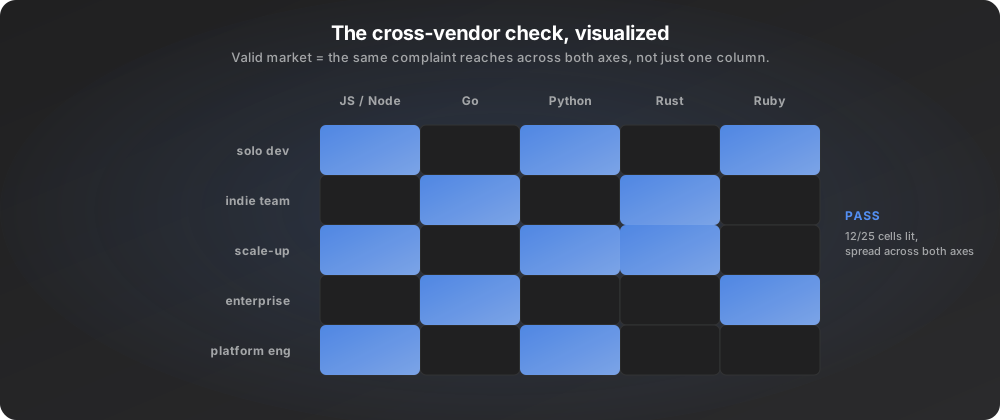
Our own clustering pipeline makes the difference concrete. Three clusters from the snapshot taken 30 July 2026:
| Cluster on the 30 July 2026 snapshot | Mentions | Distinct owners |
|---|---|---|
| Subagent execution failures and bottlenecks | 68 | ✓ 23 |
| Inconsistent Theme Implementation Issues | 58 | ✓ 37 |
| Challenges with Committing Code | 11 | ✗ 1 |
The first two clear the cross-vendor bar without any interpretation needed. Sort all three by volume and you would rank them in one order; sort them by distinct owners and the third drops out of the list entirely. A cluster with real volume and one owner behind it is a support ticket wearing a market’s clothes. Read the owner column first, then the volume column, and only then decide whether a wedge generalizes.
Run the cross-vendor check on every idea
Before you spend a weekend on anything, write down the pain you are betting on. Now answer this: can you cite five distinct owners (people, teams, or orgs) who have hit this same wall in five different technology stacks in the last thirty days? Not five upvotes on the same thread. Not five people in the same Discord. Five different stacks, five different owners, recent.
According to Pmarca’s classic essay on Product Market Fit, the only thing that matters is being in a good market with a product that satisfies it. Cross-vendor pain is the cheapest way to know you are in a market without paying the discovery tax of building first.
What good cross-vendor evidence looks like
- Different stacks: the pain shows up in at least three different language/framework communities, not one.
- Recent: at least three complaints are inside the last sixty days, not screenshots from 2020.
- Different owner types: a mix of solo developers, small teams, and platform engineers, not just one persona.
- Workarounds in the wild: the complaints reference homegrown scripts, internal docs, or paid tools they cobbled together to cope.
- The language is specific: “this specific thing broke when I did X” beats “the developer experience is bad” by an order of magnitude.
The practical rule
If the same complaint never appears outside of one stack, the wedge is too narrow for a horizontal product. Either niche down further or move on.
3. Build one landing page and buy fifty clicks
A landing page test is the cheapest binary signal you can run. The mistake is to make the page elaborate, treat it as a brand exercise, or skip the paid traffic. The page exists to measure whether strangers who do not know you will click a CTA and leave their email after reading it. Looking polished is beside the point. Founders who have used this well include the Buffer two-page landing test in 2010 (documented in the Buffer blog), the Calendly pre-launch list in 2013, and the entire indie-hacker community on platforms like Carrd today.
Send exactly one page, exactly one CTA
Write a landing page that does four things in this order: name the pain in the headline using language you pulled from test 1, show one or two screenshots or diagrams of the proposed solution, name a price, ask for an email. No newsletter, no roadmap, no “join the community”. Just email and price. Buy fifty clicks of paid traffic to it, targeted at the keyword your users would actually search. The click-to-email rate is one demand reading among several, and the cheapest one to buy; our guide to measuring demand for a SaaS idea covers the search-volume, waitlist, and repeat-visit readings that sit alongside it.
Reading the numbers without flinching
| What the fifty clicks returned | How to read it | What to do next |
|---|---|---|
| Above 5% email-to-click | ✓ Real interest | Run tests 4 and 5 |
| Between 1% and 5% | ~ Weak, and it could be the copy rather than the idea | Rewrite the headline using verbatim quotes from test 1, retest |
| Below 1% | ✗ The wedge is wrong, the audience is wrong, or both | Stop and go back to test 1 |
| High click-through, no emails | ✗ The headline grabbed but the value-prop did not | Rewrite the first paragraph |
| High emails, no replies on follow-up | ✗ People gave a fake email | Disregard the count entirely |
Practical rule: fifty clicks is the cheapest unit of truth you can buy. Sixty dollars on Reddit Ads or Google Ads, results in 48 hours. Run it before you write a line of code.
4. Run five customer interviews with a jobs-to-be-done script
Five interviews is the threshold past which the answers start to repeat. Below five you are guessing, above ten you are stalling. The job here is to understand what the user was trying to do when the pain showed up, not to rubber-stamp the idea you already have. This is where Tony Ulwick’s outcome-driven innovation method gives you a script that works in any category. For the mechanics of a single call, how to open it, which questions poison the answers, and how to close without pitching, see our walkthrough on running a problem interview.
Use a script that ignores your idea
Do not describe what you want to build. Ask three questions: when did you last hit this kind of pain, what did you do, and what would have made it ten times better. Most founders cannot resist pitching the product mid-interview, and the moment they do, the interview becomes a sales call. Record the calls (with permission), transcribe the answers, and look for the verbs and nouns that repeat.
Signals that emerge from real interviews
- They name a workaround you have not heard of: this is the gold. Workarounds are the proof of unmet pain.
- They cite a specific tool they almost bought: this tells you the willingness-to-pay range and the substitutes in their mind.
- They struggle to estimate how often the pain happens: low-frequency pain rarely converts. High-frequency pain (“multiple times a week”) is the leading indicator.
- They mention the pain unprompted before you describe it: this is the strongest signal of all.
- They say it would be “nice to have” but cannot tell you what they would stop doing to use it: nice-to-have means no.
The practical rule
Five real interviews beat fifty surveys. If you cannot get five people on a 20-minute call, your audience is wrong or your network is wrong, and that is the first thing to fix.
5. Pre-sell to three buyers before you ship anything
Pre-selling is the only test that converts intent into a wire transfer. It collapses six months of validation into one decision point. Companies that did this well include Tarsnap (Colin Percival sold storage credits before the service was ready), Storenvy (founder collected payment for accounts before launch), and dozens of indie SaaS founders who have done founding-customer pricing rounds in the last two years.
Offer a six-month founding deal with cash up front
Pick three target users from your interview list in test 4. Send each of them a personalized offer: a six-month subscription at a 50% discount, paid up front today, in exchange for being the first three customers and getting your phone number for support. Set a date. Either three of them say yes inside two weeks, or you have a problem.
According to the 2024 CB Insights teardown of why startups fail, “no market need” is the top reason cited by founders themselves, ahead of cash and team issues. Pre-selling is the single cheapest way to discover this before you ship.
What good pre-sell evidence looks like
| What the buyer does | How to read it |
|---|---|
| They pay before the product is built | ✓ The only definition of validation that matters |
| They send you the names of two other potential buyers | ✓ Organic referral, the strongest go-to-market signal |
| They negotiate on terms but not on the existence of the problem | ✓ The pain is real; the price might be wrong |
| They tell you the deadline they need it by | ✓ Urgency in their words, not yours |
| They ghost after expressing interest | ✗ The pain was not urgent. A soft no, so move on |
Practical rule: if three people will not give you 300 dollars to solve this before it exists, three thousand people will not give you thirty dollars after it exists. Pre-sell or kill.
6. Concierge the workflow manually for one weekend
A concierge test is when you do the work by hand, end to end, for one real user. No code, no app, no automation. You sit at a terminal or in a spreadsheet, do the thing manually, charge for it if you can, and learn what the actual workflow involves. Companies built this way include Manychat (founders manually responded to messages before the bot), DoorDash (founders delivered the food themselves), and countless indie founders who ran “manual” versions of their service via Notion and email.
Do the job for one user, end to end
Pick one of your interview candidates and offer to do the thing manually for them this weekend. No commitment, no contract, just an experiment. Your goal is to learn three things: how long the workflow actually takes when you do it, what edge cases show up, and whether the user perceives the result as worth their time.
Where founders get this wrong
- Skipping the test because it does not feel scalable: the point is not scale, the point is learning the workflow before you encode it in software.
- Charging too little or nothing: free work attracts free attention. Charge a nominal fee even if it is awkward.
- Optimizing for delight at the expense of speed: the goal is to learn the median case, not to wow one delighted user.
- Pretending to be the software: tell the user it is a manual experiment. Saying so plainly pays back in better feedback.
- Doing it once and not measuring the gap: write down how long every step took, what was easy, what was painful.
The practical rule
If you cannot deliver the value of the product manually in one weekend, the product is too complex for your first version. Cut scope until you can.
Use what the manual run taught you to decide what the minimum viable product for a developer tool actually has to contain.
7. Audit existing willingness to pay in adjacent categories
The cleanest signal that a market exists is that people are already paying for adjacent solutions. The mistake is to confuse “competitors exist” with “the market is taken”. Most categories have room for a better-positioned product if you can name the gap precisely. Adjacent categories to study include the early Linear positioning against Jira, Notion positioning against Confluence, and Resend positioning against Mailgun.
Find three paid substitutes and read their churn reasons
For your idea, name the three closest paid substitutes. They do not need to be direct competitors, just things your target user might use to solve the same job differently. For each one, search G2, Capterra, and Trustpilot for one-star and two-star reviews. The patterns of complaint are your gap. If you want a repeatable process for this, our guide to market research for developer tools covers where to read substitute pain without paying for a research seat.
According to the 2024 Bain Technology Report, SaaS net retention has dropped roughly five percentage points across the industry since 2022, which means dissatisfaction with existing tools is at a multi-year high. Buyers are open to switching for a sharper wedge.
A useful companion for understanding adjacent-category dissatisfaction is the EchoSift opportunities page, which surfaces dev-tool complaints clustered by category so you can read substitute pain without manually scanning twenty review sites.
What good adjacent-category evidence looks like
| What you find in the adjacent category | How to read it |
|---|---|
| One-star reviews repeat the same three complaints | ✓ Those three are your wedge |
| The vendor is large enough to be slow to fix them | ✓ Big slow vendors will not outpace you; small fast ones will |
| Pricing is high relative to value | ✓ Users who feel they are overpaying are price-sensitive to switching |
| The product has not changed materially in 18+ months | ✓ A complacent incumbent is addressable |
| A "best alternative to X" search returns six articles | ✓ Search demand for substitutes already exists |
Practical rule: if no one is paying for any adjacent solution to the pain you found, you have found a flat field, not a green one. No paying substitutes usually means no demand, not open space.
8. Map the build-buy-cope split before deciding to build
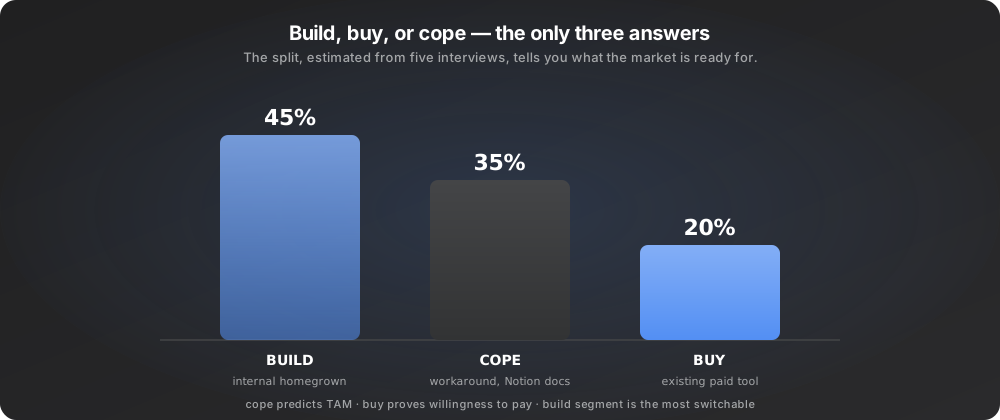
For any real pain, the population splits three ways: people who built something internal, people who bought a tool, and people who cope (Notion pages, shell scripts, internal Slack channels). The split tells you what the market is ready for. If 90% cope, you have an awareness problem before you have a market. If 90% build internal, you have a “they have it but it sucks” market that may be addressable. If 90% buy, you are looking at displacement, which is the hardest sale.
Estimate the split for your specific pain
Go back to your interview notes from test 4. For each interviewee, tag what they did about the pain: built internal, bought a tool, or coped. Five interviews is enough to get rough percentages. If the split is roughly even, the market is mature enough to spend money. If cope dominates, your first job is to articulate the problem better before you build.
Where founders get this wrong
- Assuming the cope segment will buy if you build: many will not. Cope is often a cheaper substitute, not an unmet need.
- Underestimating internal-build inertia: a CTO who wrote an internal version of your product will defend it.
- Treating “buy” as the only validation: the build segment is often more open to switching than the buy segment.
- Not asking how much time the cope costs: if the workaround takes ten minutes a week, no one will pay you for it. If it takes ten hours, they will.
- Skipping this test because the answer seems obvious: the split is rarely what founders predict.
The practical rule
The cope segment is the leading indicator of total addressable market. The buy segment is the proof of willingness to pay. You need both, in measurable proportions.
Turning that split into a number you can defend is the job of a TAM, SAM, and SOM calculation, sized bottom-up from the people you actually interviewed rather than top-down from an analyst chart.
9. Use community pain signals as a tripwire not the answer
Listening tools are tripwires. They tell you when something has moved, not what to build. Tools that promise to surface “trending pain” are useful as input to the validation funnel, never as the validation itself. A trending complaint can mean a real market is forming. It can also mean one influencer made a viral post and twelve hundred imitators jumped on the same line. Scale makes this worse, not better.
Raw volume like that is a firehose, and most of it will not survive the cross-vendor and willingness-to-pay tests. If you want a sense of what durable, recurring complaints look like once the noise is filtered out, our breakdown of developer pain points in 2026 walks through the ones that actually persisted.
Use the tripwire to trigger tests 1 through 8
Treat any pain signal you find from a community-listening tool as a candidate for the funnel above, not as proof. If a complaint shows up across three Subreddits and a GitHub issue, that is a candidate. Run the cross-vendor test on it (test 2). Run the landing-page test on it (test 3). Run five interviews on it (test 4). If it survives, run the pre-sell test (test 5). If it does not, kill it without remorse.
What good tripwire usage looks like
| How to use a tripwire | Why |
|---|---|
| Write the headline from the signal | ✓ The landing-page language comes verbatim from the complaints surfaced |
| Recruit the interviewees from the signal | ✓ You contact the people who actually posted, not random "members of your target audience" |
| Log the signals over time, never one-shot | ✓ A complaint recurring across three months beats one that trends for a week |
| Discount pain that shows up in one community only | ~ See test 2: one stack is not a market |
| Never quote signal volume as validation | ✗ 500 mentions of "X sucks" means nothing without the cross-vendor and willingness-to-pay tests |
Recruiting from the signal is the step that makes continuous customer discovery sustainable instead of a one-off scramble for five names.
Practical rule: any tool that tells you “this pain is trending, build it” is overselling. The pain is the candidate, not the conclusion.
10. Time-box validation to six weeks and write the kill criteria first
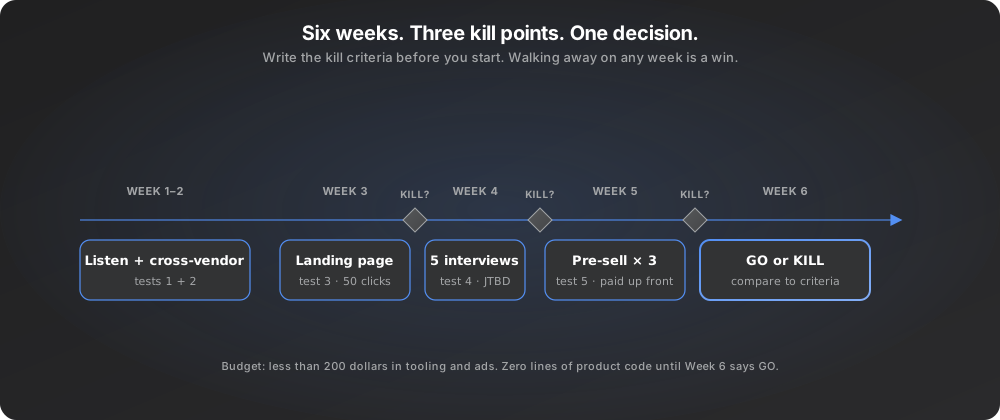
The single biggest mistake in SaaS validation is not running the wrong tests, it is letting the validation phase drift indefinitely because no NO ever arrives. Six weeks is enough to run all nine tests above. Past six weeks, you are either building or moving to a different idea. The kill criteria should be written down before the validation starts, not negotiated after.
Write a one-page validation plan with kill criteria
On day one, write down what would make you walk away. Specific numbers. Below 3% conversion on the landing page. Fewer than two people willing to pre-pay. Cross-vendor evidence in fewer than two stacks. Then run the tests for six weeks. At the end, compare what you saw to what you wrote. If any kill criterion fires, kill the idea that day. Do not renegotiate the criteria after the fact.
Where founders get this wrong
- Writing the criteria in vague terms: “good response” is not measurable. “Five pre-paid customers” is.
- Negotiating the criteria after the fact: “well, the click-through was low but the comments were positive” is how dead ideas survive past six weeks.
- Not setting a budget cap: time bounds and money bounds both matter. 60 dollars on ads, 0 dollars on code.
- Skipping the post-mortem on kill: a killed idea still teaches you. Write what you learned, then move on.
- Building the product in stealth during validation: this defeats the entire point. If you are coding before validation closes, you are not validating, you are stalling.
The practical rule
The cost of carrying a half-validated idea for six months is the opportunity cost of the next idea you did not test. Time-box and walk.
Comparison at a glance
What each test costs you, and what it hands back:
| Test | Effort | Resources | Outcome |
|---|---|---|---|
| 1. Listen passively | 2 weeks × 15 min/day | Browser + notes file | Real user language, pain vocabulary |
| 2. Cross-vendor check | 1 day | Search engines, community feeds | Pain generalizability score |
| 3. Landing page test | 2 days + $60 ads | Carrd / Framer + Reddit Ads | Click-to-email conversion |
| 4. Customer interviews | 1 week | 20-min calls × 5 | Workflow understanding, JTBD signal |
| 5. Pre-sell | 2 weeks | Stripe Checkout, personalized DMs | Cash commitment |
| 6. Concierge weekend | 1 weekend | You, a spreadsheet, one user | Workflow time-and-edge-case learning |
| 7. Adjacent willingness-to-pay | 2 days | G2, Capterra, Trustpilot | Competitive gap |
| 8. Build-buy-cope split | Re-read of interview notes | Same five interviews | Market-readiness signal |
| 9. Community signal tripwire | Ongoing | Pain-monitoring tool | Trigger for tests 1-8 |
| 10. Six-week time-box | Up front | One-page plan | Kill criteria, walk-away discipline |
And when to reach for each one, with the thing that most often decides whether it works:
| Test | Best for | Quick tip |
|---|---|---|
| 1. Listen passively | All ideas | Tag every quote with workflow context |
| 2. Cross-vendor check | Horizontal products | Five owners, five stacks, sixty days |
| 3. Landing page test | Top-of-funnel validation | Reuse verbatim quotes from test 1 |
| 4. Customer interviews | Mid-funnel | Never pitch mid-interview |
| 5. Pre-sell | Bottom-of-funnel | Six-month founding deal, 50% off, paid today |
| 6. Concierge weekend | Workflow-heavy ideas | Charge even a nominal fee |
| 7. Adjacent willingness-to-pay | Categories with incumbents | Read one-star reviews, not five-star |
| 8. Build-buy-cope split | After test 4 | The cope segment predicts TAM |
| 9. Community signal tripwire | Continuous discovery | Treat signal as candidate, not answer |
| 10. Six-week time-box | Every validation | Write the NO numbers before you start |
From Idea to Execution Your Next Move
Strong validation is the discipline of designing tests that can return a NO, then running them quickly enough that the NO arrives before you have spent six months building. The 10 tests above are the ones I would actually run, in roughly this order, if I were starting from a fresh idea today. They take roughly six weeks if you commit, and they cost less than 200 dollars in tooling and ads. The cost of skipping them is the cost of the next year of your life. Clearing all ten does not mean you have a business yet, only that the idea earned the right to be built; the evidence you watch for after that is a different set, and we mapped it in the signals of product-market fit.
If you are about to start, run this five-question filter before anything else:
Have I quoted a real user's exact words for this pain?
If you cannot, you have not listened yet (test 1).
Can I cite five owners across five stacks who hit this in the last 60 days?
If not, the wedge is too narrow (test 2).
Will three people in my interview list pay me 300 dollars today for the unbuilt version?
If not, the pain is not urgent (test 5).
Can I deliver this manually for one user in one weekend?
If not, your scope is wrong for V1 (test 6).
Have I written, in numbers, what would make me walk away?
If not, you are not validating, you are wishing (test 10).
Don’t build the generic “AI SaaS for everyone”. Build the AI tool for one specific job in one specific stack, like Cursor for Python or Continue.dev for VS Code users in regulated industries.
Don’t build the next horizontal monitoring tool. Build the monitoring sidecar for one specific cause of incidents, like cold-start latency in Cloudflare Workers or memory leaks in Bun runtime.
Don’t build a “Reddit for founders”. Build the daily digest that pulls cross-vendor complaints in one developer macro-area, with the explicit promise of NO content from one-source posts and no creator metrics.
If you are a developer-founder running validation in 2026, EchoSift is built for exactly that job. It surfaces clustered developer pain across GitHub, Stack Overflow, Hacker News and Bluesky, with the cross-vendor and diversity filters that separate real markets from one-person amplification. The 10 tests above still need a human, but the tripwire and the listening can run while you sleep. See the EchoSift pricing page or the validation guide for finding ideas if you want to start with the upstream step before validation.
This article was drafted with AI assistance and reviewed against EchoSift’s proprietary signal data before publishing.