How to Run a Beta Program for a Dev Tool
Run a structured beta as a controlled experiment: recruit testers who hold the pain, size the cohort deliberately, set activation and retention gates up front, and graduate to GA on evidence.
 Alessio Persico Founder of EchoSift



Picture a founder three months after launch: two hundred sign-ups from the launch post, and a dashboard showing eighty percent of them opened the tool once and never returned. The silence reads like a product problem, but without a structured beta to generate prior evidence there is no way to read it.
What a launch with no beta behind it cannot tell you
Whether the silence came from a recruiting miss, a broken activation step, or a real gap in the product.
A real beta program is a controlled test with a small, chosen population, a written prediction about what success looks like, and a decision waiting at the end. It answers a question that a landing page cannot: when people who genuinely have the problem put your tool inside their real workflow, does their behaviour actually change.
This article is about running that structured test for a developer tool. It comes after the work of validating a SaaS idea and scoping a minimum viable product, and it is a different job from building a waitlist. A waitlist proves that strangers will raise a hand for a promise. A beta proves that a working build survives contact with a real repository, a real CI pipeline, and a real deadline. The waitlist gives you demand on paper. The beta tells you whether that demand converts into use.
Recruit testers who hold the pain, not a crowd
The single biggest mistake in a beta is inviting anyone who is willing instead of everyone who hurts. A tester without the pain is a tourist. They poke at the tool, send a polite note, and churn, and their indifference reads on your dashboard exactly like a product problem when it is really a recruiting problem. Your first job is to find people for whom the problem you solve is already a recurring, expensive annoyance.
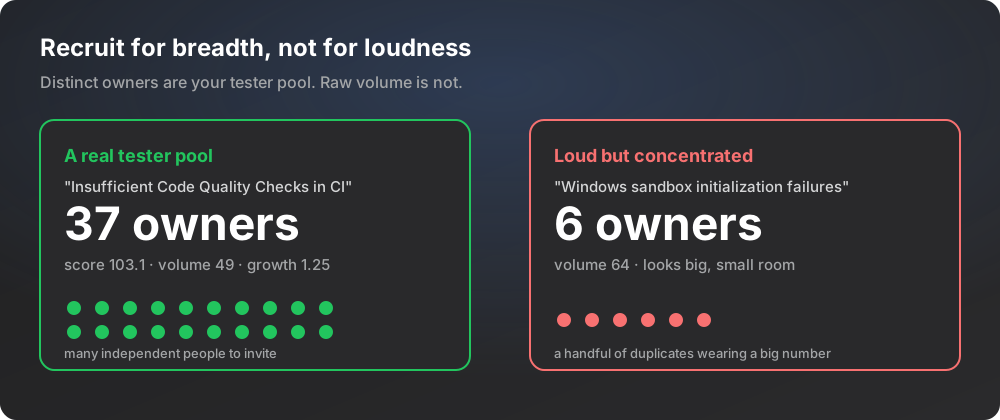
This is where you read demand by breadth, not by loudness. In EchoSift’s live data, “Insufficient Code Quality Checks in CI” carries a score of 103.1, but the column that matters for recruiting is the owner column.
| Signal on the live feed | Mentions | Distinct owners | Reads as |
|---|---|---|---|
| Insufficient Code Quality Checks in CI | 49 | 37 | ✓ A real tester pool |
| Windows sandbox initialization failures in Codex | 64 | 6 | ✗ A handful of duplicates |
The second signal looks larger by raw count and is in fact a much smaller room. When you go hunting for testers, chase the pains with wide, independent ownership, because those are the ones where the next person you email is a stranger who feels the same thing.
Growth is the second recruiting filter. A pain that is spreading gives your beta urgency and makes testers show up. “Challenges with git worktree management and path limits” sits at a score of 107.5 with a growth ratio of 4, meaning mentions of it multiplied recently. “Frustrations with CI/CD and Deployment Reliability” carries a growth ratio of 0.8 across 44 mentions and 17 owners. A rising pain held by a real spread of people is the ideal recruiting ground, because the annoyance is fresh in their minds and they are actively looking for a fix.
Size the first cohort so you can talk to everyone
There is a persistent fantasy that a bigger beta is a better beta.
The cost of a big first cohort
A first cohort of five hundred gives you five hundred ways to be ignored and no way to learn why.
Usability research settled this decades ago: Nielsen Norman Group has shown that a mere handful of users surfaces the large majority of what is broken, and that testing with about five users per round is the efficient point on the curve. The same logic applies to a beta. Start with five to eight engaged testers you can reach by name, watch them closely, fix what breaks, then invite the next wave.
Small cohorts also let you do the unscalable work that early products live or die on. Paul Graham’s argument that founders should do things that don’t scale is nowhere more true than in a beta. You onboard each tester personally. You sit in their terminal, literally or over a screen share, and watch the exact moment the tool confuses them. You cannot do that for five hundred people, and you do not need to. You need to do it for eight, learn the three things that matter, and carry those fixes into the next cohort. Waves of five to eight, each one a little larger and a little more hands-off, will teach you more than one big-bang release ever could.
Write the success criteria before you send an invite
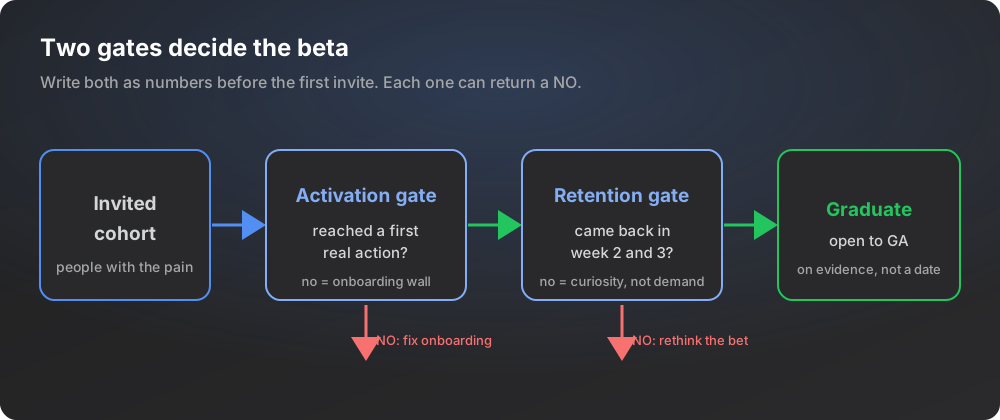
A beta is only an experiment if it can return a NO. Before the first invite goes out, write down what a working beta looks like in numbers, and write it somewhere you cannot quietly edit later. Two gates matter more than any survey score.
The first is an activation gate. Define the single action that means a tester actually used the tool for its real purpose, not just installed it. For a CI-quality tool that might be “connected one repository and saw a first check run against a real pull request.” Then set a bar: what fraction of invited testers must cross it, and by when. If they install and never reach that first real action, you have not learned that the market is wrong, you have learned that your onboarding is a wall, and that is a finding you can act on.
The second is a retention gate, which is the one that predicts a business. A tester who activates once and vanishes was a moment of curiosity, not demand. The behaviour to watch is the return: do testers come back in week two and week three, unprompted, because the tool now lives in their loop. This is the same read described in the signals of product-market fit: sustained, repeated use by people who would be annoyed if you took the tool away. Set the gate as a concrete return rate over a fixed window, and hold yourself to it.
Run tight feedback loops and read behaviour over applause
During the beta, instrument two things and trust them over everything testers say. Track activation and return in your own analytics, and keep a short, direct channel, a shared thread or a single-question weekly check, so friction surfaces the day it happens rather than in an exit survey. Testers are generous with praise and stingy with truth, so weigh what they do far above what they tell you. A tester who says the tool is great but has not opened it in nine days is giving you a retention number, not a testimonial.
Watch for the difference between a bug backlog and a wrong bet. If testers reach activation, come back, and ask for polish, “Insufficient CI/CD testing infrastructure”, scored 88.4 across 52 mentions and 30 owners, is the sort of adjacent need they will surface, and you are in a healthy beta that needs iteration. If testers never activate at all, no amount of feature work will save it, and you should return to the problem, perhaps by running another round of problem interviews before writing more code. The beta’s job is to tell you which of those two worlds you are in.
Graduate to general availability on evidence
A beta ends on numbers, not on a date on the roadmap. You are ready to open the doors when a cohort clears both gates on its own: a healthy share of invited testers activate, a healthy share return through a second and third week, and at least a few start pulling in colleagues without being asked.
The strongest signal a beta produces
A developer who tells a teammate to try your tool is spending social capital on it. Unprompted referral inside a cohort beats every survey score you could collect.
If the gates stay red across two or three cohorts, resist the urge to launch anyway and hope volume fixes it. It will not. A wider door on a leaky funnel just wastes more traffic. Tighten the recruiting so you are inviting people with sharper pain, or narrow the product until the activation gate clears, then run another wave. The whole point of a structured beta is to buy certainty cheaply, and launching on a schedule instead of on evidence throws that certainty away at the last step.
Beneath every recruiting and gating decision here is one skill: reading which developer pains are broad, rising, and real before you spend a cohort on them. Doing that by hand means combing GitHub issues, Stack Overflow, Hacker News, and Bluesky, which is exactly the manual grind EchoSift automates. It watches those four sources continuously, clusters the complaints, and ranks them by distinct-owner breadth and growth, from a base of 31,706 signals with 2,356 new in the last week, so you can pick your beta’s target pain from evidence instead of instinct. It is $39/month, and it turns the recruiting step of your beta from guesswork into a shortlist.
This article was drafted with AI assistance and reviewed against EchoSift’s proprietary signal data before publishing.