How to Find Startup Ideas: A Founder's Method for 2026
Most idea advice is brainstorming dressed up as strategy. Here is the method working founders actually use to find startup ideas in 2026, with a cross-vendor signal test.
 Alessio Persico Founder of EchoSift



42% of startup post-mortems name “no market need” as the root cause, according to CB Insights’s analysis of why startups fail. That figure describes a process failure as much as a market failure, and the process is the one nearly everybody is taught.
Where the classic idea playbook fails
You sit down, brainstorm a list, score ideas by passion and market size, and pick the highest number. It reliably produces things that look promising on a spreadsheet and invisible in a market.
Finding startup ideas that people will actually pay for requires a different motion entirely.
The founders I take seriously do not brainstorm. They notice. They file. They return to the same patterns long enough to see whether the patterns hold. That is a very different motion from “idea generation,” and it is the motion that separates founders who eventually find product-market fit from founders who burn eighteen months building something nobody asked for.
The cost of getting this wrong is well measured. According to CB Insights’s analysis of why startups fail, no market need is the most common single cause of startup death, cited in 42% of post-mortems. Running out of money tops the list as the proximate cause, but no market need is the underlying disease. You do not run out of money building the right thing. You run out of money building the wrong thing slowly.
This article is a method, not a list. Lists rot in six months because the categories shift. A method survives because it tells you what to do when the categories shift.
Table of Contents
- Why “brainstorm startup ideas” is the wrong default setting
- The two failure modes most idea searches fall into
- The cross-vendor signal test
- Where founders actually find validated ideas in 2026
- The idea-to-wedge translation most founders skip
- Building a lightweight idea pipeline
- Common objections that block the method
- A worked example from our own data
- From idea to action: what to do this week
Why “brainstorm startup ideas” is the wrong default setting
The brainstorming trap is so universal that I have to start there. Open any post titled “how to find startup ideas” and you will get the same arc. Pick a domain. Free-associate. Score by passion plus market size plus founder fit. Cross-reference your shortlist with a SWOT grid. Pick the highest score. Build.
This pipeline produces ideas the way a slot machine produces winnings. Sometimes you hit, mostly you do not, and you are confusing variance with skill the whole time.
Paul Graham made the point years ago in his essay on how to get startup ideas: the very best startup ideas tend to have three things in common. They are things the founders themselves want, that they themselves can build, and that few others realize are worth doing. You do not get there by brainstorming. You get there by living in a corner of the world long enough that the broken parts of that corner become visible. Brainstorming optimizes for breadth. Noticing optimizes for depth.
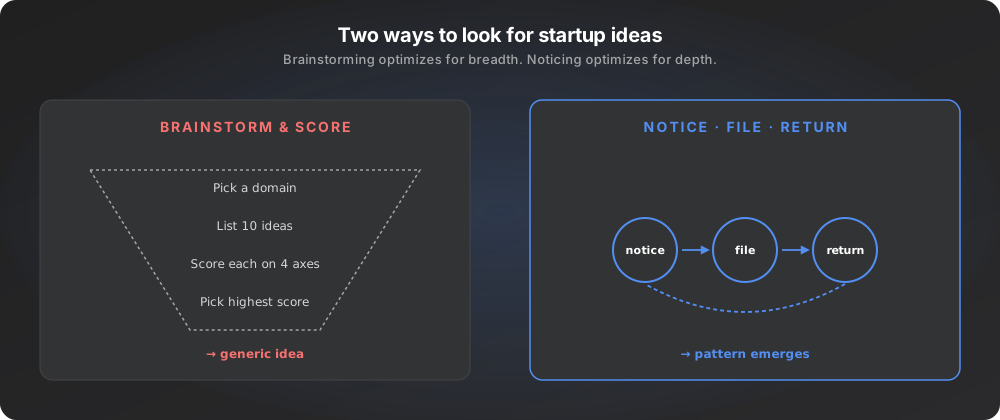
Y Combinator’s own data on this point is striking. As they describe in their guide to getting startup ideas, roughly 70 percent of the top 100 YC companies found their idea organically, by encountering a problem in their existing work, rather than by sitting down to invent one. The Airbnb origin story is not unusual. The first version was literally an air bed in someone’s living room because the founders could not afford rent during a design conference. That is a noticed problem, not a strategized one.
If you take only one shift from this section, take this: stop asking “what should I build” and start asking “what keeps breaking in the places I already spend time.” The first question has no upper bound on bad answers. The second question is small enough to actually answer.
The practical rule
If a startup idea did not exist in your life before you wrote it on a list, it is unlikely to survive contact with reality.
The two failure modes most idea searches fall into
Even founders who avoid brainstorming fall into two predictable failure modes. Both feel like real ideas. Neither is.
Failure mode one: solution-first thinking
This is the “Uber for X” disease. The founder starts with a shape they want to build (a platform, an API, an AI agent) and then goes hunting for a domain to apply the shape to. Y Combinator names this directly in their curriculum. A founder shows up saying “Uber for plumbers” and what they have actually built in their head is the Uber UI. The plumbing market is incidental. They have started with a solution, not a problem, and the resulting product almost always lands in a market that did not ask for it.
You can spot solution-first thinking in the language. If you can describe your idea in one sentence and the sentence is structurally “X for Y” where X is a known company, you are doing solution-first.
What the "X for Y" sentence leaves out
The sentence is not wrong, just empty. It tells you nothing about the buyer, the pain, the willingness to pay, the substitutes, the urgency, or the wedge.
Failure mode two: confusing personal annoyance with market pain
The second failure is more subtle because it disguises itself as the first piece of correct advice in this article. The founder notices a problem. The problem is real for them. They jump straight to “I should build this.” What they skipped is the cross-vendor check: does anyone else have this problem, or am I the unusual one?
This is where indie founders especially get burned. You spend a weekend annoyed by some workflow gap, you ship a tool, and three months later you have one paying customer who is you. The pain was real but the cluster of people with the same pain was small enough that the market does not support a business. That failure comes from skipping cross-vendor verification before building, not from poor execution.
The fix for both failure modes is the same posture: treat your own notice as the first signal, not the final answer. Your notice is the seed. The next question is whether the seed lives anywhere else.
The cross-vendor signal test
Most pain looks identical when you look at it through a single lens. A developer complains about something in a GitHub issue. A founder vents in a Reddit thread. Someone asks a question on Stack Overflow that has the same shape. By itself, each of these is one person being frustrated. What separates a market opportunity from a personal annoyance is whether the same complaint shows up across vendors who do not know each other.
This is the cross-vendor signal test. It is unforgiving and it is the only filter I trust to separate noise from a real wedge in 2026.
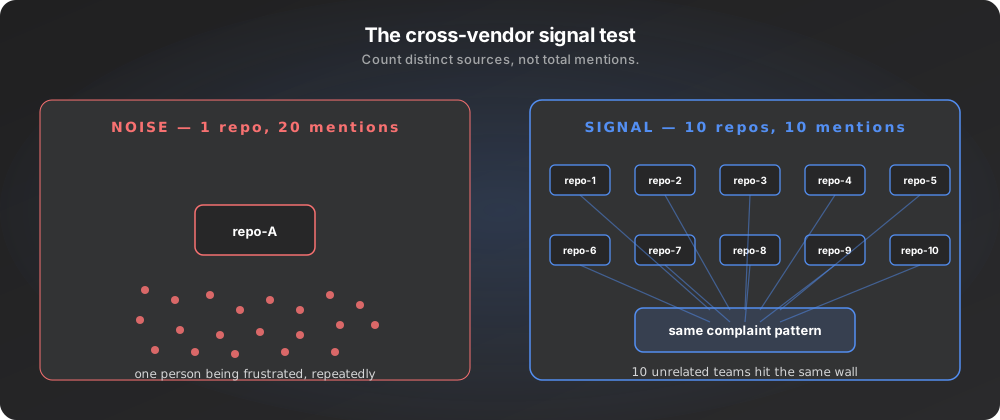
Here is how the test works in practice.
Take the complaint you noticed
The one your own week produced, phrased the way you would phrase it.
Search at least five independent communities
Different codebases, different vendors, people who do not know each other.
Count sources, not repetitions
Twenty issues on the same repository is one signal, not twenty. Twenty issues across twenty repositories is something else entirely.
Our own pipeline shows how brutal that filter is. Grouping complaints by macro-area across the 30 days ending June 7, 2026, and applying “at least two distinct repository owners report the same pain”, this is what survived.
The low end was DATA_STORAGE and the high end was AI tooling. In other words, 89 to 100 percent of single-source complaints in any given category never recur across a second vendor. The diversity-ratio gap between categories is real and informative: it tells you which problem spaces actually have markets and which are made of isolated annoyances dressed up as patterns.
Source: EchoSift internal signal data, 2026-05-09 → 2026-06-07, 7,440 cluster signals across GitHub, Stack Overflow, Hacker News, and Bluesky.
The implication for how to find startup ideas is concrete. If your noticed pain does not survive the cross-vendor test, you have not found an idea yet. You have found a chore. The chore may still be worth fixing for yourself, but it does not support a business. Returning to the test in two months is fine. Skipping the test and building anyway is the most expensive mistake a technical founder makes.
There is a related point hidden in those numbers. Categories with very low diversity ratios, with DATA_STORAGE in our data being the clean example, are not without pain. The pain there is intense and frequent. It is just intensely specific to the chosen stack. Postgres pain, Mongo pain, and cloud-serverless pain do not cross-pollinate because the underlying tooling does not. For a founder, that has a sharp implication. In a low-diversity category, you build for one stack, not for “the database market.” In a high-diversity category, you build for the pattern. If you want a category-level read on where the recurring pain actually concentrates right now, our breakdown of the developer pain points shaping 2026 walks through the macro-areas one by one.
Where founders actually find validated ideas in 2026
The brainstorming trap and the cross-vendor test together imply where to actually look. Founders who consistently find good ideas live inside the places where workflow complaints concentrate. They are not equally distributed across the internet. There are five clusters that matter, ranked roughly by signal density.
| Where the pain concentrates | Why it works | The catch |
|---|---|---|
| GitHub issues and discussions | ✓ Densest source, written by the people most invested in the workflow, so the pain is real rather than performed | The same pattern shows up phrased seven ways across seven projects, so you need a way to cluster |
| Technical subreddits: r/microsaas, r/SideProject, r/indiehackers, r/buildinpublic | ✓ Founders ask "is anyone else seeing X" and twelve people answer, which is the cluster signal itself | Reddit search is opinionated and time-decays fast, so you revisit deliberately |
| Hacker News comment threads on tool announcements | ~ Adjacent pain leaks out: a database launch produces thirty comments on migration, observability and connection pooling | The announcement threads themselves are mostly marketing |
| Bluesky and X conversations among technical founders | ~ Founders are articulate about the problem they have not solved yet | Sparse: it takes following twenty people for sixty days to see the room |
| Stack Overflow questions with zero or low-confidence answers | ✓ A documented pain pattern, dated and indexed, that passes a cross-vendor test cleanly | Gold and underused, so nothing surfaces it for you |
GitHub earns the top slot because every team that uses a framework, library, CLI, or developer tool eventually files an issue when something breaks or feels missing, and we wrote a full walkthrough of that mining process in how to turn SaaS ideas out of GitHub issues if you want the label queries and clustering steps in detail. The subreddits are not where people promote; they are where people answer. And the unanswered Stack Overflow questions are the visible tip of a much larger ice sheet: according to the 2024 Stack Overflow developer survey, 62 percent of developers report technical debt as their single largest frustration, and more than 60 percent spend at least thirty minutes a day searching for solutions.
The shared property across all five is volume of evidence. None of them rely on you guessing what people want. They rely on you reading what people are already telling each other they want.
The idea-to-wedge translation most founders skip
Suppose you have noticed a pain, applied the cross-vendor test, and confirmed that the pain exists across at least ten distinct sources. Most founders at this point jump to “what is the product.” That is one step too fast.
The skipped step is the idea-to-wedge translation. A pain is not a product. A product is not a wedge. A wedge is the smallest possible thing you can ship that lets you make the case to a real buyer that you understand their problem better than the substitutes do. The wedge has to be narrow enough to ship in weeks, sharp enough to solve a real pain, and credible enough that the buyer believes the broader vision after they see the wedge work.
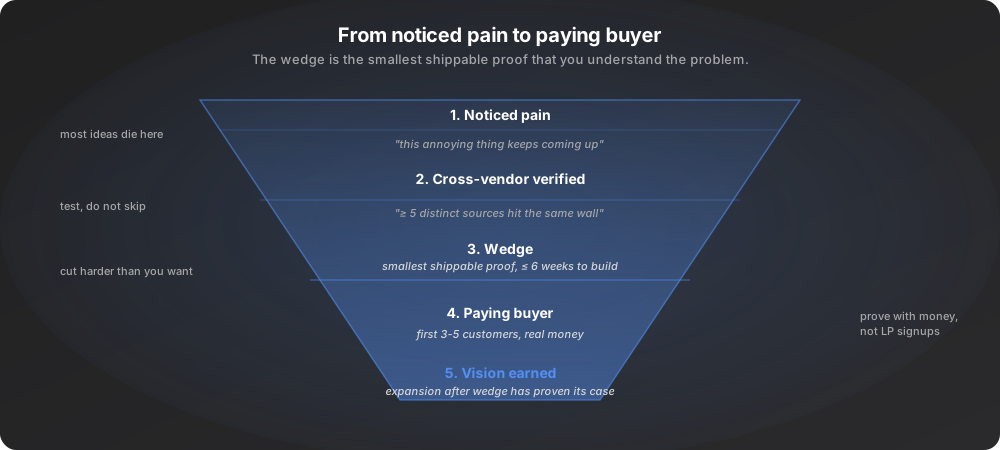
The wedge for Stripe was not “payments infrastructure for the internet.” It was “seven lines of code to take a credit card.” The vision was payments infrastructure. The wedge was seven lines of code. Founders who try to ship the vision lose because the vision is unmarketable. Founders who ship the wedge can earn the right to the vision incrementally.
The translation move is a specific exercise, and the third step is where studying best-selling products in adjacent categories pays off, because it surfaces the price ceilings buyers have already normalized and confirms that willingness to pay exists before you write a line of code.
Start from the verified pain
Not the one you like most, the one that survived the cross-vendor test.
Write down today's workaround
Whatever the buyer is actually doing to route around the problem right now.
Write down the substitute they pay for
If any, and at what price.
Price the workaround
In time or money, whichever the buyer feels.
Cut to the smallest software that removes it
For the most common version of the pain. That smallest piece is your wedge.
This exercise tends to produce uncomfortable answers. The wedge is almost always smaller than you wanted to build. Good. The smaller the wedge, the faster the validation cycle, the cheaper the cost of being wrong. First Round Review collected twenty different founder paths to product-market fit and the recurring lesson across them is the same: founders who narrowed their early wedge reached PMF faster than founders who insisted on shipping the broader system from day one.
Practical rule: if your wedge takes more than six weeks to ship in a usable form, it is not a wedge yet. You are describing a whole product. Cut.
Building a lightweight idea pipeline
The method so far has three discrete moves: notice, cross-vendor test, wedge translation. That sequence is what working founders run. The fourth move is what separates a one-shot idea from a sustainable idea pipeline: the loop that brings new candidates in continuously without becoming a full-time job.
The whole apparatus fits in three recurring appointments. You do not need software for the daily part, you can use a notes app. You do not need a research firm for the monthly part, you need a quiet Sunday.
| Cadence | Time | What you actually do |
|---|---|---|
| Daily | 30 minutes | Read inside the five clusters with idea-finding intent, hunting the second instance of a complaint you saw earlier in the week, and file it with one sentence, a link and the date. |
| Weekly | 60 minutes | Cluster the file, grouping entries that name the same pain even when the language differs. Three or more independent mentions is a candidate; one is noise unless it accumulates. |
| Monthly | 2 hours | Run the cross-vendor test on your top three, then translate the cleanest pass into a wedge with a written summary of who buys it and what they pay for today. |
The intent matters more than the timing. You are not catching up on news, and the point of the weekly review is to look at the file with fresh eyes rather than force conclusions early. A real pattern will appear in the file three or four times within a few weeks. One validated wedge per month is plenty, and twelve per year is more than most founders need to find a business they want to spend a decade on.
There is also a tooling layer worth mentioning. Reading five communities deeply takes more time than thirty minutes a day if you do it manually, so a lot of founders quietly use either custom scripts or aggregation tools to compress the input. The discipline matters more than the tool. We built EchoSift partly because we wanted this loop to run while we did other work, but the loop predates any specific tool and the discipline is the part that compounds. The tool just gives you back hours per week.
Common objections that block the method
I have given some version of this talk to founders for several years and the objections are reliable. They are worth pre-empting because each one points at a real concern, but the conclusion the objector reaches from the concern is usually wrong.
| The objection | Why it feels reasonable | Why the conclusion is wrong |
|---|---|---|
| "This is too slow" | An hour a week of reading feels like delay when you could be building | Six weeks of disciplined noticing is faster than six months of building the wrong product and pivoting after launch. The market does correct you, in the harshest currency there is. |
| "Only works for technical founders in dev communities" | The five clusters above are all developer-shaped | The method is community-agnostic. Lawyers complain in lawyer forums, restaurant operators on industry Slacks, veterinarians in private groups with the same signal density as r/microsaas. What changes is which five you watch. |
| "I have no edge, so I should pick a hot category" | It arrives wrapped in humility, and following smart people feels safe | Hot categories are crowded categories, and the cross-vendor test is meaningless inside one because every complaint surfaces enough times to look like signal. Spend three months acquiring an edge instead. |
| "What if I miss the trend by waiting" | Being late to a market is a real risk | A market that compresses to nothing in six weeks is a fad, and fads are graveyards for indie founders because the audience leaves before the product is built. A real market in 2026 is the same market in 2027. |
| "Isn't this market research with extra steps" | The activities do look similar from outside | Research starts with a hypothesis and tries to confirm it; this starts with nothing and lets the pattern arrive. Confirmation bias is a major contributor to the 42 percent no-market-need failure rate. |
The last one is worth sitting with, because the difference is structural rather than procedural. Letting the signal find you does not feel as productive in the short term, since you do not finish each day with a clean hypothesis. It produces better outcomes because the signal you find is rarely the one you wanted to find. It is the one that was actually there.
The general shape of all five objections is the same. They are arguments for skipping the slow part. The slow part is where the method earns its return. Every shortcut around the slow part is a different way of paying for a confidently wrong idea later.
A worked example from our own data
To make this less abstract, here is one pattern from our own pipeline this quarter that illustrates how the method runs end to end.
We noticed during a routine review that several independent JavaScript projects had filed issues about JWT refresh-token rotation handling within a week. The first reaction is “JWT is solved, everyone uses an SDK.” The second reaction, the right one, is to apply the cross-vendor test. We pulled all signals tagged as authentication-related from the last thirty days and grouped by complaint pattern. The JWT token expiration handling cluster came back like this.
That is a cross-vendor signal. JWT is an eleven-year-old standard. The fact that thirteen unrelated teams are still building the refresh logic incorrectly in 2026 is not a sign that the standard is broken. It is a sign that the official SDKs all assume server-rendered or session-managed flows, and that the long tail of teams running custom token rotation in SPA or mobile contexts is large enough to support a more opinionated library that handles the corner cases by default.
Whether we choose to build that library or someone reading this article decides to is irrelevant. The point is that the method surfaced a candidate that brainstorming would never have produced, because nobody brainstorming startup ideas in 2026 lists “JWT refresh handling library.” It sounds too narrow, too solved, too unsexy. The cross-vendor data says otherwise.
The same pattern repeats across categories. The opportunities that survive the cross-vendor test almost always look unsexy from the outside. They look mundane, specific, almost embarrassingly small. That is the property that makes them buildable in weeks and defensible against well-funded competition once shipped. Sexy markets attract competition. Mundane cross-vendor pain attracts buyers.
From idea to action: what to do this week
If you have read this far the most useful thing you can do is collapse the method into the next seven days, not the next quarter. The mistake at this stage is to try to do everything. Pick one notice, one cluster, one test.
Pick two communities today
From the five listed above, choose the two where you already spend time, and add a tab in your notes app titled "noticed".
File every second instance
Every day this week, when something annoys you or someone in those communities sounds annoyed about the same thing twice, write one sentence, the link, and the date.
Read the file on Sunday
Find the pattern that shows up most often and write one paragraph describing it.
That paragraph is your starting point. The cross-vendor test happens next week. The wedge translation happens the week after, and once you have a wedge our guide on how to validate a SaaS idea covers the falsification tests that can still return a clean no. By week four you have either a validated wedge to start sketching, or you have learned that the patterns you noticed do not survive the test, and that is also a result. Knowing what is not an opportunity is, in expected value terms, almost as valuable as knowing what is.
The reason this method works has nothing to do with cleverness. It works because it stays honest about what the search for ideas actually looks like from the inside. It rejects the brainstorm fantasy. It privileges the patient observer. It treats validation as a step you take before you build, not after, because validation after you build is just rationalization with extra code.
If you want to compress the part where you watch many places at once, EchoSift aggregates the same kinds of community complaints described above and clusters them into pain patterns that have already passed a version of the cross-vendor test, with diversity scores and source counts on each one. We built it for ourselves and other indie founders who wanted the idea pipeline to keep running without becoming a job. The method described in this article works without us. It just runs faster with the right input.
Either way, the next move is the same. Notice. File. Cross-vendor test. Wedge. Ship the wedge. The rest follows from there.
This article was drafted with AI assistance and reviewed against EchoSift’s proprietary signal data before publishing.