How to Build a Waitlist for a Developer Tool
Treat a pre-launch waitlist as a demand instrument, not a mailing list: a landing page, qualifying questions, and activation steps that turn signups into your first real developer users.
 Alessio Persico Founder of EchoSift



A validated list of 100 qualified names, collected before you write a single line of code, is a stronger demand signal than three months of private beta with no conversions to show for it. A waitlist is the cheapest instrument you own for turning a hypothesis into a list of named, reachable people, and it works before the tool exists. Done well, it answers a question that no amount of internal debate can settle: will people you have never met raise a hand for the thing you are about to build. Done badly, it becomes a pile of addresses that flatters your dashboard and predicts nothing.
This article is about the waitlist as a validation tool, not as a growth hack. It sits next to the broader work of validating a SaaS idea, and it overlaps with, but is not the same as, measuring demand for a SaaS idea. Demand measurement asks how big the appetite is out in the world. A waitlist asks a sharper, more personal question: of the people who see your specific claim, how many will commit their email and a minute of attention to be first in line. That commitment is a small down payment, and small down payments are the honest currency of pre-launch interest.
A waitlist is a smoke test, not a mailing list
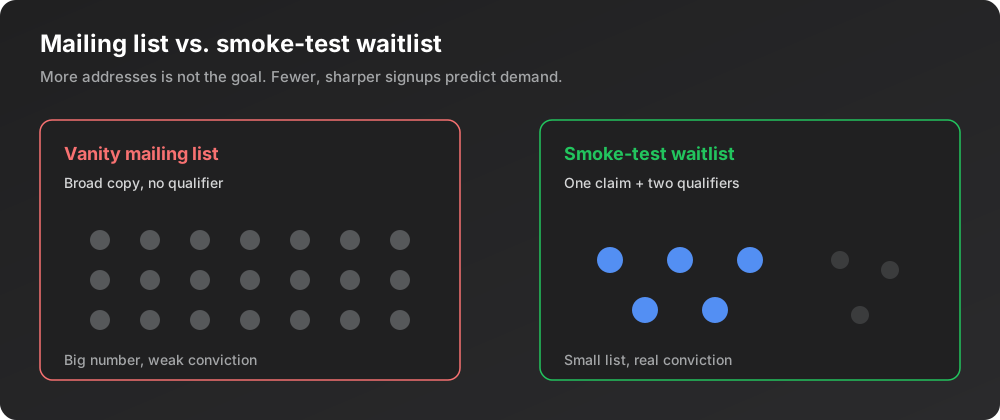
Borrow the framing from software: a smoke test checks whether the thing catches fire the moment you switch it on. A pre-launch waitlist does the same for demand. You publish a page that describes a tool as if it were real, you invite people to sign up, and you watch whether anyone does. The signups are the smoke. If no one signs up, you have learned something valuable for the price of an afternoon, and you have learned it before writing code.
The trap is treating the list as a mailing list, where more addresses is always better. That mindset pushes you toward broad, watered-down messaging that collects the maximum number of weakly interested people. A validation waitlist wants the opposite: a smaller list of people who felt a specific pain sharply enough to act. One hundred qualified signups who all share the same problem tell you more than two thousand who wandered in from a viral tweet. The number is only a proxy. What it stands in for is conviction, and conviction does not average well across a crowd.
Build the landing page around one painful claim
The page that collects signups works as a single argument, not a brochure, and the argument is a claim about a pain you can name precisely. Lead with the problem in the words your audience already uses, show the cost of living with it, then promise the specific relief your tool provides. A landing page that tries to describe every feature converts worse than one that lands a single sharp promise, because a reader deciding whether to hand over an email is answering one question: does this person understand my problem.
Ground the claim in a pain you can see, not one you imagine. In current developer discussion, documentation and onboarding friction is a broad, live complaint, and the signal “Enhancing README Documentation for Onboarding” is the shape of it.
A landing page for a tool that fixes onboarding docs is standing on real ground, because 137 separate people have already told you, in public, that the pain is theirs. Write the page for those people specifically, and the copy almost writes itself.
The sign-up form is a qualifying instrument
Here is where a validation waitlist departs hardest from an email list. The form is more than a single box that asks for an address. It is a short qualifier that lets people disqualify themselves. Ask two questions, no more, and choose them so the answers separate a future buyer from a curious bystander.
Two questions, chosen so people can disqualify themselves
For a developer tool, good qualifiers are which stack the person works in, how they handle the problem today, or how many people on their team hit it. Each answer is a data point you would otherwise have to guess, and the people who abandon a form over one extra field were rarely serious.
Qualifying questions do two jobs at once. They give you the raw material for your first round of interviews, and they quietly filter the list. This is the same discipline as writing an ideal customer profile: you are deciding, up front, which answers make someone your person and which do not. A waitlist without qualifiers gives you a number. A waitlist with two good qualifiers gives you a segmented list you can act on the day you launch.
Read the list the way signal data reads demand
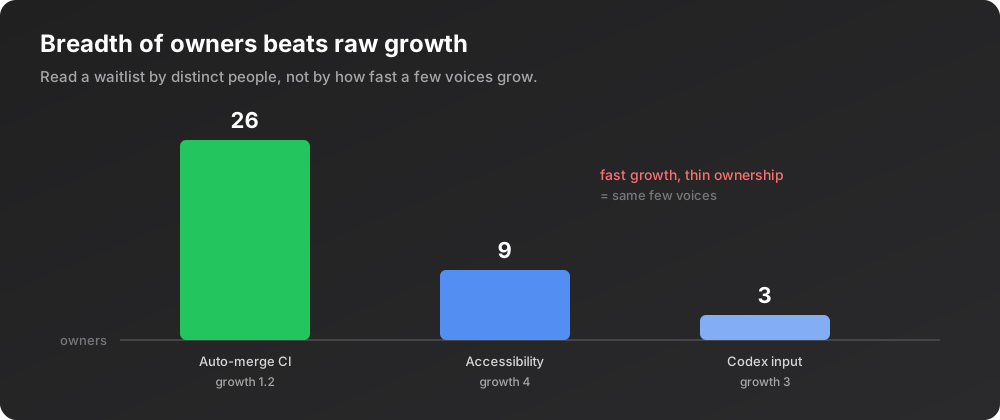
Once signups arrive, resist the urge to celebrate the top-line count. Read the list the way a good analyst reads live demand data, where breadth of distinct people beats raw volume every time. EchoSift tracks 31,158 signals across 4 sources, with 2,377 new in the last seven days, and the lesson that repeats across that data is simple: the count of independent owners is a truer measure of an audience than the count of mentions.
Two contrasts from the current data make the point. “Auto-merge flaws undermine CI and review integrity” scores 102.8 and is raised by 26 distinct owners, with a growth ratio of 1.2. That is an audience that is both broad and building. Compare it to “Improving Accessibility in App Design”, which is growing fast at a growth ratio of 4 but is held by only 9 owners, or “Input failure in Codex app workflow”, which is accelerating at a growth ratio of 3 yet traces back to just 3 owners. High growth with thin ownership is a waitlist that fills with the same few loud voices. Apply the same reading to your own signups: fifty different companies matter more than five hundred addresses from the same forum thread.
Choose incentives that select for buyers
Every incentive you attach to a signup shapes who signs up. Offer a gift card and you attract everyone, including people who will never use the product. Offer early access, a founder’s direct email, or a say in what gets built first, and you attract the people who actually have the pain, because only they value those things. The best pre-launch incentive is proximity to the thing itself: a spot at the front of the line, a private changelog, a call with the person building it. This is doing things that do not scale on purpose, and at the waitlist stage it is a feature, not a compromise, because you are trying to learn, not to grow.
When only a giveaway moves them
The incentive is also a test. If the only thing that moves people to sign up is a gift card, you have learned that the pain is not sharp enough to stand on its own yet. Treat that as a finding rather than a failure: better to see it on a landing page than after three months of building.
From waitlist to first activated users
A waitlist is not finished when it stops growing. It is finished when it starts converting. The last and most important measurement is activation: of the people who signed up, how many take a first real action once you open a door, whether that is installing a beta, running one command, or completing a first task. A name that signs up and never returns was interest, not demand, and the gap between the two is where most pre-launch optimism dies.
Sequence the handoff deliberately. Open access to a small batch first, watch who activates, then use what you learn to sharpen the page and the qualifiers before the next batch. This is the same loop you would run for a minimum viable product for developer tools: ship to a few, measure the first real action, and let the results correct your aim. A waitlist that reaches activation has done its whole job, which was never to collect emails. It was to hand you a short list of people who will show up when you build the thing.
What a waitlist cannot tell you
A waitlist proves that people will raise a hand.
What the raised hand does not prove
It does not prove they will pay, that they will stick, or that your solution actually solves the problem once they touch it. Signups are a leading indicator, and leading indicators lie when you lean on them too hard.
Use the waitlist to earn the right to build, then let real usage and, eventually, real payment carry the burden of proof from there. Treat the list as the start of a conversation with named people, not as a verdict, and it will be one of the most efficient tools you have before launch.
This article was drafted with AI assistance and reviewed against EchoSift’s live developer signal data before publishing.