Tips for Market Research: 10 Methods Founders Use in 2026
Ten market research tips that produce actionable signal in days, not weeks. Cross-vendor verification, pre-committed kill criteria, payment-readiness tests.
 Alessio Persico Founder of EchoSift



Market research fails founders in a specific way: the instruments they inherit were built for someone else’s job. Consulting decks reach for total addressable market sizing because their clients are buying confidence; venture associates reach for survey instruments because their job is to defend a memo; academic papers reach for double-blind methodology because their incentive is to publish. None of those produces what a founder actually needs, which is a fast, defensible decision about whether to keep going.
The cost of getting market research wrong is documented and severe. CB Insights’s review of more than a hundred startup post-mortems found that no market need is the single most-cited cause of death, named in 42% of cases. The point is not that founders are lazy about validation. The point is that the validation methods most founders inherit are either too slow to fit a startup’s reality or too generic to surface anything the founder could not have guessed.
We hit this exact wall while building EchoSift. The standard market research playbook either consumed weeks we did not have or produced findings we already knew. The ten tips below are the ones we converged on after rebuilding our own research process from scratch, then keeping only what survived contact with a founder’s calendar. Each is fast enough to fit between meetings, cheap enough to skip a budget conversation, and specific enough either to kill a bad idea or sharpen a good one. They assume you are a technical founder with limited time and no patience for theatre.
What this guide is, and is not
These ten tips are about research discipline: the habits that convert a week of poking into a go or kill decision. Kill criteria you commit to in writing before you look, an interview cadence you can actually keep, and a wedge you validate apart from the vision. They are not the measurement layer.
If you want the instruments that put an actual number on demand, existing volume, recency, breadth across sources, a smoke test, and willingness to pay, that toolkit is how to measure demand for a SaaS idea. Run the instruments there; run the discipline here.
Table of Contents
- 1. Pre-commit the kill criteria before you start
- 2. Read complaints, not articles, for the first hour
- 3. Apply the cross-vendor signal test
- 4. Five users for fifteen minutes, not fifty for one hour
- 5. Close every interview with a payment-readiness question
- 6. Map the workaround before you map the solution
- 7. Look for the pain in three different communities
- 8. Measure how long the pain has lived, not just how loud
- 9. Run a test you can be wrong about in writing
- 10. Validate the wedge separately from the vision
1. Pre-commit the kill criteria before you start
Most market research never produces a decision because the founder never wrote down what evidence would change their mind. The single most useful market research tip in 2026 is also the cheapest: before you talk to anyone, write down the threshold below which you will stop.
A workable form is two or three sentences. “I will keep building only if I can name five teams who currently pay someone else to solve this problem, who would switch to my version, and who can describe the switching cost in dollars.” That is a specific, falsifiable claim. You can answer it in two weeks of work and the answer is either yes or no.
Founders skip this step because writing kill criteria in advance feels like inviting failure. It is the opposite. Pre-committed criteria force you to decide what evidence matters before you have any. After you start interviewing, every conversation feels promising in the moment and the bar drifts up unconsciously. Without a written threshold, you will rationalise a no into a yes ten interviews from now.
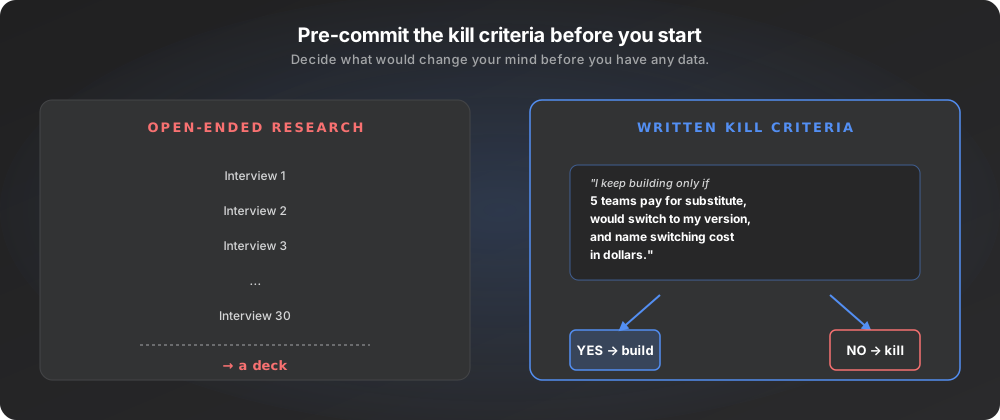
A concrete example of what the criteria look like when sharpened. A founder considering a developer-onboarding SaaS would not write “users find onboarding painful.” That is not falsifiable; everyone finds onboarding painful at some level. They would write “I will keep building only if at least three engineering managers at companies with twenty or more engineers describe a specific moment in onboarding their last hire that cost more than two full days of work, name the workaround they currently use, and accept a fifteen-minute follow-up call to evaluate a prototype.” That sentence specifies the segment, the magnitude, the existing substitute, and the commitment behaviour. After five interviews you know whether the criterion is met.
The one-breath test
If you cannot write your kill criteria in one breath, you do not yet understand the bet you are taking. Spend an afternoon on this before spending two months on the research.
The criteria do not need to be perfect. They need to be specific enough that you cannot rationalise a no into a yes after the fact. Imperfect criteria written in advance are stronger than perfect criteria assembled in hindsight from research findings.
2. Read complaints, not articles, for the first hour
The wrong way to start market research is to open a tab on Crunchbase and read funding announcements. The right way is to open a complaint and read someone being annoyed.
Complaints are honest in a way articles never are. Articles are written by people who are trying to convince you of something; complaints are written by people who are trying to fix their day. Inside a complaint you find the workflow the person was running, the specific moment it broke, the language they use to describe the problem, and a strong signal of whether they have already tried to fix it.
The places to read complaints have shifted modestly since 2020 but the principle has not.
Open the complaint surfaces, not the news
GitHub issues, Stack Overflow questions with low-confidence answers, niche subreddits, Hacker News comment threads under product announcements, and the long tail of public Discord servers in your domain.
Read with idea-finding intent, do not engage
One note per thread, capturing the language the writer uses to describe the pain rather than your summary of it.
Stop at fifteen to twenty raw complaints
An hour gets you there, and that list in the founders' own words is the seed of your interview script for the next two weeks.
Skip this and your interviews will be founder-led, which is exactly the wrong orientation.
3. Apply the cross-vendor signal test
Once you have a candidate pain, the single most important question is not “how many people say this?” but “how many independent sources say this?” These are very different numbers and conflating them is the most common analytical error in founder-led research.
A complaint that appears twenty times on one repository is one signal. The same complaint appearing once each on twenty unrelated repositories is something else entirely. Markets are made of the second kind of pattern, not the first. The cross-vendor signal test is simply: count distinct sources, not total mentions.
What our data shows. Across our internal pipeline at EchoSift we group developer complaints by macro-area and apply the simple filter “at least two distinct repository owners report the same pain in the last 30 days.” The percentage of cluster signals that survive that filter ranges from 0% in our DATA_STORAGE bucket up to 10.8% in AI tooling. In practice that means 89 to 100 percent of single-source complaints in any given category never recur across a second vendor. The diversity-ratio gap between categories is real and instructive: it tells you which problem spaces actually have a market and which are made of isolated annoyances dressed up as patterns. We analysed 7,440 cluster signals across eight macro-areas in the 30 days ending June 7, 2026.
Source: EchoSift internal signal data, 2026-05-09 → 2026-06-07, 7,440 cluster signals across GitHub, Stack Overflow, Hacker News, and Bluesky.
The most useful number to attach to a candidate pain is not its raw volume but its distinct-owner count: how many separate repository owners, not how many separate posts, describe the same problem. One loud person filing forty issues is one owner. Forty owners each filing one issue is a market. As of 4 July 2026 our pipeline holds 25,482 clustered signals across those same four sources, and the pattern that best illustrates the distinction is “Lack of Rate Limiting on API Endpoints”.
Owner count is the closest cheap proxy a founder has for “how many separate wallets feel this pain,” and it is exactly the axis single-source volume hides. The same discipline drives our read of recurring developer pain points: a complaint only counts once you can name the second, third, and fortieth owner behind it.
The implication for any market research tip is the same.
Where a single-source pain fails
If your noticed pain does not survive the cross-vendor test, you have found a chore worth fixing for yourself, not a market worth pursuing. The cost of skipping this step is six months of building.
4. Five users for fifteen minutes, not fifty for one hour
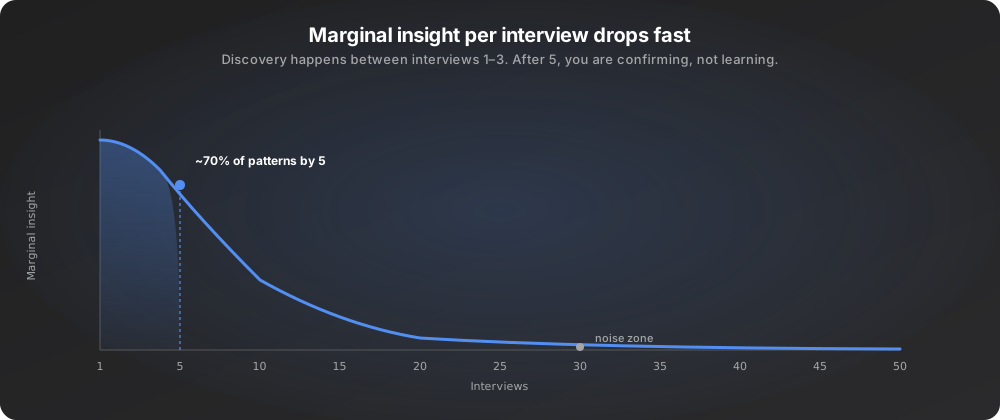
Founders new to market research consistently over-invest in interview length and under-invest in interview count. The instinct says a long interview surfaces deeper insight. The data says the opposite: the marginal usefulness of an interview drops sharply after the first fifteen minutes, and the gap between five interviews and one interview is enormous, but the gap between fifty and twenty is small.
The reason is that the first five people will surface 70 to 80% of the high-confidence patterns. They will use the same three or four phrases to describe the pain, they will point to the same workarounds, they will recognise the same constraints. Patterns that show up in interviews one through five are stable. Patterns that only emerge at interview thirty are noise.
The right cadence is fifteen-minute structured conversations with five people in your target segment. The first three to four minutes are warm-up, the middle eight are open questions about their workflow and frustrations, and the last three are testing a single hypothesis against a written prompt. Zoom’s Jane Davis, in her UX research crash course on First Round Review, describes this same compression: short and tactical beats long and exploratory once you have a hypothesis to test.
| Interview plan | What it costs you | What it returns | The follow-up door |
|---|---|---|---|
| Five 15-minute interviews in one week | ✓ One afternoon | ✓ 70 to 80% of the durable patterns | ✓ Stays open, because you respected their time |
| Fifty hour-long interviews over two months | ✗ Two months of founder attention | ✗ Insight decay: the early conversations age out before the late ones land | ✗ Closes |
Five conversations across one week is what a founder can reasonably ship without compromising other work. Fifty is research theatre.
The structural reason this works is that interview five is rarely the discovery, it is the confirmation. Discovery happens between interviews one and three when you hear the same phrase twice from people who have never met each other. After three the marginal information you can extract per fifteen minutes drops by half, then by half again. Founders extending interviews to an hour are doing the right thing for sales calls (you need that depth when you are selling) but the wrong thing for early research, where the goal is breadth of independent confirmation rather than depth of any one signal.
A second structural reason is that short interviews respect the interviewee’s time, which makes the next request for one easier. Five fifteen-minute interviews is a single afternoon. The interviewee comes away with a clear sense that you respect their time, and the door for a follow-up conversation in three months, once you have something to show, stays open. Long interviews close that door.
5. Close every interview with a payment-readiness question
The single most common interview mistake is ending on a sympathetic note. “Thanks so much, that was really helpful, I’ll let you know how it goes.” The interviewee has no incentive to be candid in the closing minute, and the founder walks away with social warmth instead of signal.
The fix is to close every interview with the same blunt question: “If we built this in six weeks and charged you ninety dollars a month, would you commit a calendar invite next month to evaluate it?” The point is not the price. The point is the calendar invite. People who say yes and put a date on the calendar are signal. People who say yes and never follow up are noise. People who say no with reasons are also signal because the reasons are nearly always specific.
Steve Blank’s customer development methodology, formalised in the Stanford handout based on The Four Steps to the Epiphany, is built around exactly this principle: customer validation is not about whether someone says they would pay, it is about whether they commit a behaviour that costs them something. A calendar invite costs five seconds; that is enough to separate enthusiasm from interest.
Where a warm close fails
An interview that ends with "thanks, this was great" produced no validation data. Close with a calendar invite, or you are talking to friends rather than researching a market.
6. Map the workaround before you map the solution
Every real pain has a workaround already. Founders rarely look at the workaround before they design the replacement, which is why the replacement so often misses. Mapping the workaround is the single biggest signal of whether your solution will actually displace anything.
A workaround tells you three things. First, what the user is currently willing to do, in time and money, to keep functioning. Second, what they have already tried and abandoned, which gives you the negative space of the solution. Third, who the current substitute is, which is rarely the named market leader in your category and often a Google Sheet, a shell script, or a manual procedure.
The right interview question is not “what tools do you use?” but “show me what you do today when this problem comes up”. Watching someone share their screen for two minutes produces more signal about your competitive landscape than any analyst report, and it feeds directly into a grounded market opportunity assessment because you are sizing the gap against the real substitute rather than an imagined one. You will discover that your “competition” is rarely a SaaS. It is the head of engineering’s hand-rolled tooling and the operations team’s cron job. Until you can name the workaround in concrete terms, you do not know what you are replacing.
7. Look for the pain in three different communities
The single best test of whether a pain is universal or vendor-specific is whether the same complaint shows up in three independent communities you would not expect to be talking to each other. Founders consistently under-invest in cross-community verification because the natural research instinct is to dig deeper into the one community where you noticed the pain.
The mechanics are simple. Pick three places where the buyer would complain if the problem were real. For a B2B SaaS founder targeting developers, those might be GitHub issues on a popular project in the relevant ecosystem, a niche subreddit, and a public Discord server. For an indie SaaS founder targeting operators, those might be a Facebook group, a Slack community, and a Twitter circle. The point is the three communities should not share an audience by more than 20%.
| Independent communities carrying the same complaint | What it usually means | What to do next |
|---|---|---|
| One | ✗ Real, but narrow | Keep reading, do not build |
| Two | ~ Probably regional or stack-specific | Widen the search before committing |
| Three | ✓ A market | Move to interviews |
Y Combinator’s playbook on how to get startup ideas makes this point directly: the strongest founder evidence is the kind that surfaces organically from places you did not intentionally aggregate.
This is also the cheapest research method in your toolkit. It costs zero dollars and roughly thirty minutes per day for two weeks. If the pain does not survive the three-community test, that is your answer.
8. Measure how long the pain has lived, not just how loud
Volume is the most over-weighted research signal. Duration is the most under-weighted. A pain that has been live for ten years is more valuable than a pain that exploded six months ago, even if the recent one has more posts attached to it.
The reason is that durable pains are pains the market has tried and failed to solve. They are the surviving questions after every easy answer has been attempted. A pain that has been documented on Stack Overflow continuously since 2018, with new posts every quarter, has survived attempts by motivated developers, by frameworks, by official SDKs and by community libraries. It is still here because the underlying constraint is hard. That is precisely the kind of pain a paid product can address, because the alternatives have already failed.
A recent loud pain is the opposite shape. It is loud because the topic is hot, but loudness has not been pressure-tested by time. Half the volume is people repeating what they read elsewhere; the other half is people experimenting with the new thing and surfacing teething problems that the ecosystem will fix in six months without your help. Building a product against a six-month-old pain is a bet that the underlying constraint is real rather than transitional. That bet often loses.
A practical filter is to pull the timestamp of the oldest visible complaint matching your pattern, then count how many quarters since then have produced new complaints of the same shape. If the answer is more than eight quarters with continuous activity, you have a durable pain. Fewer than four quarters, you might be looking at noise.
A concrete example helps. JWT token expiration handling is a complaint that has been documented in developer communities continuously since the standard stabilised around 2015. Auth0 launched, Okta entered the developer space, Clerk arrived as the modern wrapper, Supabase Auth made the cheap version possible, and yet the JWT-expiration complaint continues to surface in 2026 because the underlying constraint (the gap between identity-provider SDK assumptions and the long tail of custom token rotation flows) is structural, not transitional. That is a durable pain. Building a JWT-expiration helper library in 2026 is betting against a documented eleven-year history of attempts to make this go away. The bet might still lose, but at least you know what you are betting on.
Compare that to a noisy six-month-old pain like “Codex CLI fails on Windows path normalisation.”
| Candidate pain | How long it has been documented | What has already tried to fix it | Read |
|---|---|---|---|
| JWT token expiration handling | ✓ Continuously since 2015 | Auth0, Okta, Clerk, Supabase Auth | ✓ Durable: the constraint is structural |
| Codex CLI Windows path normalisation | ✗ About six months | The official SDK, three release cycles out | ✗ Transitional: the vendor overtakes you before version one |
The volume on the second one is high right now, which is exactly what makes it seductive. The durability filter would have caught it in five minutes.
9. Run a test you can be wrong about in writing
The discipline that separates research that produces decisions from research that produces narrative is writing down the test in advance. Without that step, the human brain interprets ambiguous evidence as confirmation, and you walk out of a week of interviews more confident than your data justifies.
The mechanics of writing the test are not complicated. One sentence: “If I do X, and Y happens, I will conclude Z.”
Name the action, X
Something specific and dated: five cold emails to a target segment, a landing page, one small ad.
Name the observable outcome, Y
A number you cannot argue with afterwards: at least three replies, at least ten email signups in 48 hours, at least one paid customer.
Name the conclusion, Z, including the no
Written before the first email goes out, so the ambiguous week cannot rewrite it.
The reason this matters is that writing the test forces you to think about what would falsify your belief, not what would confirm it. Founders who skip this step routinely run experiments where the only outcomes they have planned for are “great, building it” and “needs more research,” and the second answer is just the first answer with extra steps. A real test names a stopping condition. This is the same falsification mindset that underpins any serious attempt to validate a SaaS idea: a test that cannot return a no is not a test.
First Round Review collected twenty different founder paths to product-market fit and one of the most-repeated lessons across them was exactly this: founders who pre-committed to a falsifiable outcome reached product-market fit faster than founders who treated research as continuous discovery. The pre-commitment is the discipline that turns research into a decision instead of an open browser tab.
10. Validate the wedge separately from the vision
The final tip is the one most founders never get to because the previous nine usually kill the bad ideas first. If you have made it through them, you have a real pain, a real audience, and a real workaround you can credibly replace. The mistake at this stage is to validate the broader vision instead of the narrow wedge.
A vision is the ten-year version of what you want to build. A wedge is the six-week version that proves you understand the problem better than the substitutes. Vision validation is impossible because the future has too many free parameters; wedge validation is possible because you can ship one in weeks and see what happens.
The right move is to write two documents.
| Document | What it is for | Do you validate it |
|---|---|---|
| The vision document | The ten-year north star, with too many free parameters to test | ✗ No: it goes in a folder |
| The wedge document | The six-week proof that you understand the problem better than the substitutes do | ✓ Yes: five interviews, a landing page and a payment-readiness close, all about the wedge |
(We built EchoSift following this exact decomposition: the vision was pain-pattern intelligence across all developer communities, and the wedge was a clustered feed of cross-vendor GitHub issues. The wedge took six weeks; the vision continues to expand only because the wedge validated.)
When the wedge validates, you have earned the right to the vision. When the wedge fails, you have learned something specific about what to cut. Either way, the path through is the same: validate small, vision later.
Two practical refinements make this work. First, the wedge document should describe a single buyer’s single problem with a single dollar amount attached. If the document needs more than one sentence per dimension you have not narrowed enough. Stripe’s wedge was “seven lines of code to take a credit card on a website.” Three nouns. Notion’s wedge was “a writing surface that combines a doc and a database for product teams.” The discipline of one sentence per dimension forces you to ship in weeks rather than months.
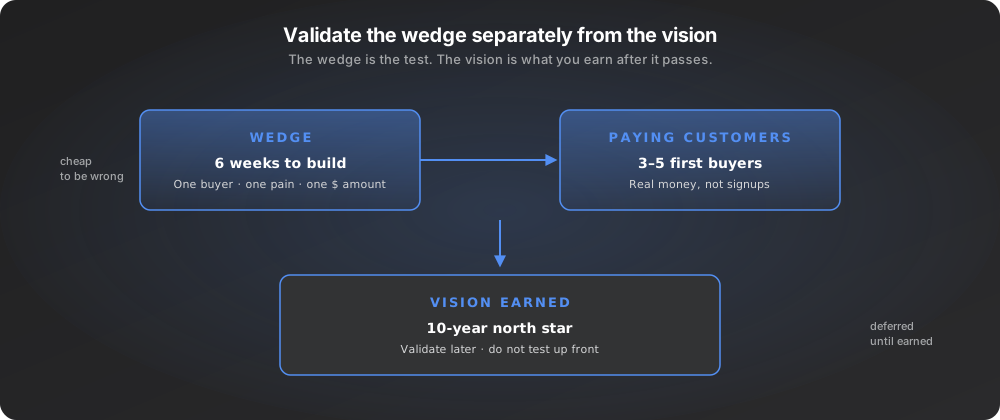
Second, the buyer for the wedge is rarely the buyer for the vision, and that is fine. The wedge is a permission slip to learn from a smaller market that you can grow into the bigger one. The first buyers of the EchoSift wedge were indie SaaS founders trying to validate a single idea; the vision buyers will eventually be product teams running pattern analysis across competitive landscapes. The two audiences are related but distinct, and trying to validate the vision audience before the wedge audience has paid is the most expensive mistake a founder can make in 2026. The wedge audience pays you to learn; the vision audience pays you to deliver. You need the first money first.
If you remember nothing else from these ten tips, remember this one. Markets are not won by the founders with the deepest research. They are won by the founders who let the market correct them quickly and cheaply, and who treat every research conversation as a forcing function for a decision rather than as content for a deck.
From research to decision
The thread across these ten tips is a single rule: every step is designed to produce a decision rather than more research. Founders who internalise this stop doing market research as a phase and start doing it as a verb that happens twice a week for an hour. The output is not a deck. The output is a series of small commitments and the rejections of bad ideas before they cost six months.
A second thread is that none of the tips above require a budget.
The opportunity cost is real but the cash outlay is zero. Founders who treat market research as a capital-intensive activity have inherited a frame from consulting that does not apply to a four-person company. The right metaphor is closer to debugging than to deck-building: most of the work is reading inputs, forming small hypotheses, and running cheap experiments that you can iterate on the next day. If your research week looks like a Gantt chart you are doing it wrong.
If you are building for developers and want to skip the manual part of the cross-vendor verification described in tip three, EchoSift aggregates pain signals across GitHub, Stack Overflow, Hacker News and Bluesky and clusters them by macro-area with diversity scores and source counts on each pattern. We built it for ourselves and other indie founders who wanted the watching part of market research to keep running while they did other work. The discipline is what compounds; the tool just gives you back hours per week.
Whichever way you run the research, the next move is the same. Notice. Verify cross-vendor. Test against a written prompt. Either kill the idea or sharpen it. Then do it again next week.
This article was drafted with AI assistance and reviewed against EchoSift’s proprietary signal data before publishing.