How to Write a Value Proposition for Developers
Write a value proposition as one testable promise: a before and after transformation, a one-sentence formula, and proof a skeptical developer will actually believe, grounded in live signal data.
 Alessio Persico Founder of EchoSift


You can pick the right audience, name the right buyer, and still lose them in the first sentence they read. The value proposition is that sentence. It is the promise you make to a developer in the seconds before they decide whether to keep reading or close the tab. Everything upstream, all the research about who they are and which slice to serve first, exists so that this one promise can be sharp instead of generic. Get it wrong and the best product in the category reads like every other landing page.
This article is about writing the promise itself. It is not about dividing your market into groups, which is audience segmentation, and it is not about choosing which single buyer to serve first, which is defining an ideal customer profile. Those decide who you are talking to. A value proposition decides what you say to them once the choice is made. The distinction matters because a promise aimed at everyone reduces to noise, while a promise aimed at one well-understood reader can be specific enough to be believed.
A value proposition is a testable promise, not a slogan
A slogan decorates. A value proposition commits. The difference is that a real proposition can be proven wrong.
| Line at the top of the page | Can it be proven wrong | Why |
|---|---|---|
| "The developer platform for modern teams" | ✗ No | It does not claim anything a reader could check |
| "Keep your main branch green on every merge without adding a new pipeline" | ✓ Yes | It names a pain, an outcome and a tradeoff, so reality can contradict it |
A promise that can return a NO is a promise a reader can trust, because they sense you have staked something on it.
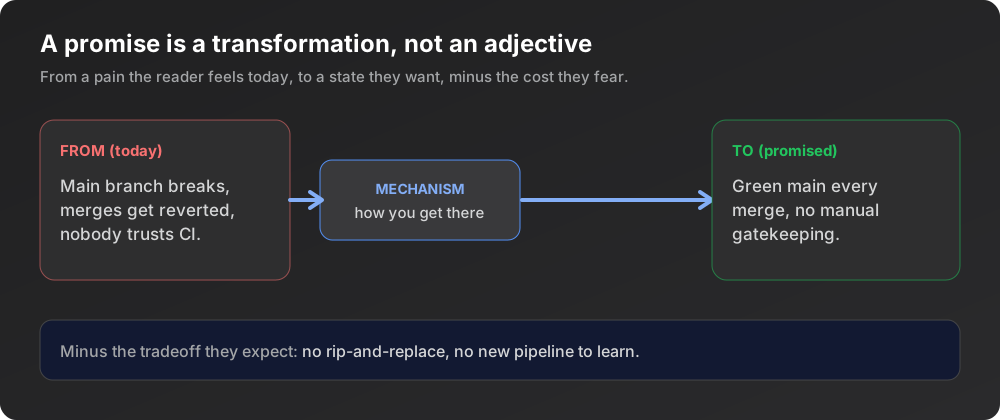
The shape underneath every strong proposition is a transformation. You are describing a move from a painful current state to a better one, minus the cost the reader expects to pay for the change. The classic framing behind this is the value proposition as a statement of the benefits a customer gains, but the version that works for developers is blunter: name the pain they have today, name the state they want, and name the tradeoff you are sparing them. Skip any of the three and the promise goes soft.
Anchor the before state in pain you can see
The weakest propositions invent the pain they solve. The strongest ones borrow it, word for word, from what developers are already saying in public. You are not guessing at a problem, you are pointing at one the reader has felt this week. That is where live signal data earns its place in the drafting process. EchoSift tracks 31,158 signals across 4 sources, with 2,377 new in the trailing seven days, and every one of them is a complaint or a request phrased by a real developer.
Take a concrete anchor: “Continuous Integration Failures on Main Branch”, rising at a growth ratio of 1.67.
That is not a pain you have to argue exists. Thirty-six separate people have already documented it for you. A proposition built on that anchor starts from agreement instead of persuasion, because the reader recognizes their own Tuesday in your first line. Compare it to a pain you assume without evidence, and the difference in conviction is the difference between a nod and a shrug.
Notice too that the anchor gives you the reader’s vocabulary. Developers do not describe a broken build as a “quality assurance challenge.” They say the pipeline is red and the merge got reverted. When “Broken Links in Documentation” shows up with a score of 112.3 across 22 owners and a growth ratio of 3.5, the phrase to steal is broken links, not “content integrity.” Write the before state in the exact words of the complaint and the reader stops feeling marketed to.
Assemble the promise from four slots
Once you have the before state, the promise itself fits a small structure. Four slots, each filled with a concrete noun. Written out it reads like a sentence, not a template, but the slots keep you honest.
The audience
Who the promise is for, as a concrete noun rather than "modern teams".
The outcome
The state they gain, in a form they can picture: the main branch stays green.
The mechanism
How you deliver it. "By gating every merge on the test suite" is what separates a claim from a plan.
The tradeoff it avoids
The cost they feared, named and removed: no new pipeline to learn, no ripping out their current setup.
A vague word in any one of those slots is where belief drains away, and the mechanism is the one developers care about most and the one most propositions fudge. A developer wants to know how, not just what, because they have been burned by tools that promised an outcome and delivered a wrapper around the same problem. If your proposition says “keep the build green,” the reader immediately asks how.
Prove it to a skeptic
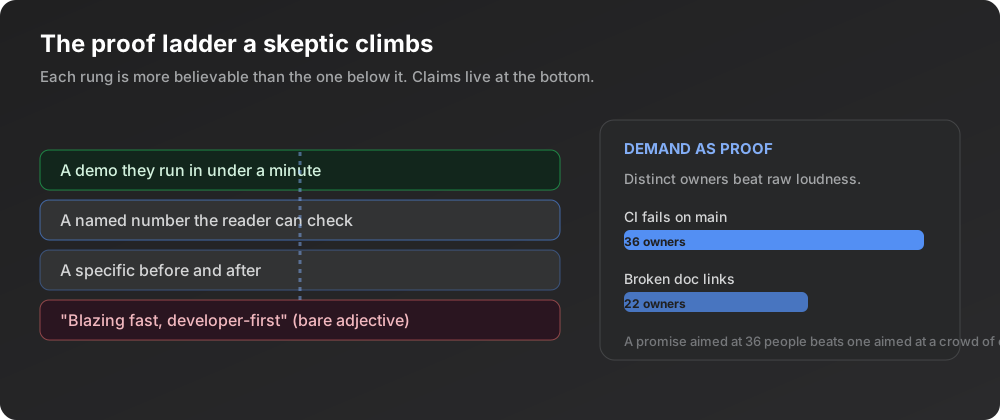
Developers are trained skeptics. They read a bold claim and reflexively look for the catch, because their job is to find where systems break. So a proposition aimed at them has to carry its own proof, and proof comes in a ladder. At the bottom sit bare adjectives, the “blazing fast” and “developer-first” language that signals nothing because everyone uses it. One rung up is a specific before and after. Above that is a number the reader can check for themselves. At the top is a demo they can run in under a minute, which is the only claim a skeptic fully believes, because they verified it with their own hands.
Demand data is itself a form of proof, and it is the kind founders most often skip. When you can show that a pain is widely held, you are proving the promise is not a niche fixation. The lesson that repeats across the signal feed is that the count of distinct owners is a truer measure of a real audience than raw mention volume. A dashboard-redesign request touching 50 separate owners, or a code-quality gap in CI raised across 35, is stronger evidence of a live market than a single loud thread. Lead your proof with the breadth, not the loudness, and a technical reader gives you the benefit of the doubt.
Position against the real alternative
Most value propositions are written as if the competition were a rival product. For developer tools it rarely is. The real alternative is almost always the status quo: a shell script someone wrote two years ago, a manual checklist, or simply living with the pain. Positioning is the act of deciding what you are an alternative to, and if you choose a named competitor when your reader’s actual default is a cron job and a prayer, your whole promise misses.
This changes what your proposition has to beat.
You are competing against tolerance, not against features
If the status quo is free and merely annoying, your promise has to make the pain feel less tolerable than the reader had settled for, and then make the switch feel cheaper than the pain.
“Enhanced Internal Markdown Link Verification System” appears in the feed with a score of 89.7 across 15 owners, which tells you people are already building homegrown link checkers. A proposition for a docs tool has to beat that hand-rolled script, not an enterprise suite the reader has never considered. Name the humble alternative plainly and your promise gets sharper, because you finally know what you are up against.
Test the promise before you commit
A value proposition is a hypothesis, and hypotheses are meant to be tested, not admired. The cheapest test is to read your one sentence aloud to a developer who has the pain and watch their face. If they lean in and ask how it works, the mechanism slot is doing its job. If they nod politely and change the subject, the promise is generic and you learned it for free. This is the same falsification discipline that runs through validating a SaaS idea: you write the claim down in a form specific enough to be wrong, then go looking for the NO before you spend a month building around a maybe.
Ground every revision back in the evidence. The pains that developers document most widely, like the CI and documentation complaints in current developer pain points, are the anchors most likely to make a promise land, because the before state is already agreed on. A proposition that survives being read to ten people who share the pain is one you can put at the top of a landing page with confidence. Reading complaints across four public sources by hand to find those anchors is slow work, and it is exactly the work EchoSift does automatically, clustering the raw noise into the ranked pains you can build a promise on.
This article was drafted with AI assistance and reviewed by the EchoSift team. The signal figures are drawn from EchoSift's live data.