Developer Pain Points in 2026: What the Complaint Data Actually Says
A data-led look at where developers actually hurt in 2026, drawn from EchoSift's live signal feed across GitHub, Stack Overflow, Hacker News, and Bluesky, plus a method to turn that pain into a wedge.
 Alessio Persico Founder of EchoSift



Ask ten developers what hurts and you will get ten timelines’ worth of opinion. Ask the complaint stream instead, and you get something colder and more useful: a measurement of where developers stop what they are doing and write down that something is broken. For a founder deciding what to build next, that difference is the whole game.
What the stream measures
Opinion tells you what sounds important. The stream tells you what is important enough to interrupt someone's work.
This article does not hand you a ranked list of gripes to nod along to. It shows you what developers are complaining about right now, counted rather than remembered, and then walks through the harder question a list can never answer: which of these pains is durable, broad, and specific enough to be worth a product. Most pain is not. Learning to tell the difference is the skill.
Every figure below is a live aggregate from EchoSift’s own signal feed, which continuously ingests developer complaints from GitHub issues, Stack Overflow questions, Hacker News threads, and Bluesky posts and clusters them into recurring patterns. Nothing here is cherry-picked to prove a thesis. Where a number appears, it is what the feed held on the snapshot date, not a figure recalled to fit an argument.
Table of Contents
- Counted pain versus remembered pain
- The volume of complaint in mid-2026
- Three live clusters from the current feed
- Four questions that turn a gripe into an opportunity
- How to read a pain point without deceiving yourself
- Narrowing a 2026 pain into a wedge
- A one-week exercise you can run today
Counted pain versus remembered pain
There is a persistent gap between the frustrations developers report when asked and the frictions that actually eat their day. When you interview someone, their answer runs through a filter of recency, self-image, and a wish to sound like they work on serious problems. Nobody volunteers “I burned half an hour today because a review passed clean when it should not have.” It feels petty and small. Yet petty, small, repeated friction is precisely what durable developer tools get sold against.
The big annual instruments are worth reading for mood and direction. The Stack Overflow Developer Survey remains the broadest read on which tools developers admire, avoid, and want more of. But an instrument that fires once a year cannot tell you what broke this week, and it cannot tell you whether a frustration is climbing or fading. For a founder, direction beats level. A pain that is large but shrinking is a trap dressed as a market. A pain that is mid-sized but accelerating is a lane with room to run.
So the primary instrument here is the raw complaint stream, not the survey. A GitHub issue is not a person telling a researcher what they believe they feel. It is a person, mid-task, hitting a wall hard enough to stop working and describe it. That is about the most honest signal a developer ever produces, and it arrives continuously rather than annually.
The volume of complaint in mid-2026
Before naming individual pains, look at how much raw material the field is producing. This is what EchoSift’s feed held on the 2026-07-01 snapshot.
The reason the source count earns its own line is not coverage bragging: a complaint that surfaces on a single platform is easy to wave away as that platform’s local temperament, while a complaint that appears independently across four is much harder to dismiss.
A few thousand new complaints a week is not exhaust to be filtered out. Those complaints are the live surface of the developer-tooling market, refreshing itself faster than any roadmap can respond. The work is not to read all of it (no human can) but to locate the small number of clusters where different people keep hitting the same wall for the same underlying reason, then judge whether that wall is worth removing for money.
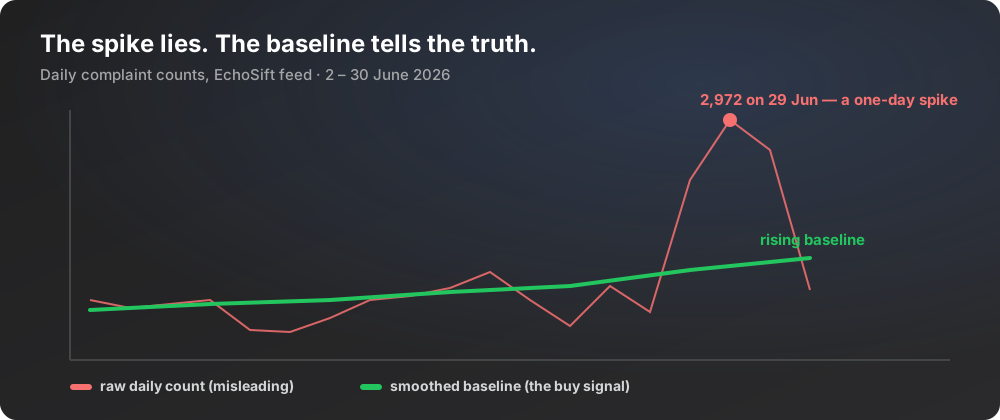
The aggregate also teaches its own first lesson: weekly volume is spiky. On 2026-06-29 the feed logged 2972 complaints in a single day, well above the surrounding baseline, driven by whatever the news cycle and release calendar happened to produce. A day like that tells you almost nothing on its own. What you are hunting is a cluster whose baseline is drifting upward, not a lone spike a viral thread produced and Thursday erased.
Three live clusters from the current feed
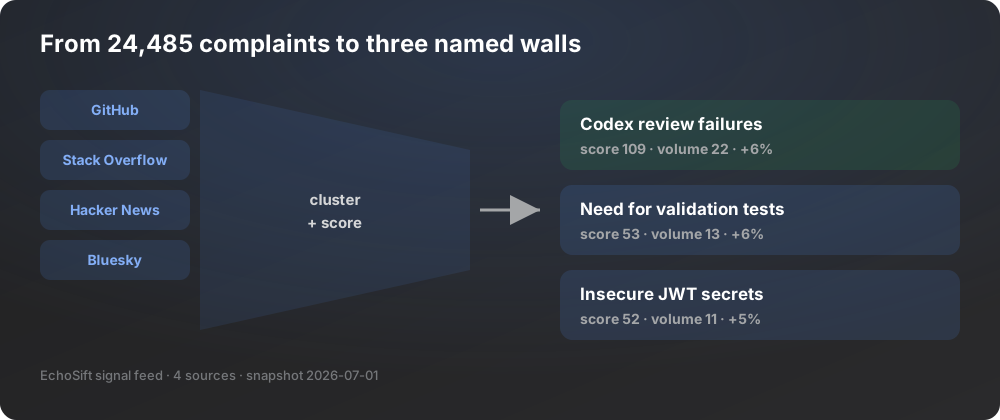
Here are three real clusters pulled straight from the current feed. They are unglamorous on purpose. Durable opportunities usually are. The exciting-sounding ones are typically either crowded or imaginary.
| Cluster on the 2026-07-01 snapshot | Pain score | Complaints | Growth |
|---|---|---|---|
| Codex review failures and misconfigurations | 109 | 22 | 6% |
| Need for enhanced validation tests | 53 | 13 | 6% |
| Insecure JWT secret configuration | 52 | 11 | 5% |
Codex review failures and misconfigurations. The highest-scoring cluster in the current snapshot. The theme underneath it: review runs that fail to execute properly because of environment misconfiguration, sometimes producing false clean passes that let broken work through. A false clean pass is a particularly nasty class of pain because it is invisible at the moment it hurts. The developer trusts a green result and finds out later that the check lied. Anything that makes automated review trustworthy again, or that surfaces the misconfiguration before the false pass, is selling reliability to people who did not realize their safety net had a hole in it.
Need for enhanced validation tests. The recurring theme is that ordinary linting is not enough to catch structural problems in build artifacts, so faulty work reaches deployment before anyone notices. This is a quieter, more structural pain than a hard failure: nobody is fully blocked, but everybody is exposed. Structural pains like this are easy to misread, because the stated complaint (“linting isn’t catching enough”) is rarely the real job (“I need confidence that what I ship is actually well-formed before it ships”). The distance between the complaint and the job is where most founders lose the thread.
Insecure JWT secret configuration. The theme is developers shipping applications with weak or unset JWT secrets because nothing warns them when the environment variable is missing, opening a real security hole. Security-adjacent pains are worth close attention: the cost of the pain is asymmetric and deferred, which means the people feeling it often do not feel it until something goes wrong. A guardrail that fails loudly the moment a secret is missing is selling insurance against a bad day that has not happened yet.
Notice the shared shape. None of these is a sweeping thesis about the future of software. Each is a specific, repeated, nameable wall. That specificity is the asset. You cannot build against “developers want better DX,” but you can absolutely build against “review passes clean when the environment is misconfigured.”
Four questions that turn a gripe into an opportunity
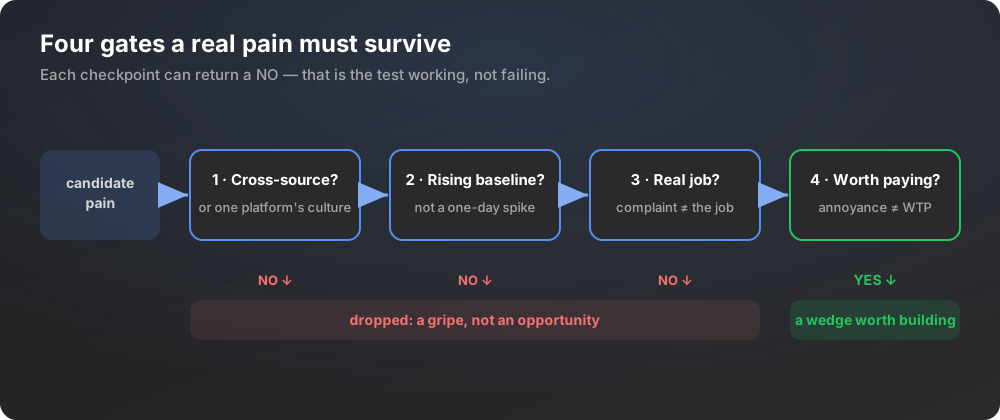
A cluster being real does not make it a business. Run each candidate pain through four questions, and design each question so it can return a clean no. If you cannot find a way for a question to fail, you are not testing the idea. You are rehearsing your enthusiasm for it.
Is it cross-source, or is it one platform's culture?
A complaint that lives only on Hacker News may be a Hacker News mood rather than a market pain. Independent appearance across GitHub, Stack Overflow, and elsewhere is what promotes a gripe to a pattern. This is exactly why the source count matters more than the raw headline volume.
Is the baseline rising, or is it only spiking?
Trust the trend, not the day. A steady 6 percent climb on a modest but growing cluster is more interesting than a huge one-day count that evaporates by the weekend. Founders reliably overweight the spike, because the spike is loud and the baseline is quiet.
Is the stated complaint the real job?
"Linting isn't enough" is a complaint. "I need to know my artifact is well-formed before it deploys" is the job. Build for the job and you have a product; build for the phrasing and you have a forum thread with a landing page.
Would removing this pain be worth paying for?
Some pains are real, broad, rising, and worth exactly nothing, because the people feeling them will never pay to fix it or can route around it for free in minutes. Annoyance is not willingness to pay. This question kills more candidates than the other three combined, and it should be allowed to.
This filter is the same falsification discipline underneath our broader founder’s method for finding startup ideas: a genuine test is one that can return a no, and a candidate that survives several clean nos in a row is the rare one worth your weekend.
How to read a pain point without deceiving yourself
The most common failure is reading your own roadmap into the data. You already have a half-built tool, you go looking for pain that justifies it, and (because the corpus runs into the tens of thousands of signals) you find some.
Confirmation is trivially easy
With 24,485 signals to fish in, you will always find a cluster that flatters the tool you already started. The only defence is to commit to your kill criteria before you look, not after you have found the comforting cluster.
A second failure is treating volume as importance. The largest cluster is not automatically the best opportunity; it is frequently the most crowded, already worked by incumbents who saw the same big number you did. The interesting openings are often mid-volume clusters with real growth and thin competitor density, precisely the combination a naive “top complaints” ranking hides. Sizing that gap properly is its own discipline, the same one behind sharp market research for a developer tool, which is about drawing the wedge narrow enough to win before you widen it.
A third failure is mistaking the absence of a complaint for the absence of a pain. Some of the worst pains are silent, because the people suffering them stopped filing issues and quietly left. The feed only sees what people still bother to report. Treat the low-volume-but-furious clusters with respect. Sustained rage is a stronger willingness-to-pay signal than sheer count.
Narrowing a 2026 pain into a wedge
Suppose the “insecure JWT secret configuration” cluster clears all four questions for you. The jump from “this is a real pain” to “this is my product” is not automatic, and most founders fumble it by trying to solve the whole category in one swing.
The move is to pick the narrowest version of the pain that still has a paying audience. Not “make authentication secure,” which is a decade of work and a graveyard of incumbents. Instead, name three things.
The specific failure mode
A missing secret that produces no warning.
The specific population
Teams deploying a specific framework or platform.
The specific moment it bites
The deploy that silently ships an insecure default into production.
A wedge is a pain filed down small enough to actually win.
Then validate against the same stream you found it in. Go back to the source issues, read the exact language people use, and check whether your proposed fix maps to their words or to your assumptions. If the developers describing the pain never mention the thing you want to build, that is a quiet no worth hearing before you write a line of code.
Authority sources help you size the surrounding context. GitHub’s annual Octoverse report gives you the platform-scale backdrop (which languages and ecosystems are growing) so you can judge whether the population behind a cluster is itself expanding or shrinking. The complaint feed tells you the what; reports like Octoverse tell you the how big and in which direction.
A one-week exercise you can run today
You do not need a platform to begin. This week, choose one developer ecosystem you already know well, and read its issue tracker and its slice of Stack Overflow with a notebook open. Log every repeated wall. After a few days you will have a short list of named pains, and you can run each through the four questions above. That manual motion is the entire method in miniature, and it genuinely works.
It is also slow, partial, and biased toward whatever you happened to read. You will see one platform’s culture, miss the cross-source confirmation, and have no idea whether a cluster is rising or fading because you have no baseline to compare against. That gap is exactly what EchoSift was built to close: it watches GitHub, Stack Overflow, Hacker News, and Bluesky continuously, clusters the complaints into patterns, scores them by volume, cross-source diversity, growth, and recency, and surfaces the durable clusters instead of the daily spikes. Plans start at $39/month. The manual method teaches you to read pain; the tool lets you read all of it at once.
If the deeper question for you is not “what hurts” but “what should I build,” start from the broader founder’s method for finding startup ideas and treat this article as the data layer beneath it.
This article was drafted with AI assistance and reviewed against EchoSift’s proprietary signal data before publishing. All signal figures are live aggregates from EchoSift’s feed as of the 2026-07-01 snapshot.