SaaS Ideas From GitHub Issues: Mining the Backlog Nobody Reads
A repeatable method for turning GitHub wontfix threads, thumbs-up pile-ups, and workaround comments into a defensible dev-tool SaaS, grounded in EchoSift's live signal feed.
 Alessio Persico Founder of EchoSift



On the 2026-07-02 snapshot, EchoSift’s feed held 24,613 clustered signals, and a large share of them trace back to a single behavior: a developer opening a GitHub issue because a tool did not do the thing they expected, annoyed enough to type the failure out for strangers. Multiply that by a popular repository and you are looking at a running, timestamped, upvotable wishlist that the maintainers themselves publish for free. For a founder hunting a dev-tool wedge, reading that data deliberately is where product ideas come from.
The problem is that almost nobody mines it deliberately. This piece is about the opposite habit: reading the boring parts of the backlog on purpose, learning which signals inside an issue actually predict willingness to pay, and turning a cluster of related complaints into a product a specific group of developers would hand you money for.
The habit that wastes the backlog
Founders skim a trending repo, notice a loud thread, and mistake the loudness for a market.
Every figure below comes from EchoSift’s own signal feed, which continuously ingests developer complaints from GitHub issues, Stack Overflow questions, Hacker News threads, and Bluesky posts and clusters them into recurring patterns. Where a number appears, it is what the feed held on the snapshot date.
Table of Contents
- Why the backlog beats a survey
- The five signals inside an issue that actually matter
- What the current feed says developers are filing
- From a wontfix thread to a wedge
- Three traps that turn issue-mining into wishful thinking
- A weekend protocol you can run on one repository
Why the backlog beats a survey
A survey answer is filtered through self-image and recency. An issue is filed mid-frustration, by someone who has already tried the obvious fixes and failed. That difference in provenance is the whole reason the backlog is worth reading. Nobody opens an issue to look clever. They open it because a real workflow broke and the free tool in front of them offered no way out.
The GitHub REST API for issues exposes far more than the title and body: reactions, comment counts, labels, state, and the timeline of who touched the thread and when. Each of those fields is a small behavioral vote, and behavioral votes are worth more than stated preferences. A thumbs-up on a two-year-old issue is a person going out of their way, today, to say “me too” about a problem the maintainer has not solved. That is a stronger buy signal than any answer to “would you use a tool that…”.
Crucially, the interesting issues are usually the ones the maintainers cannot or will not fix. The backlog does not just tell you what hurts. It tells you what the incumbent has explicitly declined to relieve.
Why out-of-scope is the gold seam
A feature request closed as out-of-scope is a maintainer publicly declaring "this is a real need, but not my job." Repeated across many repos in the same ecosystem, that sentence is often the outline of a product.
The five signals inside an issue that actually matter
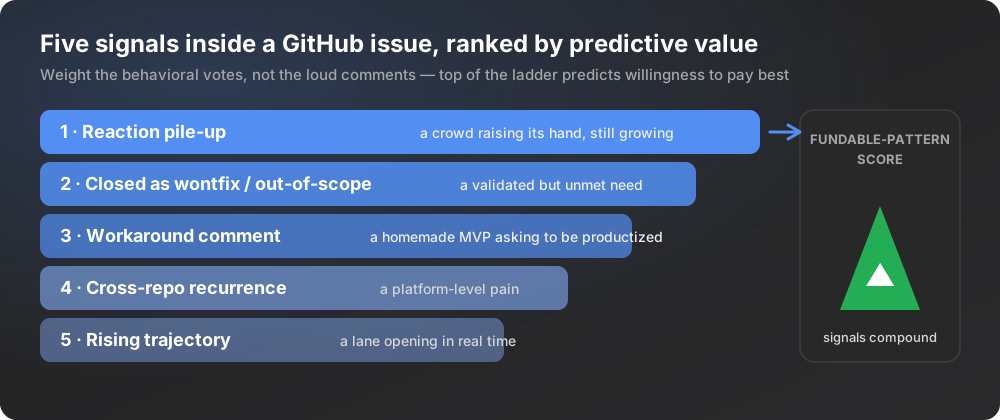
Reading issues at random will drown you. The skill is knowing which fields to weight. Five signals, in rough order of predictive value, separate a fundable pattern from a lone gripe.
Reaction pile-up. An issue with a large, still-growing count of thumbs-up or heart reactions is a crowd raising its hand. One person is an anecdote; forty people reacting over eighteen months is a market subscribing to a problem. Sort a repo’s issues by reactions and you are reading its demand curve.
Closed as wontfix or out-of-scope. These are the gold seams. The need was validated by a maintainer’s attention and then deliberately left unmet. A cluster of wontfix threads across sibling repositories in one ecosystem is the clearest “build me” the internet offers.
The workaround comment. Somewhere in a long thread, a developer posts “here’s the hacky script I use to get around this.” That comment is a hand-built, unmaintained, undistributed version of your product. If several threads contain different homemade workarounds for the same underlying gap, the market has already built the MVP for you and is asking someone to productize it.
Cross-repo recurrence. A complaint that appears in one project is that project’s local quirk. The same complaint independently filed against three unrelated projects in the same ecosystem is a platform-level pain, and platform-level pains are where durable tools get built. This is why searching issues across GitHub, not one repo at a time, matters, which the GitHub issue search documentation makes tractable with qualifiers like is:issue, label:, and reaction sorting.
Trajectory, not just volume. A pain that was filed constantly two years ago and has gone quiet is a problem someone already solved, or one that stopped mattering. A pain whose filing rate is climbing is a lane opening in real time. The tracker gives you dates on every event; use them to tell a rising cluster from a fading one.
What the current feed says developers are filing
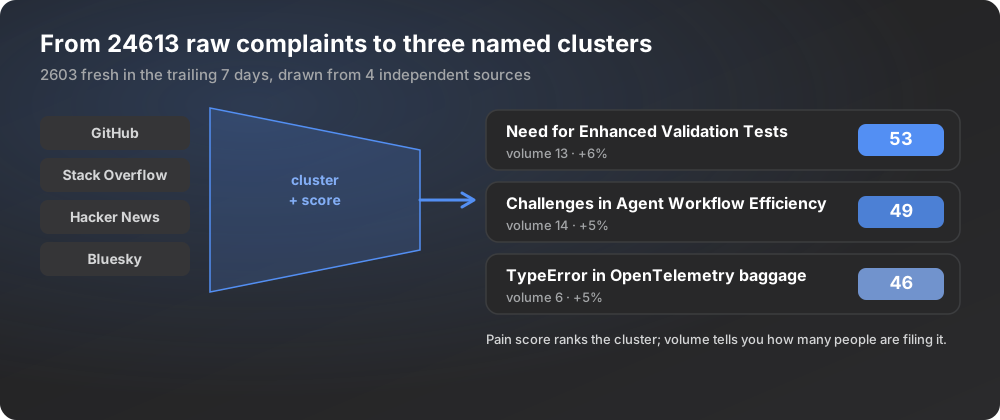
Individual repositories give you depth on one project. To see the cross-source shape, you need to zoom out to the aggregate. This is what the 2026-07-02 snapshot held.
GitHub issues are one input among those four, but they are the input where a complaint is most tightly bound to a specific, nameable software surface, which makes them the easiest to act on. Three clusters from the same snapshot show the texture of what founders can mine right now.
| Cluster on the 2026-07-02 snapshot | Pain score | Volume | Growth |
|---|---|---|---|
| Need for Enhanced Validation Tests | 53 | 13 | ✓ 6 percent |
| Challenges in Agent Workflow Efficiency | 49 | 14 | ✓ 5 percent |
| TypeError in OpenTelemetry baggage retrieval | 46 | 6 | ✓ 5 percent |
Under the first, the recurring theme is that ordinary linting does not catch structural problems in build artifacts, so faulty work reaches deployment before anyone notices. This is exactly the kind of pain that surfaces as issues filed against build-tool and CI repositories, where a maintainer often responds that broader validation is out of scope for their tool. That “out of scope” is the tell.
Under the second, the highest-volume of the three, the theme is documentation sprawl, unenforced best practices, and thin metrics leading to silent failures in agent-based workflows. Volume that high across a young category is a signal that the tooling has not caught up to how people are actually working, which is the classic condition for a new tool to slot in.
The third is narrower and more technical: a specific function assumes conditions about its input that do not always hold, throwing an error that traces back to an upstream context-handling problem. Narrow, technical, reproducible pains like this rarely become giant markets, but they frequently become sharp, defensible tools for the exact population that hits them, precisely the wedge a solo founder can win.
Note also the shape of the raw stream. On 2026-06-29 the feed logged 2969 complaints in a single day, well above the surrounding baseline. A day like that tells you little on its own; a maintainer merging a controversial change, or a release going out, can produce a one-day flood that says nothing about durable demand. What you are hunting inside the issue data is a cluster whose baseline is drifting up week over week, not a spike a single popular thread produced and next Tuesday forgot.
From a wontfix thread to a wedge
Suppose you have found it: a cluster of issues, across several repos in one ecosystem, all circling the same unmet need, several closed as out-of-scope, a couple with homemade workaround scripts, reaction counts still ticking up.
The move that kills most of these opportunities
Announcing you have found your idea and starting to build the general solution.
The discipline is to narrow before you build. Take the broadest phrasing of the pain and file it down to the smallest version that still has a paying audience. Not “make CI validation better,” which is a decade of work against entrenched incumbents. Instead: the specific structural check that keeps getting requested, for the specific build tool whose maintainers keep declining it, delivered at the specific moment the artifact is produced. A wedge is a pain sharpened until one clearly-defined group would pay to have it removed and no incumbent is racing you to remove it.
Then validate against the same tracker you found it in. Go back to the source issues and read the exact words developers use to describe the pain and their workarounds. If your proposed product maps to their language, you are onto something. If you find yourself translating their complaint into your solution (adding capability nobody asked for), that gap between their words and your plan is a quiet no worth hearing before you write code. This is the same falsification habit that underpins the broader founder’s method for finding startup ideas: a real test is one that can come back negative, and an idea that survives several of those negatives is the rare one worth a weekend.
Three traps that turn issue-mining into wishful thinking
Loud does not mean large. A single thread with hundreds of heated comments feels enormous, but a flame war is often one contentious decision, not a market. Sustained, distributed, cross-repo demand beats one viral argument every time. If the pain lives in exactly one thread, you have found a controversy, not an opportunity.
Maintainer priorities are not user priorities. An issue can sit open for years not because the need is weak but because the maintainer is a volunteer with a day job and a different roadmap. Read the reactions and the “still hitting this in 2026” comments, not the label the maintainer applied in a hurry. The absence of a fix is frequently a resourcing story, not a demand story, and resourcing gaps are exactly what a focused commercial product fills.
Free workarounds cap your price. If the homemade script in the thread genuinely solves the problem for the people who need it, your paid product has to be dramatically better, not marginally. The existence of a good-enough free workaround is not proof of demand; it can be proof that nobody will pay, because the pain is already relieved for free in ten minutes. Willingness to pay is the question that kills the most candidates, and it deserves to. Sizing that honestly is its own discipline, the same one behind sharp market research for a developer tool.
| Three traps | What it feels like | What actually predicts a payer |
|---|---|---|
| One loud thread, hundreds of comments | ✗ A market | ✓ The same pain filed across many repos |
| A stale maintainer label from years ago | ✗ Dead demand | ✓ Reactions still ticking up in 2026 |
| A good-enough free workaround | ✗ Proof of demand | ✓ A pain worth paying to remove |
A weekend protocol you can run on one repository
You do not need a platform to start. This weekend, pick one repository in an ecosystem you know well and its two or three closest siblings, then work the trackers in order.
Sort each tracker by reactions
Read the top of the list with a notebook open, not the trending tab.
Log the reaction count
The behavioral vote, and whether it is still climbing.
Log the closing label
Whether the thread was closed as wontfix or out-of-scope.
Log the workaround
Whether anyone posted a homemade script to get around the gap.
Check the siblings
Whether the same pain shows up in a neighbouring repo.
After a few hours you will have a shortlist of candidate wedges, each already carrying evidence of demand.
That manual motion is the entire method in miniature, and it genuinely works on a single ecosystem. It is also slow, narrow, and blind to trajectory: you are reading one platform’s culture, you cannot easily see whether a cluster is rising or fading, and you will miss the cross-source confirmation that separates a GitHub quirk from a real market pain. That gap is exactly what EchoSift was built to close. It watches GitHub, Stack Overflow, Hacker News, and Bluesky continuously, clusters the complaints into patterns, and scores them by volume, cross-source diversity, growth, and recency so the durable clusters surface instead of the daily noise. Plans start at $39/month. The manual protocol teaches you to read a backlog; the tool lets you read every backlog at once.
If the deeper question for you is less “which issues” and more “what should I build,” start from the founder’s method for finding startup ideas and treat GitHub issues as one of the richest data layers beneath it, alongside the broader developer pain points of 2026.
This article was drafted with AI assistance and reviewed against EchoSift’s proprietary signal data before publishing. All signal figures are live aggregates from EchoSift’s feed as of the 2026-07-02 snapshot.