A Minimum Viable Product for Developer Tools
How to scope an MVP for a developer tool: pick the pain with the most independent owners, ship one job done completely as a runnable artifact, and measure whether it gets run twice.
 Alessio Persico Founder of EchoSift



A minimum viable product for a developer tool is the smallest thing a developer can actually run that resolves one real problem from start to finish. Not a landing page, not a waitlist, not a slide describing five features you will ship later. Developers do not convert on promises. They convert on a command that works, an action that goes green, an extension that removes a step they used to do by hand. So the whole art of scoping a dev-tool MVP is choosing which single job to finish completely, and having the discipline to leave everything else out until that one job earns the right to grow.
This is the part most first versions get wrong. They spread a thin layer of effort across a broad surface, ship something that half-solves five things, and then wonder why nobody comes back. A tool that does one job completely beats a tool that half-does five, because a developer will wire the first one into their workflow and forget the second one exists by lunch. This guide is about picking that one job with evidence, scoping it so it can fail honestly, and shipping it as something runnable rather than something described.
Pick the pain with the most owners, not the loudest thread
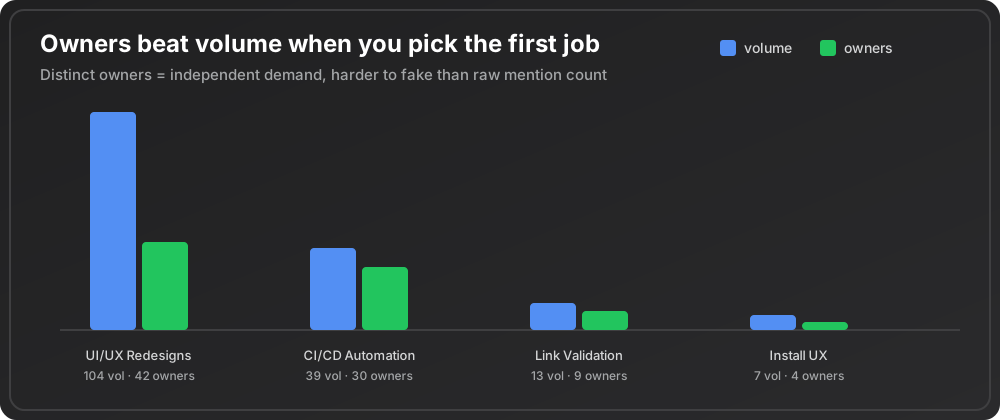
The tempting way to choose your first feature is to find the topic with the biggest pile of complaints and build for that. Volume is a trap. A single frustrated maintainer can file forty comments about one annoyance, and a scraper will happily count all forty. What you actually want is the number of distinct people, teams, or repositories independently hitting the same wall, because that count is much harder to fake and it maps directly to how many separate buyers your MVP could serve.
EchoSift tracks this as an owner count, and the gap between owners and raw volume is where the real signal lives. In the pain data behind this post, “Need for Comprehensive UI/UX Redesigns” carried a score of 86.3 across a volume of 104 mentions and 42 distinct owners. That is broad, independent demand, but it is also enormous in scope: a full redesign is a company’s worth of work, not a weekend MVP. Set against that, “Need for Improved CI/CD Automation” scored 79.7 on a volume of 39 with 30 owners, a pain that is nearly as widespread but far more scopeable into a single first action. When you rank candidate wedges, sort by owners first and by how small the complete fix is second. The winner is usually not the loudest topic. It is the one where many separate people want the same narrow thing.
The MVP is a single job done completely
Once you have a pain with real independent demand, resist the urge to widen it. The strongest dev-tool MVPs are almost embarrassingly narrow, and that narrowness is a feature. Consider three small signals from the same dataset.
| Small signal | Score | Volume and owners | The done state |
|---|---|---|---|
| Improve installation UX for Node.js packages | 50.4 | 7 mentions, 4 owners | Four steps drop to one, or it stays annoying |
| Migrating from ts-jest to Vitest | 69.6 | 16 mentions, 7 owners | The migration completes, or it does not |
| Automated Markdown Link Validation Request | 65.9 | 13 mentions, 9 owners | The broken link is caught, or it is missed |
None of these will headline a conference. Each is exactly the right shape for a first version, because each describes a single, self-contained job with an obvious done state. When the job has a crisp finish line, you can build the whole thing, not a demo of the thing, and a developer can judge it in one sitting. Marty Cagan’s writing on the minimum viable product makes the same point from the product side: the MVP is a prototype meant to learn, not a stripped-down release you are proud of. For a dev tool, the fastest way to learn is to give someone a complete small job and watch whether they run it again.
If your first version needs a paragraph to explain what it does, it is too wide. Cut until the pitch is one sentence and the job is one verb.
Scope so it can return a no
An MVP that cannot fail is not a test, it is a launch dressed as one. Eric Ries frames the whole method in The Lean Startup around validated learning: you ship the smallest thing that lets reality tell you whether the assumption underneath your idea is true or false. That only works if you decide, before you build, what a no looks like.
For a dev tool, the no is silence in the logs
It is rarely a survey answer. If you ship a CLI and nobody runs it a second time, the market just answered. So write the failing condition down first: "if fewer than half the people who install this run it again within a week, the wedge is wrong."
That sentence protects you from the most expensive mistake in dev tooling, which is mistaking politeness for demand. This is the same discipline that governs a good problem interview, where you study what people actually did rather than what they say they might do. The MVP is the interview’s continuation by other means: instead of asking whether they would use it, you hand them the tool and let their behavior answer. If you are still deciding whether the pain is real at all, do that upstream work first with a proper validation pass before you write a line of the tool.
Ship a runnable artifact, not a description
Developers evaluate tools by running them, so the MVP has to be something they can run. That usually means one of a few concrete shapes: a command-line binary, a single GitHub Action, an editor extension, a small hosted endpoint with a copy-paste snippet. What it does not mean is a marketing site with a “request access” button, because a signup tells you someone liked your copywriting, not that your tool solved anything. The scope of a first artifact should be small enough to build in the time you would otherwise spend polishing a launch page. Basecamp’s Shape Up calls this the appetite: you fix the time and flex the scope, rather than fixing the scope and letting time explode. For an MVP the appetite is short on purpose, because a wedge that takes three months to build is a wedge you have not tested.
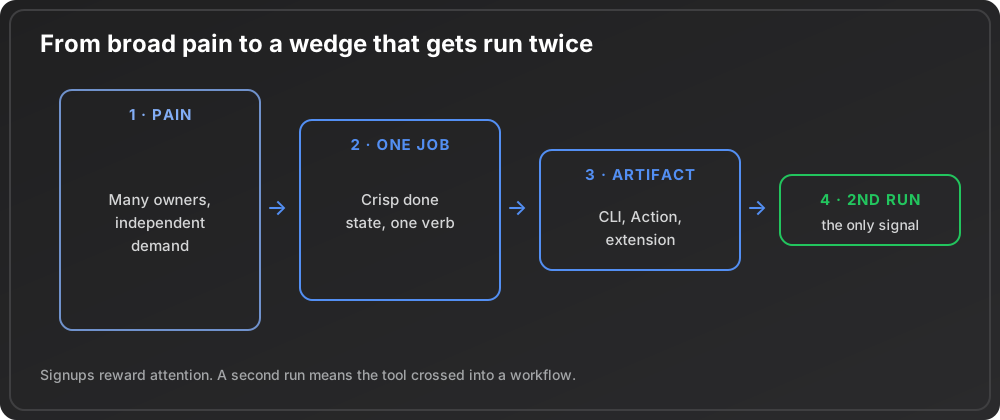
The runnable-artifact rule also changes what you instrument. Ignore vanity counts and track the single number that maps to your wedge: the second run. Signups, stars, and page views all reward attention, and attention is easy to buy and impossible to bank. A second run means the tool crossed the line from curiosity into workflow, and that crossing is the only early signal that reliably predicts retention. If you can only measure one thing in your first version, measure whether the same person invokes it twice, and treat what they ask for on the third run as the first real input for turning feedback into a product roadmap.
Read whether the wedge is surging or mature
Two wedges with similar demand can still call for different timing, and the growth data tells you which is which. “Need for comprehensive environment variable documentation” scored 109.4 with 28 owners and a growth ratio of 6, having jumped from a single recent mention to seven. That is a surging pain, and surging pains reward speed because you are riding a wave while it is still forming. A mature, steady pain like the CI/CD automation signal above rewards a different posture: less urgency, more focus on doing the job better than the incumbents who already serve it. Neither is better in the abstract. The point is to read the slope, not just the height, before you commit your short build window.
Context helps you avoid overreacting to a single spike. The dataset behind this post spans 4 sources and reads like this.
A wedge that only looks urgent because of one loud day is not urgent. A wedge whose owner count and growth both climb across the window is the one worth a fast MVP. When you can see the correlated evidence across GitHub, Stack Overflow, Hacker News, and Bluesky at once, the difference between a real trend and a noisy afternoon becomes obvious, which is the whole reason to look at pain signals in aggregate rather than one thread at a time. For a wider view of where these narrow wedges cluster into buildable categories, the developer tools opportunities breakdown is a good companion, and once your first version is live the signals of product market fit are what you watch next.
A short checklist for your first version
Before you build, answer five questions in one line each.
Rank the candidates by owners
Which pain has the most independent owners relative to its scope?
Name the job
What is the single job your MVP finishes completely, start to finish?
Choose the artifact
What runnable thing will you hand a developer, rather than describe to them?
Decide the no in advance
What behavior counts as a failure, written down before launch?
Match the slope to your window
Is the pain surging or steady, and does your build window match it?
If you cannot answer all five crisply, you are not scoping an MVP yet, you are still choosing one, and that is upstream work worth finishing first.
The reward for this discipline is speed with a spine. You ship one small thing that fully solves one real problem for many independent people, you measure the one number that cannot be faked, and you let the second run tell you whether to widen your circle into a deliberate beta program for a dev tool. That is a far faster path to a tool developers keep than any broad first release, and it fails cheaply when it fails, which is exactly what an MVP is for.
This article was drafted with AI assistance and reviewed against EchoSift’s proprietary signal data before publishing.