10 Tech Business Online Opportunities for 2026
Explore 10 actionable business online opportunities for 2026. Find validated, developer-focused SaaS and platform ideas to build your next venture.
 Alessio Persico Founder of EchoSift



What do the real business online opportunities of 2026 have in common that the usual listicles miss? They attach to a specific, recurring complaint rather than a generic category. Surface-level advice like starting a store, launching a course, or building an audience sounds appealing, but it is too broad to be useful for technical founders who can ship products. Broad advice attracts broad competition.
The better opportunities sit inside repeated complaints from people with urgent workflows. Developers are unusually good customers for this because they leave public traces. They file GitHub issues, argue on Hacker News, post workarounds in Reddit threads, and document pain in community forums. If you know how to read those signals, you can spot demand before a category gets crowded.
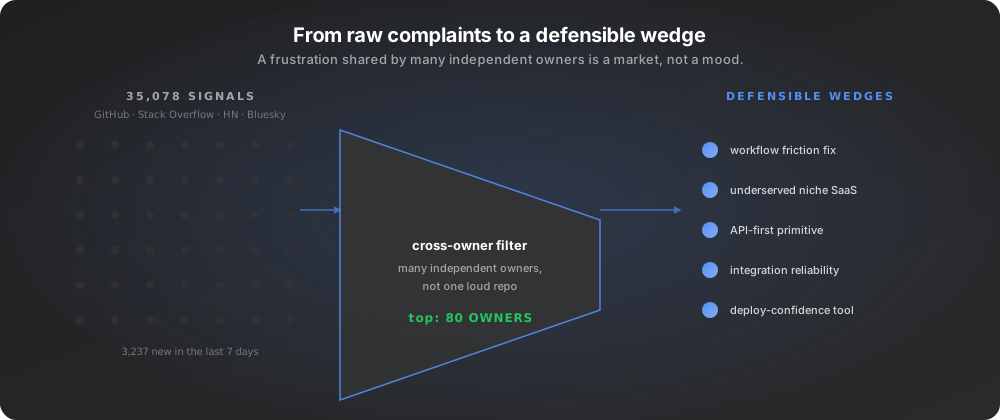
That trace is bigger than most founders assume, and it keeps growing. Here is the 2026-07-30 snapshot across GitHub, Stack Overflow, Hacker News, and Bluesky.
That corpus has grown by roughly 9,000 clustered signals since the version of this article published in early July. The strongest signals in it aren’t loud one-off rants. They recur across many independent teams, and the widest of them, a demand for automated CI/CD workflows, reached those 80 distinct project owners. When a frustration shows up in that many separate repos and threads, it’s a market, not a mood.
That matters more now because online business isn’t a side channel anymore. In the United States, e-commerce has climbed to a double-digit share of total retail sales and keeps rising quarter over quarter, as the U.S. Census Bureau’s e-commerce retail sales data tracks. That’s a large operating environment, not a niche. Even small shifts in where work happens online create room for new infrastructure, workflow software, and specialized tooling.
The mistake I see most often is founders choosing a model before choosing a pain point. They decide they want to build “an AI dev tool” or “a B2B SaaS” and only then go hunting for a use case. Strong businesses usually form in the opposite direction. A narrow frustration appears first. The product shape comes later.
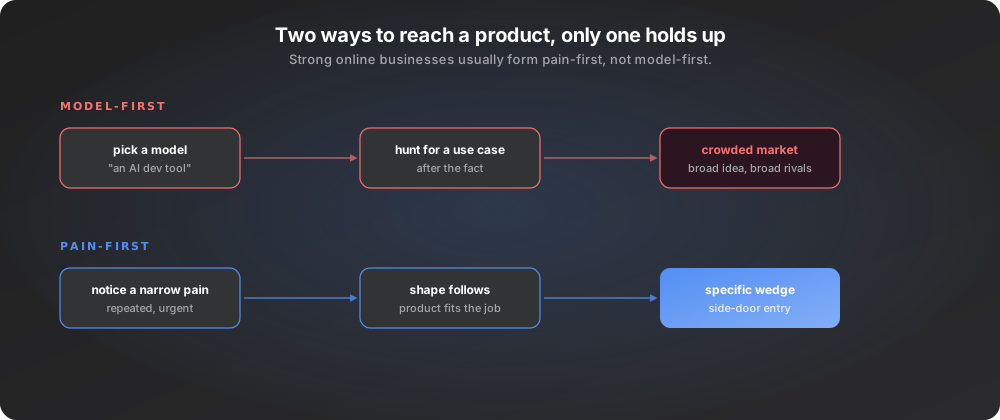
The ten opportunities below are the ones I’d take seriously if I were looking for high-impact, developer-centric business online opportunities for 2026. They aren’t generic internet business ideas. They’re wedges into real software budgets, technical workflows, and platform dependency.
Table of Contents
- Developer Tool SaaS
- Niche SaaS for Underserved Segments
- Open-Source Monetization
- API-First B2B SaaS Platform
- Developer Education and Training Platforms
- Developer Community and Networking Platforms
- B2B Marketplace and Integration Platforms
- Data and Analytics Solutions for Developers
- Specialized Code Search, Documentation, or Knowledge Tools
- DevOps, Infrastructure, and Deployment Automation Tools
- Comparison at a glance
- From Idea to Execution Your Next Move
1. Developer Tool SaaS
GitHub Copilot, Vercel, Linear, Supabase, and Figma all point to the same truth. Developers will pay for tools that remove friction from work they already do every day. The strongest developer tool SaaS products don’t ask teams to invent a new habit. They compress an existing one.
Pick one painful minute in the workflow
A good wedge is often smaller than founders expect. Not “improve software quality.” More like “make flaky test failures reproducible,” or “show why this CI run broke without reading five logs.” IDE extensions, CLI helpers, deployment diagnostics, local environment managers, and code review utilities all work when they solve a problem that’s both frequent and annoying.
One reason this remains one of the best business online opportunities is that new technical buyers keep entering the market. The U.S. Chamber of Commerce reports annual business applications have remained above 5 million since 2020, with 1.75 million already filed by April 2024, and small businesses account for 43.5% of U.S. GDP and nearly half of American employment, according to the U.S. Chamber small business data center. That creates a steady stream of small teams that need lightweight tools before they’re ready for enterprise platforms.
Developers also reward visible craftsmanship. Shipping on GitHub, publishing a polished README, and answering issues quickly often beats expensive launch marketing. If you want a longer catalog of specific wedges in this space, our breakdown of developer tools opportunities for 2026 walks through where the sharpest gaps sit right now.
What to validate before writing much code
Use a short validation pass before building the bigger roadmap.
Repeated complaint language
The same frustration appears across issues, discussions and forum posts, in wording close enough to be the same problem.
Existing workaround behavior
Teams already stitch together shell scripts, internal docs or Notion pages to cope, which means budget is already being spent in time.
Urgency signal
The pain blocks merges, releases, onboarding or incident response, so it cannot be deferred quietly.
Credibility path
You can earn trust through open code, public docs or a useful free tool rather than through a sales motion.
All four are checks you can run in an afternoon, and they share one bar: if a developer can ignore your tool for a week with no consequences, the pain isn’t sharp enough yet.
A useful way to spot rising pain before it hardens into a crowded market is to monitor clustered complaints across technical communities with a tool like EchoSift for developer pain signals.
2. Niche SaaS for Underserved Segments
Most founders say they want an unsaturated market. Then they choose a category that’s obviously broad. Scheduling. CRM. Notes. Automation. That’s usually the wrong move.
Go narrow on need, not just industry
There’s a more useful way to think about selling to small businesses. They’re a huge collective market, but segmenting only by industry is often too crude. Better segments group customers by needs like reliability, ease of use, cloud integration, customization, and price. Our guide to market research for founders walks through how to find those needs-based segments before you commit. That’s the wedge.
So instead of building “project management for agencies,” build a workflow product for agencies that need client-visible approvals, audit trails, and easy white-label handoff. Instead of “forms for healthcare,” build intake logic for a specific clinic process that generic form builders handle badly. Notion, Airtable, Calendly, Typeform, and Zapier all grew because they nailed a concrete job before they spread horizontally.
What good niche positioning looks like
The right niche SaaS feels unfairly specific. It should make a buyer say, “This was built for teams like mine.”
What unfairly specific looks like
Your buyer can describe the pain in one sentence. The incumbent solves it poorly because it serves too many use cases. Your demo shows domain understanding rather than software polish. And you can land with one team before trying to own the whole company.
What doesn’t work is cosmetic verticalization. Changing homepage copy to mention legal, fintech, or healthcare won’t save a generic product. Buyers notice fast when the workflow is still generic under the hood. For concrete examples of specific-enough wedges, our list of niche SaaS ideas shows what “unfairly specific” looks like in practice, and the method for locating one from evidence rather than intuition is in our walkthrough of how to find underserved developer niches.
Practical rule: unsaturated markets are rarely broad categories. They’re usually narrow buyer groups with obvious needs that larger vendors decided were too small to prioritize.
3. Open-Source Monetization
Open source is still one of the cleanest entry paths into developer markets, but only when the free product is useful on its own. If the open-source repo exists mainly as a funnel for your paid plan, developers can tell.
Adoption first, monetization path second
The better pattern is familiar. Publish something that solves a real implementation problem, which is easier to identify than founders assume: the issue trackers of established projects are full of requests their maintainers have declined or deferred, and our guide to finding product gaps in open-source tools covers how to read those declines as a build list. Let teams self-serve. Then monetize through hosted infrastructure, managed operations, enterprise controls, support, compliance features, or administrative workflows. GitLab, Docker, Elastic, MongoDB, and PostHog all illustrate versions of that path.
This model works because adoption and trust reinforce each other. Developers can inspect the code, try the tool locally, and recommend it internally without a procurement process. That lowers the initial trust barrier in a way pure closed-source SaaS often can’t.
The hosted version is usually the cleanest revenue layer. Teams may love running things themselves at first, but once reliability, security, maintenance, and access control become painful, they’ll often pay to stop owning that burden.
Where founders get this wrong
The common mistakes are predictable. They overprotect premium features, underinvest in docs, or fail to define governance early. Contributor friction can sink momentum faster than product defects.
A better approach is to separate user value from operational burden. Give away the thing developers need to adopt. Charge for the part companies don’t want to manage.
| Layer | What belongs in it | What it buys you |
|---|---|---|
| Free | Core utility, local use, a clear API, real documentation | ✓ Adoption and internal recommendation with no procurement step |
| Paid | Hosting, audit controls, backup, team permissions, scale management | ✓ Revenue from the burden companies do not want to own |
| Neither | Arbitrary locks on basic workflows | ✗ It makes the open product feel fake, and developers can tell |
That split only holds under one condition. Open source only helps if people would still use the free product even if your company disappeared tomorrow. If you can’t answer that, you don’t have an open-source strategy. You have a lead magnet.
4. API-First B2B SaaS Platform
API-first businesses can become excellent business online opportunities because they embed inside other products. Once your service sits in auth flows, payments, messaging, analytics pipelines, or data sync jobs, switching gets expensive.
Developer experience is the product
Stripe, Twilio, Auth0, SendGrid, and Datadog didn’t become defaults because APIs are glamorous. They won because developers could understand the first call, get to a successful response quickly, and trust the docs. In API products, documentation, SDKs, examples, error messages, rate-limit behavior, and dashboard clarity are part of the product, not support material.
That’s why feature bloat hurts early API startups. A small but dependable API with clean naming, stable objects, and good quickstarts beats a giant surface area nobody wants to integrate. If the sandbox is confusing, the sale is already in trouble.
A practical validation path
I’d validate an API platform in this order.
Start with the trigger event
What event in another system causes your API to be called at all?
Map the failure cost
What breaks in the buyer's product if your service is down or returns something wrong?
Test with one language first
Don't spread across five SDKs before the core use case works in one.
Watch implementation friction
Every support ticket during integration is product research you did not have to pay for.
The strongest wedges often come from complaints about incumbent tools that are powerful but unpleasant. When developers keep saying an API is hard to debug, hard to paginate, or impossible to test locally, that’s not chatter. That’s a buying signal.
Practical rule: don’t sell “infrastructure.” Sell a dependable primitive that another product team can build around.
5. Developer Education and Training Platforms
Education looks crowded until you narrow it to what employers, teams, and working developers need right now. Generic “learn to code” plays are tired. Targeted training tied to specific tools, stacks, and work outputs still has room.
The weakest of the ten by direct signal support
Among the fifteen highest-scoring pain signals in the 2026-07-30 snapshot, none sit in education or training, while six sit in DevOps and infrastructure. That doesn't disqualify the category, since training demand usually trails tooling pain rather than appearing beside it in an issue tracker. It does mean you validate this one with interviews and a paid pilot cohort, not with complaint volume.
A good example of the broader online shift shows up in the UK, where the proportion of retail sales made online sat near 28.8% in mid-2026 and has stayed well above pre-2020 levels, according to the Office for National Statistics retail sales bulletin. The exact consumer pattern isn’t the same as developer training, but it shows how quickly digital habits can lock in when behavior shifts.
Teach what teams need now
Egghead, Codecademy, Treehouse, Scrimba, and Bloom Institute of Technology each represent different slices of this market. The opportunity isn’t just courses. It’s structured skill transfer for messy transitions like moving to TypeScript, adopting platform engineering practices, learning observability, using a new AI coding workflow, or becoming productive in a framework that teams have started hiring for.
That’s why I’d favor cohort products, guided labs, review-based programs, or team upskilling packages over static video libraries alone. Static content becomes a commodity fast.
Why project-based training wins
Project-based training sells better because buyers can see the output. A developer finishes with a deployed service, a test harness, a production-ready integration, or a monitored application. That’s more persuasive than a completion badge.
The trade-off is support load. The more practical your training becomes, the more feedback, review, and troubleshooting you’ll need to provide. That’s exactly why the business can work. Harder-to-deliver education is harder to commoditize.
Practical rule: if your training output is a thing the learner can put in production on Monday, you have a real product. If it’s a certificate, you have a commodity.
6. Developer Community and Networking Platforms
Most founder-built communities fail because they start with the community itself. That’s backwards. Developers don’t join because a founder created “a place to connect.” They join because there’s a recurring reason to return.
The caveat from the previous section applies here too. Community platforms leave almost no trace in clustered complaint data, so nothing in the current snapshot argues for or against this category. Treat that silence as a reason to validate by hand, not as evidence of an empty field.
Community only works when utility comes first
Dev.to, Hashnode, Indie Hackers, Buildspace, and product-specific communities work because they combine identity with practical value. People publish, ask, get feedback, find collaborators, discover tools, or access jobs. A plain forum with no differentiated behavior usually stalls.
The strongest entry point is one narrow use case. Maybe it’s code review swaps for indie developers. Maybe it’s implementation notes for a new framework. Maybe it’s hiring signals for platform engineers. Community grows around a repeated action, not around a vague promise of belonging.
If you can remove the social layer and the product still helps someone, you’ve probably found the right starting point for a community business.
Monetization follows trust
Sponsors, premium memberships, recruiting products, events, and paid directories all can work. But they work after the group develops taste and trust. If the early member experience feels like lead generation in disguise, quality drops quickly.
A few practical rules matter more than founders think.
Define who the space is for
Broad membership rules create weak norms, and weak norms are what a community dies of.
Moderate early and visibly
Good communities don't stay good by accident, and the first ten enforcement decisions set the tone.
Create a signature format
Office hours, teardown threads, weekly demos and build logs give the group a recognizable rhythm to return for.
Protect signal
A smaller useful network beats a larger one full of reposted noise.
Practical rule: for developer-focused business online opportunities, communities are rarely standalone at first. They often become the distribution layer for a product, job board, research service, or education business.
7. B2B Marketplace and Integration Platforms
Integration businesses are less flashy than pure SaaS, but they often monetize faster because they attach directly to existing spend. If one team already pays for HubSpot, Stripe, Slack, Salesforce, Shopify, or a vertical tool, reducing the work between those systems has immediate value.
Start with one workflow that already exists
Zapier, Make, Stripe Connect, the HubSpot App Marketplace, and the Twilio Marketplace all show the same pattern. Buyers don’t want “integrations” in the abstract. They want one workflow to stop breaking. Lead routing. Invoice reconciliation. Identity syncing. Usage data export. Ticket enrichment.
Market-entry discipline matters. The U.S. SBA recommends evaluating demand, market size, pricing, saturation, competitor strengths and weaknesses, and barriers to entry when assessing an opportunity, as outlined in the SBA guide to market research and competitive analysis. In integration markets, saturation shows up fast because many connectors look similar on the surface, so it pays to run the checklist in our piece on the signs of a saturated market before committing a quarter to a connector that already has four free equivalents.
What makes integrations commercially useful
The useful integration products do one of three things well. They shorten setup, reduce breakage, or make edge cases manageable. If you can’t clearly improve one of those, your integration is probably a feature, not a company.
A few filters I’d use.
High-value source and destination
The connected systems already matter to revenue or operations, so breakage is expensive and visible.
Messy schemas or workflows
Manual mapping pain is where the real product value hides, and it is what a thin connector cannot copy.
Ongoing operational need
The sync has to keep working rather than complete once, which is what turns it into a subscription.
Partner potential
The ecosystem owner has incentives to let you exist rather than to absorb you at the next release.
If you’re analyzing developer complaints around integration pain, the language itself often reveals the opportunity. Terms around sync failure, brittle webhooks, duplicate records, and retry logic usually point to workflows with budget behind them. A useful companion for spotting recurring integration pain across multiple platforms is browsing EchoSift’s pattern-level signals.
Feature or company
If your integration only shortens setup, it's a feature. If it also reduces breakage or handles the edge cases, it's a company.
8. Data and Analytics Solutions for Developers
Developers don’t need another dashboard. They need faster answers. That’s the defining frame for observability, error monitoring, product analytics, log search, and performance tooling.
Own one layer of visibility
Datadog, New Relic, Sentry, Honeycomb, and Grafana all succeeded by becoming associated with a specific operational job, even when their products later expanded. Error tracing. Metrics visualization. Distributed debugging. Service health. A younger company should usually start even narrower.
The strongest wedge here is a question teams ask under pressure. Why did latency spike after deploy? Which release introduced this exception? Why is one customer segment failing this workflow? If your product helps answer one painful question faster than the incumbent, you have something.
How to avoid building another dashboard nobody opens
A lot of analytics startups fail because they optimize for visual sophistication over operational usefulness. Engineers won’t keep visiting a beautiful product that doesn’t change what they do next. Alerts, context, suggested next steps, and integration into the tools they already use matter more than ornamental charts.
I’d also pay attention to trust and data handling in this category. Teams buying analytics or monitoring products want clarity about collection, storage, and deletion behavior. If privacy language is vague, sales get harder.
The benchmark worth building against
Better observability products don't just report facts. They reduce the time between "something is wrong" and "we know what to do next."
9. Specialized Code Search, Documentation, or Knowledge Tools
Codebases get harder to work with long before they get large by enterprise standards. Shared understanding breaks first. Search relevance, stale docs, scattered snippets, and tribal knowledge become the bottleneck.
Search is only half the product
Tools like Read the Docs, DevDocs, Stack Overflow, Tabnine, and GitHub Copilot all touch this problem from different angles. The opening is often not “better documentation” as a broad promise. It’s a narrower problem like “find the right internal example,” “trace the usage of this component,” or “surface the exact setup step hidden in three repos and one wiki.”
That’s why a strong product in this space usually combines retrieval with context. Raw search is table stakes. Developers need ranking that understands symbols, versions, frameworks, ownership, and recency. They also need links back into the workflow. IDE access, pull request context, docs generation pipelines, and repository-level permissions matter.
Where the wedge usually is
The best entry points are ugly internal problems. Teams have docs, but nobody trusts them. There is search, but results are noisy. There are snippets, but they aren’t version-aware. There’s AI help, but it hallucinates because retrieval is weak.
A practical way to assess this category is to look for four signals.
Documentation drift
Teams complain that setup instructions are outdated, and nobody trusts the docs they already have.
Search abandonment
Developers ask a colleague before using the existing search tool, which is the clearest verdict search can receive.
Repeated onboarding confusion
New hires keep getting stuck in the same places, which means the knowledge is not written down anywhere durable.
Knowledge trapped in chat
Answers live in Slack threads rather than in systems that survive a search six months later.
Practical rule: this category gets more valuable as team complexity rises. You don’t need a massive company to sell it. You need a team that’s tired of wasting engineering time rediscovering its own knowledge.
10. DevOps, Infrastructure, and Deployment Automation Tools
Infrastructure products win when they remove anxiety, not when they advertise complexity. Vercel, Netlify, Railway, Render, and Fly.io each gained traction by making deployment feel safer and faster for a specific type of developer.
Remove the scary step
The buying trigger is often emotional as much as technical. Teams fear broken deploys, unclear rollback paths, bad secrets handling, drift between environments, and brittle CI pipelines. A product that removes one of those fears can earn immediate attention.
This is why “all-in-one cloud platform” is usually a weak starting position. “Deploy a preview environment from every pull request with sane defaults” is much stronger. “Move this containerized app live without hand-rolling infra” is stronger. “Make background jobs deployable by a product engineer without touching Kubernetes” is stronger.
The buying trigger is operational confidence
Founders often underestimate how much pricing clarity matters here. Infrastructure buyers hate opaque bills and surprising usage behavior. If your product saves time but introduces cost ambiguity, you’ve created a new source of stress. Metering and packaging deserve the same care as the deploy path itself, which is the argument we make in detail in how to price a developer tool.
Of the ten entries here, this is the one the current data supports most directly. Six of the fifteen highest-scoring signals in the 2026-07-30 snapshot sit in the DevOps and infrastructure macro area, covering CI/CD automation, git worktree management, pull request review handling, and MCP server configuration. The widest of them, the demand for automated CI/CD workflows, spans 80 distinct project owners.
I’d validate this category by watching what teams still do manually near release time. That’s usually where the underlying pain lives.
Manual approval rituals
People rely on tribal checklists before deploy, which means the pipeline does not encode what the team actually believes.
Rollback fear
Teams avoid releases late in the week or before events, which is a confidence problem wearing a scheduling costume.
Environment mismatch
Local, staging and production behave differently in ways that cost real hours to diagnose.
Framework churn
New runtimes and deployment patterns keep opening fresh operational gaps faster than incumbents close them.
Each of those four is a place where a team’s process has outrun its tooling. That is where the opportunity is strongest, because incumbents are powerful but overbuilt for this buyer. Many teams don’t want more control. They want fewer ways to make expensive mistakes.
Comparison at a glance
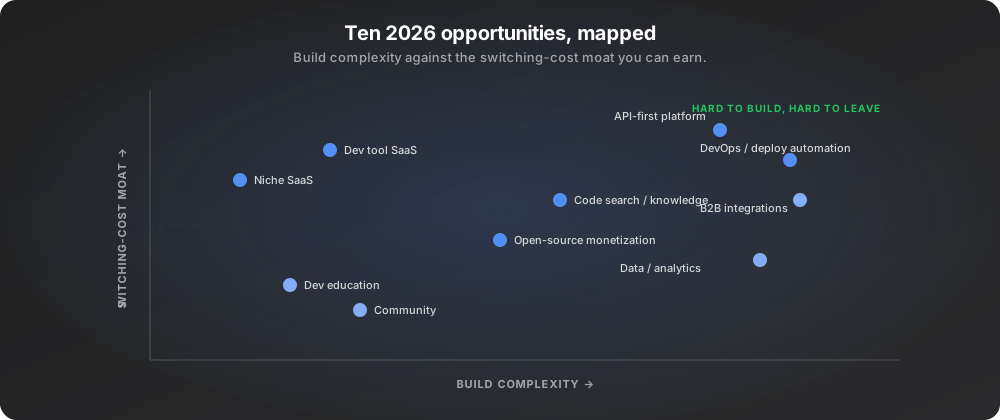
What each opportunity asks of you, and what it pays back:
| Item | Complexity | Resources | Outcomes |
|---|---|---|---|
| Developer Tool SaaS | Moderate-High | Modest dev, community ops, light infra | High LTV, organic growth, strong retention |
| Niche SaaS for Underserved Segments | Low-Moderate | Sales, marketing, domain experts | Premium pricing, low churn, capped scale |
| Open-Source Monetization | Medium | Community ops, dev resources, hosting | Rapid adoption, slower revenue, multiple streams |
| API-First B2B SaaS Platform | High | Significant engineering, docs, dev support | Predictable usage revenue, high switching costs |
| Developer Education and Training | Moderate | Content creators, instructors, ops | Recurring revenue, outcome-driven retention |
| Developer Community and Networking | Moderate | Community ops, moderation | High engagement, sponsor and recruiting revenue |
| B2B Marketplace and Integration Platforms | High | Large dev team, partnerships, maintenance | Multiple channels, strong ecosystem effects |
| Data and Analytics for Developers | High | Scalable pipelines, data eng, ops | High retention, usage-aligned revenue |
| Specialized Code Search and Knowledge Tools | Medium-High | ML/search expertise, repo integrations | Frequent usage, time-saving ROI |
| DevOps and Deployment Automation Tools | High | Substantial infra, engineering, support | Enterprise potential, long contracts |
And where each one’s edge sits, with the move that most often decides whether you get it:
| Item | Advantages | Quick tip |
|---|---|---|
| Developer Tool SaaS | Vocal early adopters, low CAC | Start narrow, build in public, free plan |
| Niche SaaS for Underserved Segments | Faster dominance, high ARPU | Validate with 50+ customers, be 10x better |
| Open-Source Monetization | Low CAC, contributions, trust | Differentiate hosted, choose license carefully |
| API-First B2B SaaS Platform | Network effects, stable revenue | Prioritize DX, generous free plan |
| Developer Education and Training | Multiple streams, measurable outcomes | Emphasize placement, target underserved tech |
| Developer Community and Networking | Network effects, low marginal cost | Start niche, moderate hard, signature events |
| B2B Marketplace and Integration Platforms | Ecosystem lock-in, high switching costs | Launch with high-value integrations |
| Data and Analytics for Developers | Continuous data moat, clear ROI | Solve one pain first, free dev plan |
| Specialized Code Search and Knowledge Tools | High daily value, AI-enhanced relevance | Integrate with IDEs, narrow use case |
| DevOps and Deployment Automation Tools | Large TAM, recurring revenue | Trivial onboarding, transparent pricing |
From Idea to Execution Your Next Move
These ten ideas are real business online opportunities, but none of them are good just because the category sounds attractive. Category selection helps. Pain selection matters more.
The strongest patterns across all ten are consistent. A useful product starts where people already feel the problem. It doesn’t ask them to imagine a future need. It attaches to a broken handoff, a repeated debugging task, an unreliable deploy, an ugly integration, a stale documentation loop, or a gap in the way a niche customer segment gets served. That’s why generic founder advice often fails. It starts with business model preference instead of user pain.
There’s another reason to be selective. Markets online keep expanding, but expansion alone doesn’t make your wedge good. More commerce, more software usage, and more digital workflows create room for new products. They also attract more builders. You don’t win by entering a growing market with a broad idea. You win by entering a growing market with a specific complaint, a credible point of view, and a product scope small enough to ship before the window closes.
If I were prioritizing from this list, I wouldn’t begin with TAM slides or abstract trend decks. I’d begin with live evidence. This is the same “notice, don’t brainstorm” approach we lay out in how to find startup ideas: I’d collect repeated complaints from GitHub issues, Reddit threads, Hacker News posts, changelog comments, Discord communities, and support forums. Then I’d sort them by a handful of practical questions.
Does the problem interrupt revenue, delivery, compliance or reliability?
If it interrupts none of the four, it is an irritation rather than a budget line.
Are people already paying indirectly, through time, headcount or workarounds?
Money that is already moving is far easier to redirect than money that has to be found.
Can I explain the value in one sentence without jargon?
If the sentence needs a diagram, the wedge is still too wide.
Can one person or a small team build a narrow version quickly?
The window closes while you are staffing up for the general case.
Is there a credible path to trust with this buyer?
Developers buy from proof, so plan the proof before the positioning.
That last point matters a lot in developer markets. Developers don’t buy from positioning alone. They buy from proof. Working docs. Fast issue responses. A clean API. Honest limitations. A repo they can inspect. A free plan that isn’t insulting. Clear migration instructions. Real examples. If you can’t earn trust in public, many of these opportunities will stay out of reach.
Loud is not the same as fundable
Some problems are loud because they're impossible to solve cleanly, and others because the market is already locked by platforms with deep distribution. The useful signal is repeated pain plus a visible gap in current solutions.
Separating the two has its own method, which we set out in how to measure demand for a SaaS idea.
For most founders, the best move is to pick one category from this list and reject the others for now. Then narrow again. Don’t build “developer analytics.” Build “release regression detection for teams using modern frontend frameworks.” Don’t build “integration software.” Build “reliable sync between two tools used by one customer segment.” Don’t build “developer education.” Build “guided migration training for teams adopting a specific stack.”
That’s how online businesses get traction without massive funding or broad brand reach. They enter through a side door, prove value in one painful workflow, and only then expand.
If you want a disciplined way to do that, use a signal-gathering workflow instead of guessing. Watch where technical complaints cluster. Read the wording people use. Check whether the problem persists across communities and owners. Then build the smallest product that makes one recurring frustration easier to survive.
If you’re evaluating business online opportunities in developer markets, EchoSift is built for exactly that job. It helps founders and product teams spot rising pain signals across developer communities, separate repeat problems from one-off noise, and choose sharper wedges before they become crowded.
This article was drafted with AI assistance and reviewed against EchoSift’s proprietary signal data before publishing. All signal figures are live aggregates from EchoSift’s feed as of the 2026-07-30 snapshot.