How to Find Underserved Developer Niches: The Owner-Count Signal
A method for spotting underserved developer niches by reading how many independent projects hit a problem, grounded in EchoSift's live developer signal feed.
 Alessio Persico Founder of EchoSift



Six months into shipping, a small group of developers were each filing nearly identical reports: Windows sandbox initialization kept hanging inside Codex. By the time the pattern appeared as a distinct cluster in EchoSift’s feed, 60 mentions from 6 independent owners had accumulated, each team reinventing the same workaround with no dedicated tool to help them. That combination, enough pain to fund a product and few enough builders that the space stays open, captures what an underserved developer niche looks like in practice. Finding it consistently requires a specific instrument: the count of how many independent projects hit a problem, not the raw volume of how loudly they discuss it.
This piece is about one number that tells you whether a developer problem is crowded or wide open: how many distinct projects independently run into it. Call it the owner count. A high owner count means the pain is common knowledge, which means tooling already exists and competitors already circle it. A low owner count paired with real intensity means a genuine gap: enough people hurt to fund a product, few enough builders noticing that you could own the space before anyone else arrives.
Every figure below is a live aggregate from EchoSift’s signal feed, which continuously reads developer complaints and questions across GitHub, Stack Overflow, Hacker News, and Bluesky and groups them into recurring patterns. Where a figure appears, it is what the feed held on the snapshot date.
Table of Contents
- Why owner count beats raw volume
- The crowded pole: many owners, no opening
- The underserved pole: few owners, deep pain
- The concentration ratio that ranks a niche
- Three ways the owner count lies
- A weekend protocol for finding your niche
Why owner count beats raw volume
Volume is the number everyone reaches for first, and it is the number that misleads first. A problem with a thousand mentions feels enormous, but if those mentions come from a handful of very loud projects, the market underneath is small. Conversely, a problem with modest total mentions can hide a wide audience if each mention comes from a different team that arrived at the wall separately.
Owner count is the antidote. It counts distinct sources, not repeated cries. When forty separate projects raise the same complaint without coordinating, that is forty independent confirmations that the problem generalizes. When two projects generate a hundred mentions between them, that is two very unhappy teams and possibly a niche of exactly two. The distinction is the whole game, because a fundable product needs many buyers, and owner count is your cleanest early proxy for how many buyers exist.
This is also why owner count is the crowding dial. A high count does not just mean the problem is real, it means the problem is known. Known problems attract builders. By the time forty projects are complaining publicly, several founders have read the same threads you are reading, and a few tools already ship. The paradox of picking the loudest problem is that its loudness is the very signal that summoned your competition. The long tail of demand is where the uncrowded opportunities live, and owner count is how you find the tail without drowning in it. Our guide to developer pain points walks the raw-volume view; this piece is the mirror image, reading the same feed for what is quiet but real.
The crowded pole: many owners, no opening
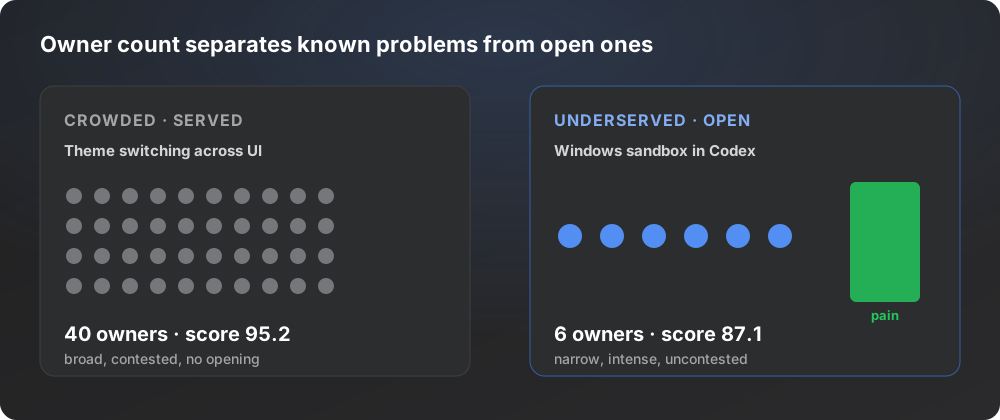
Start by learning what a served problem looks like, so you can recognize its opposite. The feed’s most-owned complaints are almost all in one place: the surface of an app, where every team ships something and every team ships it slightly wrong.
“Inconsistent Theme Switching Across UI Elements” carries a score of 95.2, and on the infrastructure side “Need for Improved CI/CD Automation” reaches a score of 80.9. Neither score is the interesting column.
Read the marks in the table below the other way round from the rest of this site: here red means crowded, not painful. A high owner count is the warning, because it says the space is already taken.
| Crowded complaint | Volume | Distinct owners |
|---|---|---|
| Inconsistent Theme Switching Across UI Elements | 97 | ✗ 40 |
| Layout and Spacing Issues Across UI | 93 | ✗ 35 |
| Broken Navigation and Footer Links | 82 | ✗ 34 |
| Need for Improved CI/CD Automation | 39 | ✗ 30 |
Theme switching is the shape of a solved-but-nagging problem: nearly everyone building an interface hits it, which is exactly why component libraries, design systems, and a dozen theming packages already exist to blunt it. Read those four together and a pattern jumps out. High owner counts, in the thirties and forties, cluster around problems that are universal, generic, and already contested. There is real pain there, but there is no opening there. Any tool you ship into a forty-owner problem lands in a crowd that has been forming for years. These are the entries you learn to skip, not because the pain is fake, but because the market has already answered the call.
The underserved pole: few owners, deep pain
Now the interesting half. Filter the same feed for low owner counts and keep only the entries where intensity stays high, and a very different list appears. These are problems felt hard by a specific, self-selected group that no crowd has gathered around yet.
“Windows sandbox initialization failures in Codex” is the sharpest example. It carries a score of 87.1 on a volume of 60 mentions, but from only 6 owners. Sixty mentions from six projects means each affected team is raising the alarm roughly ten times over: this is not a passing annoyance, it is a wall that a small population keeps slamming into repeatedly. The audience is narrow, the pain per member is severe, and the owner count is low enough that almost nobody is building for them.
The same shape repeats across the developer-tooling frontier, and the skill-sync entry grew fivefold in the window.
| Underserved complaint | Score | Volume | Distinct owners |
|---|---|---|---|
| Windows sandbox initialization failures in Codex | 87.1 | 60 | ✓ 6 |
| Improve CI checks for skill sync | 85.5 | 18 | ✓ 8 |
| Issues with AGENTS.md loading in Claude Code | 62.9 | 13 | ✓ 7 |
| Limitations in MCP Tool Configuration | 58.3 | 32 | ✓ 9 |
| Inconsistent workflow YAML linting | 51.9 | 13 | ✓ 7 |
| Need for Benchmarking Infrastructure | 50.2 | 12 | ✓ 6 |
None of those would survive a raw-volume ranking. They are quiet by design, because the audience is small and specialized. But quiet is not the same as absent. Each represents a defined group of developers hitting a genuine wall inside modern agent and CI workflows, with few or no dedicated tools pointed at them. That is the exact profile of an underserved niche: a real, painful, growing problem that the crowd has not yet found. It is the same instinct behind our catalog of niche SaaS ideas, applied one layer earlier, at the point of detection rather than selection.
The concentration ratio that ranks a niche
Once you have candidates, you need a way to rank them, and dividing volume by owners gives you a fast, honest score. Call it the concentration ratio. A high ratio means each affected team is generating many mentions, which is a strong tell for severity: people do not repeat themselves about problems they can shrug off.
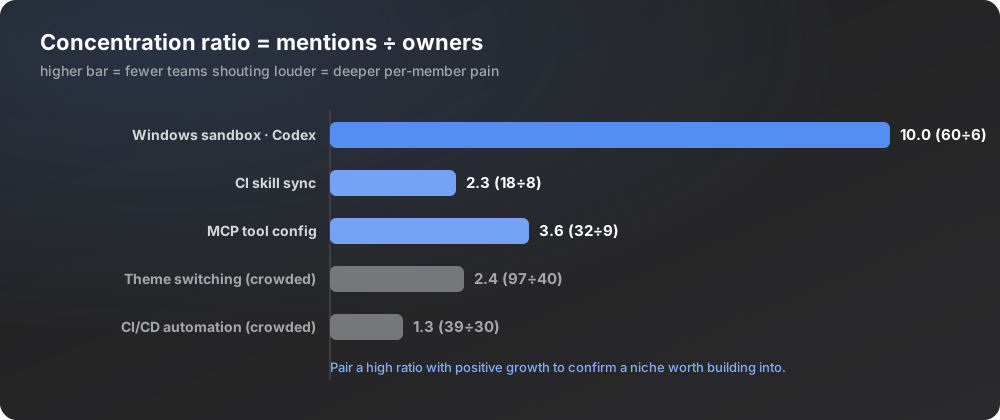
Run the numbers on the underserved list and the ranking clarifies fast. The Windows Codex sandbox entry sits near ten mentions per owner, an extraordinary concentration that says the six affected teams are close to desperate. Compare that to the crowded pole, where the forty-owner theming problem runs closer to two mentions per owner: broad, but shallow per member. The ratio inverts the raw-volume picture, promoting the intense-and-narrow over the broad-and-shrugged.
The ratio is not a verdict on its own. A niche also needs to be growing, because a small problem that is shrinking is a dead end, while a small problem climbing fast is a market forming in real time. The skill-sync CI entry growing fivefold is the kind of trajectory that turns a six-owner curiosity into a real segment within a quarter. Pair a high concentration ratio with positive growth and you have the two-factor test for a niche worth building into. For the broader framing of how a small opening becomes a fundable company, Paul Graham’s essay on getting startup ideas remains the clearest account of why narrow and growing beats broad and static.
Three ways the owner count lies
The method has failure modes, and skipping them is how founders talk themselves into niches that do not exist.
| How the count lies | The tell | The check that catches it |
|---|---|---|
| The single-project mirage | A count of 6 owners that is really forks or satellites of one project | Confirm the owners are independent teams, not one codebase wearing several hats |
| Too small to fund | Three owners with intense pain, which is a consulting gig | Look for the high single digits and low teens, climbing over time |
| Quiet because dead | Few owners and flat or falling mentions | Growth is the tiebreaker: only the ones trending up earn your time |
A real niche needs strangers to arrive at the same wall separately, and a snapshot count is a starting hypothesis rather than proof: you still have to project where it is heading. An emerging niche and a dying one look identical in a single snapshot, which is why direction matters as much as size. This is the same discipline we apply when reading developer-tools opportunities, where a market type without momentum is a trap, a point Steve Blank makes about first principles.
A weekend protocol for finding your niche
Here is a concrete loop you can run in a weekend, using nothing but a feed of developer complaints and a spreadsheet.
Pull the clusters
Take a broad set of clustered problems from whatever sources you can reach, and record volume and owner count for each.
Drop the crowded poles
Everything with an owner count in the thirties or above is already served.
Rank by concentration
Keep the entries where owner count is low but the score stays high, compute volume over owners, and sort descending.
Check the trend
Discard anything flat or falling on your surviving candidates.
Confirm independence
For the top few, open the underlying threads and check the owners are separate teams, not one project's echoes.
What remains is a shortlist of real niches, each with a defined audience, measurable intensity, and little competition.
The manual version of this is slow, because collecting owner counts by hand across four platforms is tedious and error-prone, and the number that matters most is the one that is hardest to gather by browsing. That gathering is exactly what EchoSift automates: it ingests complaints from GitHub, Stack Overflow, Hacker News, and Bluesky, clusters them into patterns, and attaches the owner count and growth to every cluster, so the crowded-versus-open judgment is a column you read rather than a census you conduct. When 2,295 new signals land in a week, the underserved ones are the needles, and owner count is the magnet. For the wider workflow that this method plugs into, start from our hub on how to find startup ideas and treat owner count as the lens you bring to it.
The lesson to carry out of this is small and durable. Loud is not the same as open. The problems worth building into are often the ones a crowd has not gathered around yet, and the fastest way to find them is to stop counting mentions and start counting owners.
This article was drafted with AI assistance and reviewed against EchoSift’s proprietary signal data before publishing.