Developer Tools Opportunities 2026: Where the Open Lanes Actually Are
A live-data read on the developer-tool categories with the most unmet demand in 2026: which pains are compounding, which are noise, and how to pick a lane, grounded in EchoSift's signal feed.
 Alessio Persico Founder of EchoSift


The developer-tool ideas that pay off in 2026 tend to share a shape, and it is rarely the shape of a hot category. They live in lanes: places where a specific pain is rising faster than anyone is shipping a fix for it.
Why a hot category is the wrong filter
A category with buzz usually runs the other way, with three funded incumbents already racing at the same pain, which makes it a knife fight rather than an opening.
So the better question for 2026 skips “which category is hot” and asks where unmet demand is outrunning the supply arriving to meet it.
This piece is about finding and reading those lanes: how to spot a category with structural whitespace, tell an opening from a saturated dead end, and pick one you can actually enter. It assumes the pain is already real. Deciding whether a given pain is durable, broad, and specific enough to build on at all is the job of our developer pain points in 2026 guide, the diagnostic layer beneath this one. Read that to qualify a pain; read this to find the lane and the room to win it.
The numbers below are live aggregates from EchoSift’s signal feed, which ingests developer complaints from GitHub, Stack Overflow, Hacker News, and Bluesky and clusters them into recurring patterns scored by volume, cross-source diversity, growth, and recency. Each figure is what the feed actually held on the snapshot date.
Table of Contents
- Why “opportunity” is a demand question, not a category question
- What the feed is registering right now
- The three open lanes the current data actually supports
- Reading a spike without being fooled by it
- How to convert an open lane into a shippable wedge
- A checklist for pressure-testing any 2026 dev-tool idea
Why “opportunity” is a demand question, not a category question
Take the supply-versus-demand framing seriously and it changes what you actually look at. A lane is not just unmet pain; it is unmet pain that no incumbent is racing to close. Buzz can exist with no such gap: a crowded category where every pain already has three well-funded answers offers you nothing but a knife fight. And a gap can exist with almost no buzz, quietly, because the people living the pain have stopped expecting anyone to fix it and have gone silent about it in public.
That is why “what are the hot categories” is the wrong opening question. The better one is: where is unmet demand accumulating faster than supply is arriving to meet it? You answer that not by reading trend pieces but by measuring the shape of complaint over time.
| Filing rate over time | What it tells you | Reads as |
|---|---|---|
| Flat | Someone is serving the pain well enough | ✗ An equilibrium, not a lane |
| Climbing while no incumbent races to close it | Unmet demand is accumulating faster than supply | ✓ A lane opening in real time |
The second row is the only kind of opportunity worth a founder’s weekend.
The trap is that rising complaint volume and durable demand look identical for the first week. Both produce a lot of noise. The skill this whole article is about is telling them apart: separating the pain that will still be filed next quarter from the one that a single viral thread manufactured on Tuesday and that nobody will remember by the following Monday.
What the feed is registering right now
Start with the aggregate, because a single repository or one loud forum thread will always mislead you about scale. This is what EchoSift’s feed held on the 2026-07-03 snapshot.
Four sources matters more than the raw count: a pain that shows up on only one platform is often that platform’s local culture, while a pain that independently surfaces across all four is a structural problem in how developers work, and structural problems are what durable tools are built on.
The number worth sitting with is the last one. A slightly negative aggregate growth figure is a gift to a founder, not a discouragement. It means the average pain is cooling (the broad market is at or past its peak of complaint), so the handful of clusters that are still climbing against that downward tide are unusually meaningful. When the average is falling and a specific lane is rising, that lane is not riding a general wave; it is genuine, isolated, accelerating demand. Those are the ones to chase.
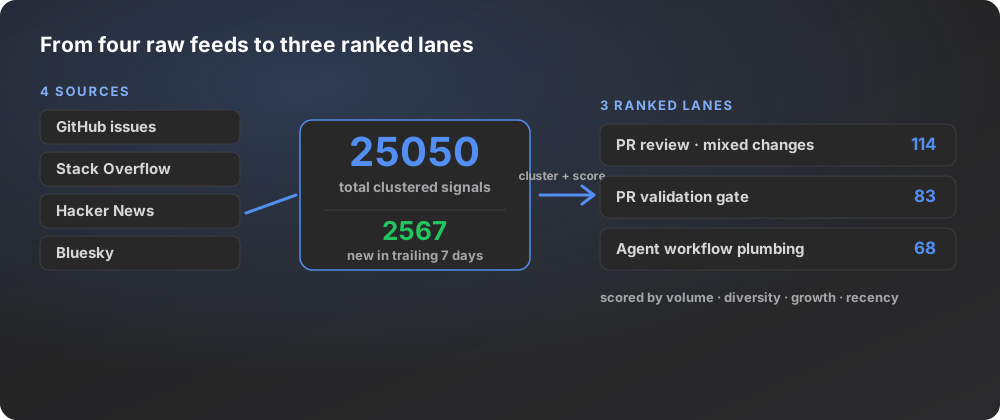
The aggregate sets the stage; the named clusters tell you where the openings are. The next section walks three of them, and reads each as a competitive lane rather than a complaint: the test here is not how much a pain hurts, which our developer pain points guide already covers, but whether an incumbent is already closing it or the space is still open. That supply-side read, who is shipping against a rising pain and who is not, is what separates this guide from a pain inventory.
The three open lanes the current data actually supports
Start with the competitive map, not the complaint. Three lanes on the 2026-07-03 snapshot clear that bar, and each one is defined by a seam no incumbent has claimed.
| Lane | Pain score | Volume | Growth | The un-owned seam |
|---|---|---|---|---|
| Inefficient PR Review Process for Mixed Changes | 114 | 34 | 6% | Between code-review and documentation tooling |
| Inadequate PR Validation Process | 83 | 14 | 8% | Above any single CI vendor |
| Challenges in Agent Workflow Efficiency | 68 | 16 | 7% | The instrumentation under the agents everyone is shipping |
Take the first one. Pull-request review is a crowded lane on paper: GitHub’s native review, GitLab, Graphite, CodeRabbit, and a wave of AI-review startups all compete for it. Yet the snapshot’s highest-scoring cluster, Inefficient PR Review Process for Mixed Changes, sits in a spot none of them has claimed: the seam between code-review and documentation tooling, where a pull request that mixes code and docs fails to get all the required namespaces evaluated in one pass. Every vendor on the code-review side treats docs as out of scope, and every docs tool treats review gating as someone else’s problem. That un-owned seam, not the raw intensity of the pain, is the opening. A focused product can own the mixed-change review pass precisely because the well-funded platforms on either side have each decided the seam belongs to the other, which means no incumbent is sprinting to close it.
The second lane sits deeper in the CI stack, where the incumbents are the pipeline vendors: GitHub Actions, CircleCI, Buildkite, and the checks ecosystem bolted onto them. Inadequate PR Validation Process, growing the fastest of the three, describes validation drift: pull requests stop being checked against the gate consistently, the divergence compounds over time, and no vendor surfaces how bad it has gotten because each one owns only its own slice of the pipeline. The whitespace is horizontal, a validation-consistency layer that sits above any single CI vendor, which is exactly the position an established vendor avoids because it would commoditize its own gate. Lower volume than the first lane, steeper slope: getting in while the lane is still widening beats arriving after it has filled with competitors, and tracking emerging tech trends gives you the tools to spot that window before it closes. Growth is the leading indicator; volume is the lagging one.
The third lane is the one every pitch deck already claims: agent tooling. Challenges in Agent Workflow Efficiency looks crowded, because the model vendors and the agent frameworks are all racing at the same exciting part. But look at where they are actually shipping: prompts, orchestration, model calls. Almost none of them are building the observability, guardrails, and metrics that keep agent workflows from failing silently, because that plumbing is unglamorous and does not demo well. That is the whitespace. The lane worth entering is not “build an agent,” which is a fought-over knife fight, but the neglected instrumentation layer underneath the agents everyone else is busy shipping. High volume in a young category almost always means the plumbing has not caught up to the usage, and the plumbing is where a solo founder can actually win.
Read together, these three clusters share a shape. None of them is a brand-new category. Each is a specific failure inside a workflow developers already run every day: reviewing PRs, validating changes, orchestrating agents. The 2026 opportunities are not in inventing new categories; they are in the neglected mechanics of workflows that have quietly gotten more complex than their tooling.
Reading a spike without being fooled by it
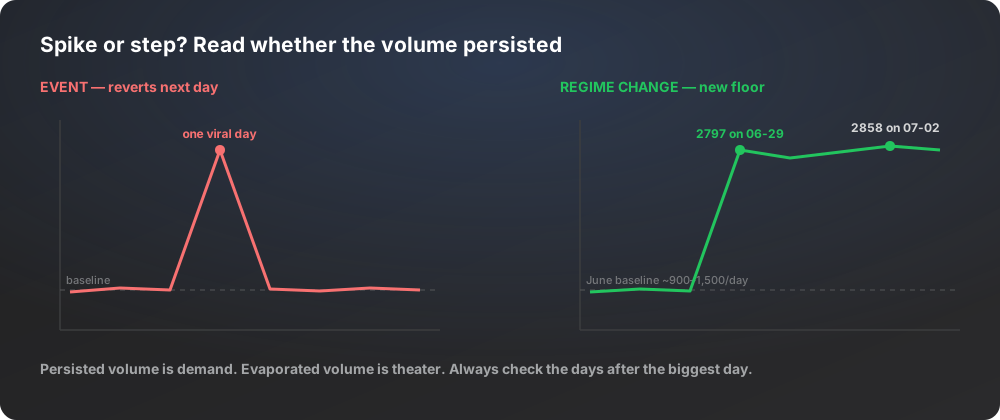
Before you trust any of those clusters, you have to inspect the raw stream that produced them, because aggregate scores can be inflated by a single anomalous day. Look at the daily complaint counts.
The days after the jump held near that elevated level rather than snapping back to the June baseline.
That distinction is the whole game. A spike that reverts the next day is an event: a popular release, a controversial merge, a thread that went viral for reasons that say nothing about durable demand. A spike that becomes the new floor is a regime change: something structural shifted in how much developers are hitting a class of problem, and it stayed shifted. When you are evaluating a cluster, do not just read its score; read whether the elevated volume behind it persisted or evaporated. Persisted volume is demand. Evaporated volume is theater.
This is the single most common way founders misread signal data. They see one enormous day, extrapolate a market from it, and build for a pain that was already receding by the time they finished their landing page. The GitHub REST API for issues gives you timestamps on every event precisely so you can do this check yourself: pull the filing dates, plot them, and ask whether the line is a spike or a step. The falsification habit here, treating a spike as guilty until proven persistent, will save you more wasted months than any clever idea generates.
How to convert an open lane into a shippable wedge
Finding an open lane is only the first move; most founders fumble the second one by trying to serve the whole lane at once. The discipline is to narrow. Take the broadest phrasing of the pain and file it down to the smallest version that still has a paying audience.
Do not build "better PR review"
That is a decade-long war against entrenched incumbents with sales teams.
Build the one specific check that the “mixed changes” cluster keeps asking for, correct multi-namespace evaluation in a single review pass, for the one CI platform whose users complain about it most, delivered at the exact moment the PR is opened. A wedge is a pain sharpened until one clearly-defined group would pay to remove it and no incumbent is sprinting to remove it first. The narrower the initial cut, the faster you reach a developer who says “finally” instead of “interesting.”
Then validate against the source. Go back to the actual complaints and read the exact words developers use: their phrasing, their workarounds, the moment in their workflow where it breaks. If your product maps cleanly onto their language, you are onto something. If you catch yourself translating their complaint into your solution, adding capability nobody requested, that gap is a quiet no worth hearing before you write code. This is the same evidence-led method behind the broader founder’s approach to finding startup ideas: a real test is one that can return a negative, and the ideas worth building are the ones that survive several honest negatives. Sizing the resulting market properly is its own discipline, the one behind sharp market research for a developer tool.
There is also a raw-material question worth answering early: is the pain even observable at the scale you need? For lanes rooted in code hosting, the GitHub issue search documentation lets you count how many repositories independently exhibit the complaint using qualifiers like is:issue, label:, and reaction sorting. If you cannot find the pain repeated across many unrelated projects, you may have found a single team’s quirk rather than a market, and that is far cheaper to learn now than after a launch.
A checklist for pressure-testing any 2026 dev-tool idea
You do not need a platform to start applying this. Take any dev-tool idea you are considering and run it through five questions, each of which can return a disqualifying no:
Is the underlying pain rising or flat?
Flat complaint volume means someone already serves it adequately. You want a line that is climbing, especially one climbing while the broader average is falling.
Does it appear across multiple sources, or just one?
A pain confined to a single platform is often that platform's culture. Cross-source recurrence, the same complaint on GitHub and Stack Overflow and Hacker News, is what separates a structural problem from a local one.
Did the volume persist after its biggest day, or revert?
Re-run the spike-versus-step check. If the pain's elevated volume evaporated within a day, you are chasing an event, not a market.
Is it in a seam an incumbent has declined to own?
The best wedges live between two established categories where each side has decided the gap is the other's responsibility. Un-owned seams are undefended.
Can you name the smallest paying audience?
If the narrowest version of your product still has real buyers, you have a wedge. If narrowing it removes the buyers, the pain may be too diffuse to monetize.
That five-question pass is the entire method in miniature, and it genuinely works by hand on one idea at a time. It is also slow, and blind to trajectory across sources: you can read one platform’s culture manually, but you cannot easily see whether a cluster is rising or fading, and you will miss the cross-source confirmation that separates a real market pain from a single community’s quirk. That gap is exactly what EchoSift was built to close. It watches GitHub, Stack Overflow, Hacker News, and Bluesky continuously, clusters the complaints into patterns, and scores them by volume, cross-source diversity, growth, and recency so the durable, rising lanes surface instead of the daily noise. Plans start at $39/month. The manual checklist teaches you to judge one idea; the tool lets you watch every lane at once.
If your real question is less “which lane” and more “what should I build first,” start from the founder’s approach to finding startup ideas and treat these opportunity lanes as one evidence layer beneath it, alongside the broader developer pain points of 2026.
This article was drafted with AI assistance and reviewed against EchoSift’s proprietary signal data before publishing. All signal figures are live aggregates from EchoSift’s feed as of the 2026-07-03 snapshot.