How to Mine Stack Overflow for SaaS Ideas: Reading Questions as Demand
A field guide to turning unanswered Stack Overflow questions, tag velocity, and view counts into a fundable dev-tool idea, grounded in EchoSift's live signal feed.
 Alessio Persico Founder of EchoSift


Stack Overflow is where a developer lands the moment something breaks and a search engine has already failed them. They are stuck, the clock is running, and they type the exact shape of their problem into a box in front of an audience of millions. The person asking is not filling in a survey or musing on a timeline. They have an unmet need at this minute and are publicly begging a crowd to relieve it. For a founder scanning for a developer-tool opportunity, that stream of half-answered questions is one of the least filtered demand records anywhere online, and hardly anyone reads it with a product in mind.
This piece is about doing exactly that: treating the question feed as a market you can survey, learning which properties of a question predict a paying audience, and grouping a set of related questions into something a defined group of developers would open their wallet for. The method is different from reading a repository tracker, and the difference is the point.
The figures come from EchoSift’s signal feed, which ingests developer complaints and questions from Stack Overflow, GitHub, Hacker News, and Bluesky and groups them into recurring patterns. Each one is what the feed contained on the snapshot date, which is stated so you can check whether the pattern held.
Table of Contents
- Why a question carries different information than an issue
- The five properties of a question worth mining
- What the feed says developers are actually asking
- From an unanswered tag to a product
- Three traps specific to question mining
- A weekend protocol on the Stack Exchange API
Why a question carries different information than an issue
A repository tracker records complaints about one tool from people already using it. Stack Overflow records the moment before a solution exists at all.
| Where you read demand | What the person has already decided | What it therefore tells you |
|---|---|---|
| Repository issue tracker | They picked their tool and want it improved | What one existing product refuses to do |
| Stack Overflow question | Nothing, because no product has earned their loyalty yet | What people cannot accomplish with any tool yet |
The asker in the second row is unattached, frustrated, and openly shopping for anything that makes the pain stop, which is the earliest and cleanest point at which you can meet a future customer.
Stack Overflow also attaches a public scoreboard to every question: an upvote score, a view count, an answer count, and a marker for whether any answer was accepted as correct. Those four numbers turn a single cry for help into a measurable event. A question viewed forty thousand times with no accepted answer is not one person’s bad afternoon. It is forty thousand arrivals at the same locked door, and every one of them would have paid, in time or money, for a key. The Stack Exchange API exposes all of those fields programmatically, which is what makes the site minable at scale rather than one browser tab at a time.
There is a companion method that reads project trackers the same way, covered in our guide to mining SaaS ideas from GitHub issues. Run both and you triangulate: the tracker tells you what an existing tool refuses to do, and the question feed tells you what people cannot accomplish with any tool yet. The overlap between those two lists is where the sharpest opportunities sit.
The five properties of a question worth mining
Scrolling questions at random will exhaust you before it teaches you anything. The craft is knowing which attributes to weight. Five properties, in loose order of how well they predict a fundable pattern, tell a real opening from background noise.
The accepted-answer gap
A question with strong views and no accepted answer is the platform admitting the community has no clean solution. Filter any tag to its unanswered view and you are reading a product brief written by the market.
Views measured against answers
Ten thousand people looked and almost nobody could help. Common pain plus scarce solution is the exact condition a tool can exploit. Many views with many good answers is already solved and worth nothing to you.
The duplicate hydra
When the same question keeps getting asked in slightly different words across months, the chain grows long. People rediscover the pain constantly because the canonical answer does not truly resolve it.
Tag velocity
A tag whose weekly question volume is climbing is a technology being adopted faster than its tooling and documentation can keep up. That lag is a lane opening in real time.
The stale-answer comment
Developers writing under old threads that the top answer no longer works, or that they are still hitting this in 2026, are telling you a solved problem quietly became unsolved again.
What the feed says developers are actually asking
One tag gives you depth on a single technology. To see the shape across sources, you have to widen out to the aggregate. This is the 2026-07-12 snapshot.
Question-shaped pain is a distinct slice of that stream, and four current clusters show its texture.
| Cluster on the 2026-07-12 snapshot | Mentions | Owners | Reads as |
|---|---|---|---|
| Improving README Documentation and Structure | 213 | 115 | ✓ Platform-wide gap, flat trajectory |
| Mismatch Between Local and CI Test Gates | 16 | 8 | ✓ Narrow and accelerating, growth ratio 2.5 |
| Challenges in Expo SDK migration | 8 | 6 | ✓ Narrow and accelerating, growth ratio 3 |
| Mobile layout usability concerns | 26 | 18 | ~ Steady demand, no lane opening |
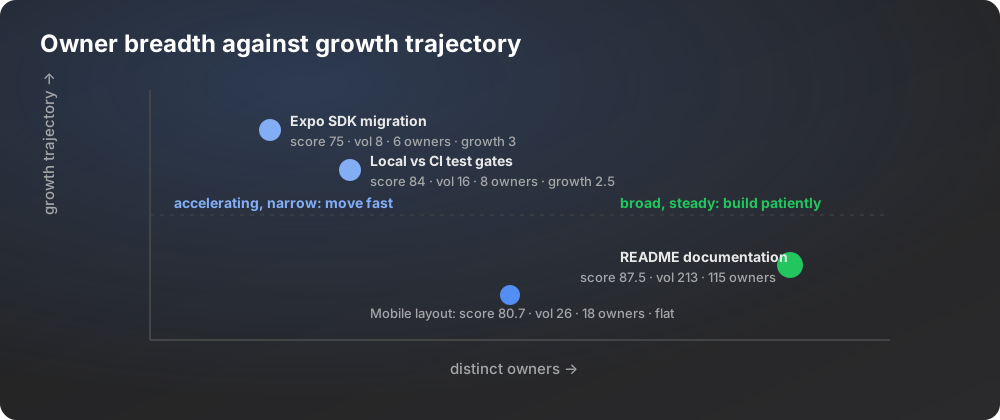
Read the owner column first. Improving README Documentation and Structure scores 87.5, and the striking figure is its 115 distinct owners. When a pain shows up independently across more than a hundred separate projects, it stops being one team’s quirk. Documentation quality is exactly the chore every maintainer resents and few solve well, which is why a tool that drafts or audits it has an audience measured in the thousands.
Then read the growth column. Challenges in Expo SDK migration scores 75 on a tiny base, and a growth ratio of 3 means the mention rate roughly tripled between windows: the classic version-bump profile, where a framework ships a new SDK, the upgrade path is rough, and nobody has published a reliable migration story. Mismatch Between Local and CI Test Gates scores 84 and is climbing at 2.5, and tests that pass on a laptop then fail in CI are a maddening, hard-to-reproduce class of problem getting more common rather than less. Mobile layout usability concerns at a score of 80.7 is the contrast: steady demand with no acceleration, a real market that rewards a patient product rather than a fast one.
Note the raw stream too. On 2026-07-10 the feed logged 2449 mentions in a single day, sitting near a multi-day plateau above the earlier baseline. A single tall day usually says little: a viral thread or a big release can flood the feed for a moment and tell you nothing durable. What you hunt inside question data is a tag whose baseline drifts up week after week, not one afternoon that spiked and was forgotten by the weekend.
From an unanswered tag to a product
Say you have found it: a tag whose unanswered view is thick with high-view, zero-accepted-answer questions, a duplicate chain that keeps regrowing, comments announcing the old fix broke again. The urge is to declare victory and build the grand, general solution. That urge has buried more of these openings than any competitor ever did.
The grand general solution has buried more of these openings than any competitor
"Make framework upgrades painless" is a career against well-funded incumbents. The one migration path, for the one SDK, that keeps producing unanswered questions, delivered at the exact step where developers get stuck, is a business you can start this month.
The discipline is to shrink the problem before you write a line. A defensible entry point is a pain narrowed until one clearly bounded group would pay to remove it and no established player is sprinting to remove it first.
Then falsify your read against the same questions that produced it. Reread the actual wording developers use, the errors they paste, the half-solutions they try.
If your planned product speaks their language, you have something. If you catch yourself translating their plain question into a grander vision they never asked for, that distance between their words and your plan is a quiet no, and it is far cheaper to hear now than after launch. This is the same falsification habit that underpins the broader founder’s method for finding startup ideas: a real test is one that can come back negative, and an idea that survives a few negatives is the rare one worth building.
Three traps specific to question mining
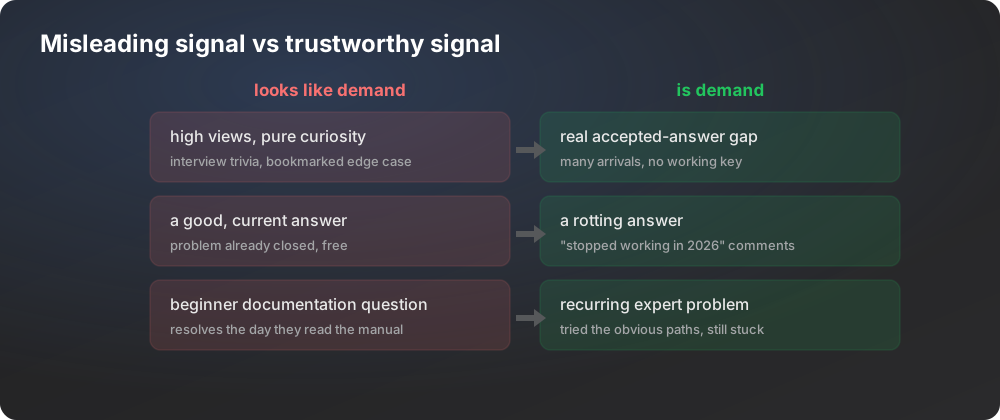
High views can mean curiosity, not pain. Some questions rack up enormous view counts because they are interview trivia or a fascinating edge case people bookmark, not because anyone is blocked. Views alone are attention. Cross-check with the accepted-answer gap and the duplicate chain before you treat a big number as demand, or you will build for spectators instead of sufferers.
A good answer already kills the market. If the top answer genuinely solves the problem and stays current, the question is closed and so is your opportunity. The value lives in questions where the answers are absent, contradictory, or rotting. An asker who found a clean copy-paste fix in thirty seconds will never pay for a product, because the pain was relieved for free before you arrived.
Beginner questions are not markets. A tag is full of questions that exist only because the asker skipped the documentation. Those are learning moments, not unmet needs, and they resolve permanently the day the person reads the manual. Weight recurring questions from experienced developers, the ones who tried the obvious paths first, over the flood of first-week confusion. Telling the two apart is most of the skill, and it is the same judgment behind reading the broader developer pain points of 2026 without mistaking noise for signal.
A weekend protocol on the Stack Exchange API
You do not need infrastructure to begin. This weekend, pick a technology you know well and pull its tag through the Stack Exchange API.
Pull one tag you know well
Query it for questions sorted by views, which puts the widest arrivals at the top of the list.
Filter to no accepted answer
What remains is the set of problems every working programmer who looked has failed to close.
Record four fields per question
View count, answer count, whether it carries a duplicate link, and the date of the most recent comment.
Rank and read the comments
After an hour you have a shortlist of unmet needs, each already carrying evidence that a crowd tried and failed.
That manual pull is the whole method in miniature, and it genuinely works on a single tag. It is also slow, blind to the other sources, and hard to trend: you are reading one platform, you cannot easily see whether a cluster is accelerating, and you miss the cross-source confirmation that separates a Stack Overflow curiosity from a real market pain. Widening the lens matters too, because developer questions correlate with what the field is adopting, a shift you can read in the Stack Overflow Developer Survey 2025. Closing that gap is exactly what EchoSift was built for. It watches Stack Overflow, GitHub, Hacker News, and Bluesky without pause, groups the questions and complaints into patterns, and scores them by volume, source diversity, growth, and recency so the durable clusters surface above the daily churn. Plans start at $39/month. The weekend protocol teaches you to read one tag. The tool lets you read every tag at once.
If your real question is less “which questions” and more “what should I build,” start from the founder’s method for finding startup ideas and treat Stack Overflow as one of the richest layers of evidence beneath it, alongside the GitHub issue method for the tools developers have already chosen.
This article was drafted with AI assistance and reviewed against EchoSift’s proprietary signal data before publishing. All signal figures are live aggregates from EchoSift’s feed as of the 2026-07-12 snapshot.