Micro-SaaS Ideas: What a Micro-SaaS Is, and Which Ones Have Demand
A micro-SaaS is one narrow problem served by one person. What that means in practice, why most micro-SaaS ideas fail, and which small problems show real demand.
 Alessio Persico Founder of EchoSift



A micro-SaaS is a software product scoped to one person: one problem, one kind of customer, usually one screen that does the entire job, and no hiring plan behind it. Revenue in the low thousands per month is a normal result and often the intended one. That is the appeal, and it is a real appeal, because it puts a working software business inside the reach of a developer with evenings and a weekend.
The same constraint is what kills them, and it kills them in a way that feels like discipline from the inside. A micro-SaaS needs a problem narrow enough for one person to own completely, and carried by enough separate people to pay for it. Those two requirements pull in opposite directions, and the second one leaves no trace on a whiteboard. A list of invented ideas cannot show it, because an invented idea has no audience attached to count.
So this piece does the countable half. It sets out what actually qualifies as a micro-SaaS, shows the failure mode with numbers rather than adjectives, and then reads candidate ideas off a live complaint feed. EchoSift ingests developer complaints from GitHub issues, Stack Overflow questions, Hacker News threads and Bluesky posts, clusters them into recurring patterns, and counts how many distinct owners sit behind each one. The figures below come from the 6 August 2026 pass and are dated, so you can check whether they held.
What counts as a micro-SaaS
Three constraints define the category. All three are limits rather than ambitions, which is the part that gets lost when the word is used as a synonym for small startup.
Scope. The product solves one problem from end to end. Not a suite, not a platform with modules, not something with a roadmap of adjacent features waiting behind it. If describing what it does takes two sentences, it has already stopped being micro.
Staffing. One person, occasionally two. That caps the surface area you can keep alive, which caps the integrations, edge cases and unusual requests you can absorb, which is why the scope has to stay where it is. A micro-SaaS that accepts one large customer with special needs quietly stops being a micro-SaaS.
Market. Small on purpose. A few hundred to a few thousand paying customers is a realistic ceiling, and that ceiling is doing useful work: it is the reason a funded competitor never shows up. A market big enough to support a sales team will eventually be served by one.
The three lock together, and breaking any one of them breaks the other two. What none of them tell you is whether anybody will pay, which is exactly where the idea lists run out. Naming a plausible small product is easy and free. Establishing that a specific number of separate people already carry that problem takes evidence, and evidence is what the rest of this is about.
Why micro-SaaS ideas fail: small in the wrong way
There are two kinds of small, and they feel identical while you are choosing between them. One is narrow focus: a tightly bounded problem that deliberately excludes everything adjacent to it. That is the asset. The other is a small population, where hardly anybody has the problem at all. That one is fatal, and by a wide margin it is the more common of the two.
Both look like restraint. Both let you write a crisp one-line pitch. Only one of them has customers on the other side of it.
A complaint feed makes the difference measurable, because every cluster carries a count of distinct owners: the number of separate repositories, askers or accounts that raised the same pain independently, as opposed to the raw mention volume. Volume can be one frustrated maintainer posting ten times. Owners cannot.
Take Frontend Linting Errors. On the 6 August 2026 pass it shows a growth ratio of 1, a clean 100 percent rise across the trailing window, which is the sort of number that ends up on a slide. Underneath it sit 2 mentions against 1 in the window before, from 9 distinct owners in total across a volume of 14.
The doubling that funds nothing
A growth ratio of 1 on Frontend Linting Errors is 2 mentions against 1, spread over 9 owners in total. Percentages hide their denominators, and on a base this small they hide everything that matters. Read the owner count first and the percentage second.
Configurable context compaction for AI model has the same shape from the other direction: a volume of 11 across 8 owners, scoring 51.2, a genuinely narrow problem with almost nobody behind it. Neither cluster is a bad idea. Both are too thin to fund one person today, which is a statement with a date attached rather than a verdict.
Which micro-SaaS ideas have demand right now
Here are six clusters from the same pass, ordered by distinct owners rather than by score. None of them is a finished business, and none of them is a gift: they are worked examples of a reading you can reproduce against whatever the feed says on the day you look.
| Cluster on the 6 August 2026 feed | Mentions and distinct owners | Reads as |
|---|---|---|
| Mobile Navigation Issues and Usability Challenges | 108 mentions, 49 owners | ✗ A category, not a micro-SaaS |
| Inadequate CI/CD Workflow Validation | 47 mentions, 31 owners | ~ Wide enough, but cooling fast |
| Enhanced Internal Markdown Link Verification System | 38 mentions, 30 owners | ✓ Narrow scope, rising against a flat field |
| Enhancing User Feedback During Loading | 45 mentions, 27 owners | ~ Real pain, awkward to sell on its own |
| Limitations in MCP Tool Configuration | 35 mentions, 11 owners | ~ New surface, owner base still thin |
| Frontend Linting Errors | 14 mentions, 9 owners | ✗ Too few teams to fund one person |
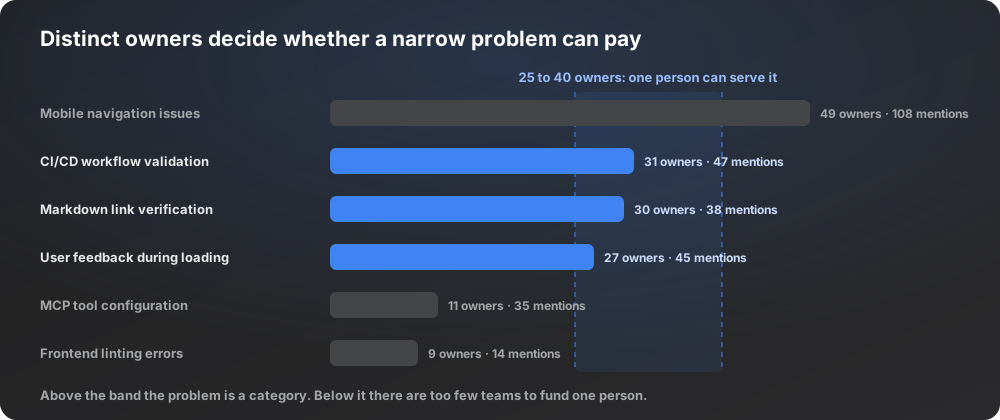
Read the owner column downwards and the band appears on its own. At the top, Mobile Navigation Issues and Usability Challenges carries 108 mentions from 49 separate owners and scores 87.5. That breadth is the disqualifier: 49 independent teams hitting one wall describes a category, and categories are where funded products live. Attacking it as a single-person tool means competing on scope you cannot cover.
The three in the middle are where a one-person product fits, and they do not all point the same way. Enhanced Internal Markdown Link Verification System is the most interesting: 38 mentions from 30 owners, with a growth ratio of 0.5, which is 9 mentions in the trailing window against 6 in the one before. Average growth across the whole feed is -0.094, so the field is flat to slightly cooling, and a cluster climbing into that is moving under its own power.
Inadequate CI/CD Workflow Validation looks stronger on owners at 31, but its growth ratio is -0.64: 5 mentions in the trailing window against 14 in the previous one. Same breadth, opposite direction. Enhancing User Feedback During Loading sits at 45 mentions from 27 owners and is a real, recurring annoyance, yet it is a design pattern more than a purchase, and the distance between felt pain and an approved invoice is where a lot of micro-SaaS revenue projections quietly die.
Two limits on this reading matter more than the ranking does. The feed watches developers, so it sees a developer’s problems and stays blind to everything that never reaches a public issue tracker. And a cluster label is a machine’s summary of many complaints, so it hands you a shape rather than a specification. What the counts buy you is the one thing an invented list never can: evidence that a specific number of separate people wrote the problem down without being asked to.
What keeps a micro-SaaS defensible
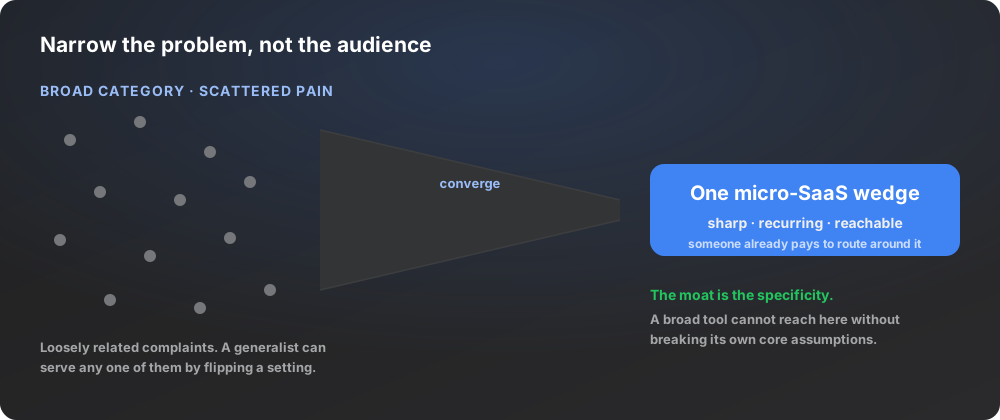
A founder picks a vertical: project management for dental practices. They build it, launch it, and six months later a large generalist platform ships a dental template in an afternoon. The audience narrowed, the underlying problem stayed exactly where it was, and a template closed the gap. Narrowing by subtraction hands you a smaller market and no moat in the same move, which is the worst combination available.
The micro-SaaS businesses that hold do the reverse. They start from a problem that differs in kind, one a generalist cannot serve without contradicting its own product model, and the audience size falls out of wherever that problem happens to live. Four properties tend to travel together in the ones that work. The problem breaks a generalist’s abstractions instead of needing a setting flipped. The pain recurs on a cycle, every sprint or release or invoice, rather than firing once. The people are enumerable, so you can name the repositories, the tag, the forum. And somebody already pays to route around it, in contractor hours or a duct-taped script or a spreadsheet maintained at 11pm.
That last one is the strongest single signal, because it means money is already moving. You are proposing to redirect a budget line rather than to create one that does not exist.
The stakes for getting this wrong are documented. In CB Insights’s analysis of why startups fail, “no market need” is the most common single reason a startup dies, cited in 42 percent of post-mortems. Each of the four properties above is a cheap test against that one failure mode, run before the build instead of after it.
Four tests before you build
A cluster on a chart is a hypothesis. Before the weekend goes in, put the candidate through tests that can come back as a no. That falsification habit matches the instinct in Paul Graham’s essay on how to get startup ideas: the good ones get noticed rather than invented. The manual version of that noticing is in the guide on how to find startup ideas, and the terrain it runs over is mapped in developer pain points to watch in 2026.
The scope test
Can one person hold the entire product in their head? Write the whole feature list on a single line. If it runs to a second line, you are describing a startup with a hiring plan.
The population test
Count separate owners, never mentions. Below roughly 25 independent parties there are not enough buyers to fund one person, whatever the percentage growth claims.
The recurrence test
Does the pain fire on a schedule, every sprint or release or billing cycle? Check whether the cluster comes back week after week. Once is an incident, weekly is a market.
The willingness test
Find the current workaround and what it costs somebody. If nobody has bothered to route around the pain, it is not yet sharp enough to fund a subscription.
Survive all four and you have earned a validation sprint, which is a separate discipline: designing cheap tests that are allowed to fail, covered in how to validate a SaaS idea. Fail any one of them and you have saved the build, which on the current arithmetic is worth more.
Sizing it without lying to yourself
Founders worry that a micro-SaaS is too small to matter. The more common error runs the other way: the number gets inflated until it feels comfortable, and the inflated version quietly bundles three unrelated problems under one label.
Size it by counting reachable, paying instances of the exact problem. For the markdown link verification cluster, that number is 30, not 38. Thirty is a count you can go and check by hand, one owner at a time, in an afternoon. Thirty-eight is a message count, and messages do not carry wallets.
If 30 turns out to be too few to sustain what you want, that is a finding rather than a failure, and it arrived before the build instead of after it. The arithmetic for turning a raw count into a defensible estimate is in market research for founders, which does the sums without the wishful thinking.
Read all three numbers, and weight owners heaviest
Volume tells you how loud a problem is. Owner count tells you how many independent wallets feel it. Growth tells you which way the wall is moving. Owner count carries the most weight, because it is the hardest of the three for one frustrated person to inflate.
From idea to first ten customers
The payoff of a properly scoped micro-SaaS is that the first ten customers are visible before any code exists. A reachable problem means you already know where the people are, and a specific problem means the pitch is a sentence they finish for you.
The sequence is boring by design. Take the one candidate that survived all four tests. Go to the three places its people gather. Describe the exact problem back to them in the words they used themselves, and ask whether it hurts as much as it looks like it does. If they lean in, keep going. If they shrug, you have spent a week rather than six months, and the feed still holds the next candidate.
That is the whole method. Stop shrinking large ideas until they feel achievable. Start from public, recurring pain, check that enough separate people carry it, keep the scope inside what one person can hold, and let the market size itself. The micro-SaaS worth building is rarely the one that sounded best in the notebook. It is the one the counts kept pointing at while you were talking yourself into something bigger.
This article was drafted with AI assistance and reviewed against EchoSift’s proprietary signal data before publishing. All signal figures are live aggregates from EchoSift’s feed as of the 2026-08-06 snapshot.