How to Define an Ideal Customer Profile for a Developer Tool
A scorecard method to define one ideal customer profile for a developer tool, using firmographic, behavioral, and pain criteria grounded in live developer signal data.
 Alessio Persico Founder of EchoSift



Who exactly are you building this for? Every founder can name a general category, but the real test is whether you can look at a specific company and return a clear yes or no in under a minute. Early go-to-market advice usually stops short of that precision: “talk to your ideal customer” gets you nowhere until you have already decided who that is, and the decision is harder than it sounds because every plausible customer looks worth chasing when you are staring at a blank market. An ideal customer profile, or ICP, is the tool that ends that paralysis: a scored description of the one buyer you build for first, specific enough that you can apply it to any real account and return a clean verdict.
This piece is about defining that single profile, not about dividing your whole audience into groups. Cutting a crowd into slices is audience segmentation, and it gives you the map. An ICP is the destination you pick on that map: after the cut, you still have to choose which one slice earns your first release, your first landing page, and your first hundred conversations. Choosing wrong is expensive, because everything downstream inherits the choice.
An ICP is a filter, not a fantasy
Founders confuse three things: a persona, a segment, and an ideal customer profile. A buyer persona is a narrative, a named character with a backstory that helps writers set a tone. A segment is a group that behaves alike. An ICP is neither a story nor a whole group. It is a set of criteria you can apply as a pass or fail test to any account in front of you.
The practical difference is testability.
Where the persona stops helping
A persona says "Priya cares about developer experience." An ICP says "a team of three to twenty engineers, shipping continuously, currently losing time to a bug they file publicly, on a stack we integrate with." Only the second lets you look at a real company and score it, and that scoring is the entire point. Without it you have a mood board, and a mood board cannot tell you whether the lead in your inbox is worth an hour of your week.
So define the ICP as a filter with a small number of criteria that each return a clean yes or no. The rest of this article is about which criteria, how to weight them, and how to read live demand data to fill them in.
The three axes of fit
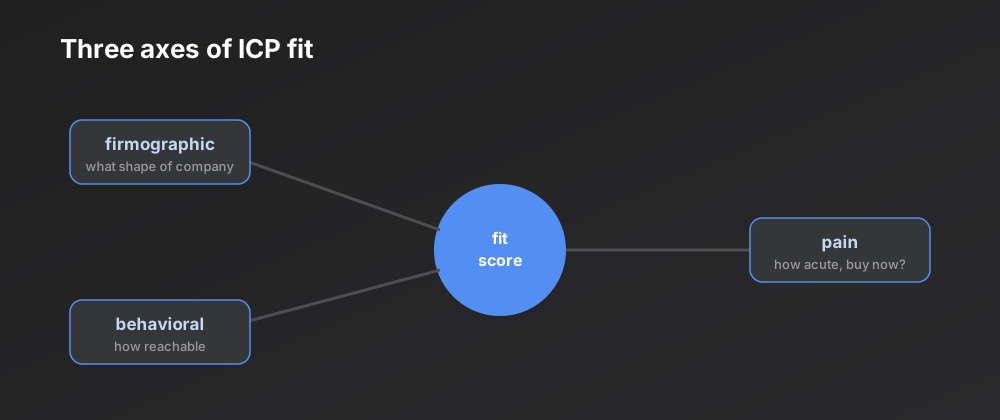
Good ICP criteria fall on three axes. Keep them separate, because each answers a different question and each is measurable in a different way.
Firmographic fit is about the shape of the company: size, stage, industry, and stack. These are the firmographics that decide whether a buyer even could adopt you, regardless of how much they want to. A solo maker and a fifty-engineer platform team can share the exact same pain and still be different ICPs, because they buy, budget, and integrate on completely different terms.
Behavioral fit is about how the buyer acts and, crucially, how easily you can reach them. Do they discuss their problems in public? Do they file issues, answer each other, adopt tools bottom-up? A buyer who solves problems out loud is cheap to reach and quick to try things. A buyer who never surfaces is expensive to find no matter how perfect the firmographic match.
Pain fit is about the problem itself: how acute it is and whether it is urgent enough to trigger a purchase now. A blocking bug behaves differently from a nice-to-have. The same signal data that sizes a market also carries a pain type, and pain type reads as buying behavior.
Read the data: where does fit actually concentrate?
The mistake is to define an ICP from imagination. Define it from where demand already clusters. Here is a recent snapshot of live developer signals.
The loudest single topic is not automatically the best ICP. “Mobile Responsiveness and UI Layout Bugs” carried a volume of 160 mentions, the broadest ownership in the snapshot, but that breadth is horizontal: its owners span every kind of company, and breadth without a common firmographic shape is hard to build one product for. Compare it with where owners concentrate inside a single macro area.
| Cluster in the snapshot | Distinct owners | Reads as |
|---|---|---|
| Mobile Responsiveness and UI Layout Bugs | 56 | ✗ A wide audience and a vague ICP |
| Continuous Integration Failures on Main Branch | 34 | ✓ Developer operations, and a firmographic shape |
| Insufficient CI/CD testing infrastructure | 28 | ✓ The same macro area, adjacent pain |
| Auto-merge flaws undermine CI and review integrity | 25 | ✓ The same macro area, adjacent pain |
Three adjacent pains, all in one macro area, each held by dozens of independent owners. Stack those together and you have a far denser and more coherent ICP than any single wider signal: teams that ship through continuous integration and keep tripping over the pipeline. That is a firmographic shape, a behavior, and a pain in one place.
Pain type sharpens it further. A topic like “Enhancing UI with Skeleton Loaders” carries a pain type of feature request, which is aspirational and sells on a roadmap timeline. The CI failures above are filed as complaints and bugs, which are present-tense blockers that sell today. When you are choosing the first ICP, weight the acute pain, because it converts without waiting for a roadmap. If you are unsure a cluster is real, confirm it through customer discovery before you commit a release to it.
Build the ICP scorecard
Turn the three axes into a scorecard. List your candidate profiles, score each axis, weight the axes for your product, and let the arithmetic name the winner instead of your gut.
Weighting matters because the axes are not equal for every business. If your product only works above a certain team size, firmographic fit is a gate, not a slider, and a fail there zeros the whole row. If your growth depends on bottom-up adoption, behavioral reachability carries the most weight, because an unreachable buyer is a dead lead however acute their pain.
A workable scoring pass looks like this. For each candidate profile, rate firmographic match, then behavioral reachability using owner breadth as the proxy, then pain acuteness using pain type and growth. Multiply by your weights and total. The CI-pipeline profile above scores high on all three: a clear firmographic shape, dozens of reachable public owners, and an acute, present-tense pain. A profile built on a single loud but narrow signal scores lower even if its raw volume looks bigger, because reachability and coherence are thin.
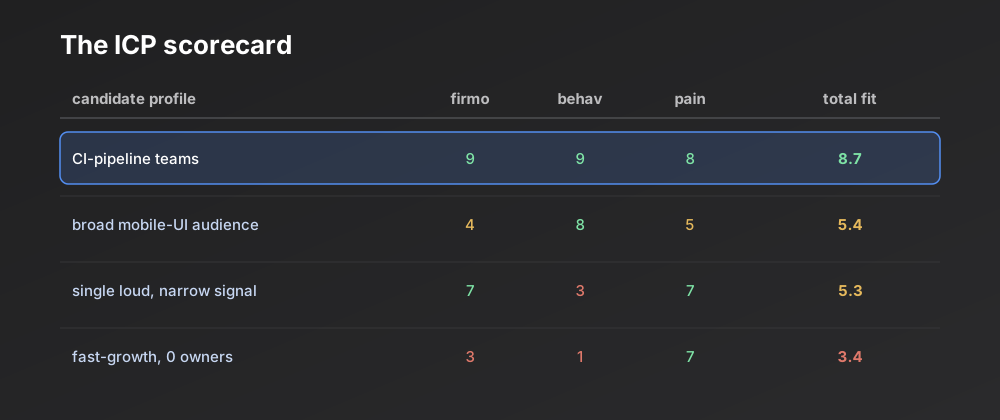
The scorecard is not precise science and does not need to be. Its job is to force you to compare candidates on the same axes, so the choice is explicit and you can defend it later when a shiny distraction shows up.
Write the anti-persona
An ICP is only as sharp as what it excludes. Write the anti-persona explicitly: the buyer who looks tempting but you will deliberately not serve first. This is where founders lose the most time, chasing customers who were never a fit.
The data flags anti-personas cleanly. “AI Tools Privacy Concerns” was growing fast, with recent mentions up from 2 to 5, yet it was held by 0 distinct owners in the snapshot. Fast growth with no distinct owners is noise, not a market: there is no reachable buyer behind it to build for. That is a textbook exclude. Contrast it with the CI cluster, where dozens of named, public owners give you people to actually reach. High growth is seductive; without owners it is a mirage.
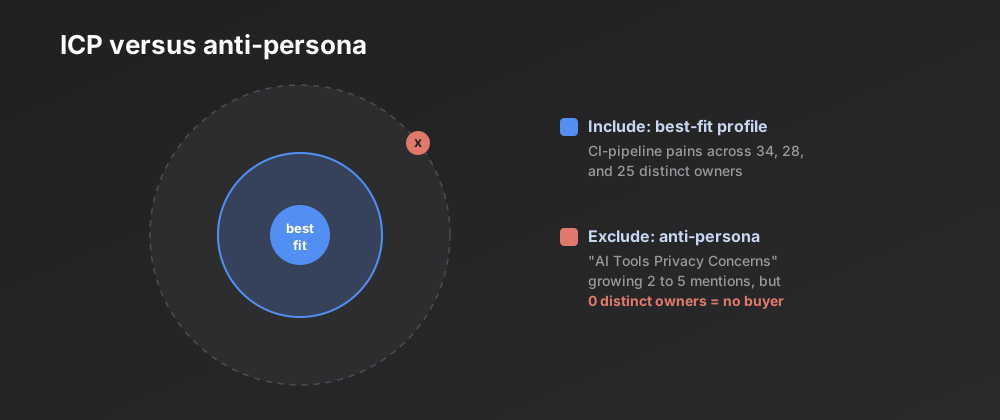
Other anti-persona tells: a pain type that is purely a feature request when you need present-tense urgency, a firmographic shape your product cannot serve yet, or a buyer who never discusses problems where you can reach them. Naming these once saves you from re-litigating every borderline lead.
The ICP is a positioning and channel decision
A defined ICP is not a slide you file away. It changes what you say and where you say it. The CI-pipeline profile tells you to lead with pipeline reliability language, not generic developer-experience language, because that is the pain those owners actually filed. Positioning is downstream of the ICP, and vague positioning is almost always a symptom of an undefined one.
It also chooses your channels. The 4 sources of public developer discussion in the data are exactly where those 34-plus owners already congregate, which means content, community, and issue threads reach them without paid interruption. A different ICP would live in different places and cost differently to reach. If your first candidate ICP turns out to be too crowded to enter, that is itself a finding, and the fix is often to move toward a narrower, underserved niche where the same acute pain has fewer competitors chasing it. Sizing that demand first, using how much demand actually exists, keeps the ICP grounded in a market big enough to matter.
Criteria that can return NO
Treat the ICP as a claim to break, not a decision to defend. A few checks that each return a clean NO:
| Check | What a NO looks like | What it means |
|---|---|---|
| Does the profile have a coherent firmographic shape? | ✗ It spans every company size and stack, like the 56-owner mobile-UI signal | You have an audience, not an ICP. Tighten it |
| Are the buyers reachable? | ✗ Owner counts collapse to single digits or zero | The behavioral axis fails and organic reach is a fiction. A 0-owner signal is an exclude |
| Is the pain urgent enough to buy now? | ✗ Nothing acute anchors the profile, only feature requests | A feature request sells on a roadmap, a bug sells today. Expect a long cycle |
| Does one profile clearly outscore the rest? | ✗ Two candidates tie on the scorecard | The ICP is not tight enough to pick a first release. Add a criterion until one wins |
If a profile passes all four, you have something rare: one specific, reachable, acutely-pained buyer to build the first version for. Everything after that, the messaging, the channels, the first hundred conversations, finally has a single person to answer to.
This article was drafted with AI assistance and reviewed against EchoSift’s proprietary signal data before publishing.