How to Calculate the Burn Rate: A Founder's Guide
Two clean formulas for calculating burn rate, gross vs net burn explained, and how to turn runway into a real founder decision deadline.
 Alessio Persico Founder of EchoSift



You log into your bank account on a Monday morning, glance at the cash balance, and do the math in your head. Payroll is coming. A contractor invoice is overdue. You want to hire two engineers, but you’re not sure whether that’s confident execution or reckless timing.
That’s the moment burn rate stops being a finance term and becomes a founder problem.
Burn rate is the speedometer for how fast your startup is consuming cash. If you know how to calculate the burn rate correctly, you can decide whether to hire, whether to cut spend, and when to start fundraising before the pressure gets ugly. If you don’t, you’ll make major decisions from a vague feeling instead of a number.
Table of Contents
- Your Startup’s Clock Is Ticking. How Fast?
- Gross vs Net Burn: The Two Numbers You Must Know
- How to Calculate Burn Rate with Spreadsheet Formulas
- From Burn Rate to Runway: How Many Months Do You Have Left?
- Common Burn Rate Mistakes That Can Sink a Startup
- Forecasting Your Burn and Measuring Capital Efficiency
Your Startup’s Clock Is Ticking. How Fast?
Founders usually feel burn rate before they calculate it. You see cash leaving the account every week, but the pattern isn’t obvious until you turn it into a monthly number. Once you do, the company gets simpler to manage.
The cleanest starting point is the balance-sheet method. A foundational formula is (Starting cash balance − Ending cash balance) ÷ months, which tells you how much cash the company consumed over a fixed period. First Round also ties that number directly to runway planning, with a recommended runway that moves by stage and by market.
That matters because most founder decisions are timing decisions in disguise. A hire changes burn. A pricing improvement changes burn. A delayed enterprise deal changes burn. If you don’t know the pace of cash consumption, you’re steering with a fogged windshield.
Burn rate is not one number in practice
There are really two views you need to hold at once.
One tells you how much cash the business spends to operate. The other tells you how much cash disappears after revenue offsets part of that spending. If you only look at one, you’ll either feel safer than you are or more panicked than you should be.
Practical rule: burn rate isn’t there to make your board deck look tidy. It’s there to tell you how much time your current plan can buy.
A founder who knows the number can act early. A founder who waits until the account balance feels low usually cuts too late, raises too late, and negotiates from weakness.
Gross vs Net Burn: The Two Numbers You Must Know
Gross burn is your total cash spend on operations. Think payroll, software, contractors, rent, taxes, insurance, and the other costs required to keep the company running.
Net burn is what happens after revenue helps plug part of that leak. If gross burn tells you the size of the bucket’s hole, net burn tells you how fast the water level is dropping.
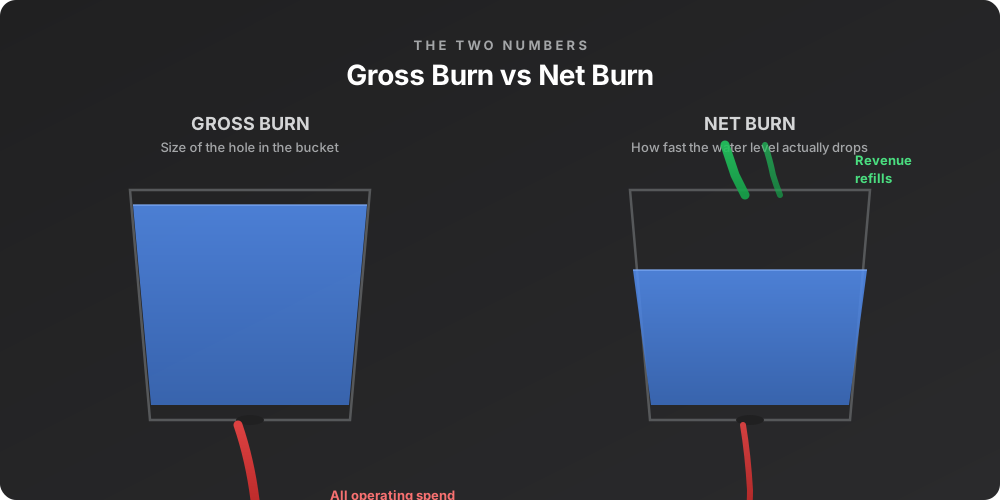
Gross burn shows operating scale
Gross burn is useful when you’re asking operational questions. Can you afford a bigger team? Has tooling spend drifted up? Did a new go-to-market motion permanently change your cost base?
This number matters because it exposes your spending habits without the comfort of revenue. If gross burn keeps rising, you need to know whether that’s deliberate investment or sloppy accumulation.
Net burn shows survival time
Net burn is usually the more important number for founders because it determines how quickly cash reserves shrink. Carta gives a straightforward example: a company spends $750,000 over 12 months, which means a gross burn of $62,500 per month. If it earns $20,000 in monthly revenue, its net burn becomes $42,500 per month.
For SaaS, this distinction matters. A company with strong recurring revenue can support the same gross spending profile as another startup while having a very different cash-out timeline.
Which one should you manage against
Use both, but for different jobs.
| Decision in front of you | Read gross burn | Read net burn |
|---|---|---|
| Cost discipline | ✓ Yes: it shows the size and direction of operating spend | ~ Revenue hides drift |
| Runway and fundraising timing | ✗ It overstates urgency | ✓ Yes: this is the number tied to cash survival |
| A major hire | ✓ The payroll step-up lands here immediately | ✓ Whether revenue rises fast enough to justify it |
Gross burn tells you how heavy your company is. Net burn tells you how long it can run at that weight.
A common founder mistake is quoting gross burn in one conversation and net burn in another as if they’re interchangeable. They aren’t. If your head of finance, your co-founder, and your investors aren’t using the same definition, you’ll end up with three different runway answers.
How to Calculate Burn Rate with Spreadsheet Formulas
The practical answer to how to calculate the burn rate is this: use two methods and reconcile them. One is fast and audit-friendly. The other is operationally useful.
Method one, using cash balances
If you want the cleanest top-down calculation, use starting cash and ending cash over a recent period.
Formula:
Burn Rate = (Starting Cash Balance − Ending Cash Balance) ÷ Number of MonthsThat method is especially useful when you want a number grounded in actual cash movement instead of assumptions. Hiline describes this as the most audit-friendly approach and warns against using stale balances or overly long periods, because burn rate is a current metric.
If you’re setting this up in Google Sheets or Excel, keep it simple.
Example spreadsheet layout
- Cell
B2= Starting cash - Cell
C2= Ending cash - Cell
D2= Number of months - Cell
E2= Burn rate
Formula for E2:
=(B2-C2)/D2If cash fell over one month, this gives you monthly burn directly. If you’re measuring a quarter, divide by the number of months in that quarter.
Method two, using monthly revenue and expenses
This is the more operational view. It tells you what the business is doing each month, not just what happened to cash over a period.
Formula:
Net Burn Rate = Total Monthly Expenses − Total Monthly RevenueThis method is useful when you want to understand the levers. If burn went up, was it because payroll increased, revenue slipped, collections got delayed, or one-time spend hit all at once? The cash-balance method won’t answer that by itself.
A spreadsheet setup might look like this:
- Cell
B2= Monthly expenses - Cell
C2= Monthly revenue - Cell
D2= Net burn
Formula for D2:
=B2-C2For gross burn, you don’t need subtraction. It’s just total monthly cash expenses.
A simple template you can copy into Sheets or Excel
Build one tab for monthly operating view and one tab for cash summary. That gives you both lenses without overcomplicating the model.
| Metric | Month 1 | Month 2 | Month 3 |
|---|---|---|---|
| Starting Cash | |||
| Ending Cash | |||
| Total Expenses | |||
| Total Revenue | |||
| Gross Burn | |||
| Net Burn |
Use these formulas:
- Gross Burn row:
=Total Expenses - Net Burn row:
=Total Expenses − Total Revenue - Cash Balance Method row:
=(Starting Cash − Ending Cash) ÷ 1
If you’re calculating a rolling average across three months, use:
- Average gross burn:
=AVERAGE(range) - Average net burn:
=AVERAGE(range)
One weird month becomes stable reality
First-time founders build a single monthly number out of an unusual month and then treat it as the company's true pace. That is risky if collections are lumpy, annual bills hit in one month, or payroll changes mid-quarter.
A better template includes a notes column for unusual items:
- Annual software renewal
- Tax payment
- Debt principal payment
- Launch spend
- One-time legal bill
That note matters because the number is only useful if you can explain it. If burn rises and you can’t say why in one sentence, your model isn’t ready for decisions.
Keep the spreadsheet boring. Fancy dashboards are optional. A clear monthly model that reconciles to cash is not.
One more operational rule: use recent months. Burn rate is a live metric, not a historical vanity number. If your spending changed after new hires, a pricing change, or a cloud bill jump, old averages will mislead you.
From Burn Rate to Runway: How Many Months Do You Have Left?
Burn rate becomes useful the moment you convert it into runway.
The core formula is simple: cash balance ÷ burn rate per month. BaseTemplates recommends using runway this way for operating decisions and then stress-testing it against a short-horizon cash forecast such as a 13-week model.
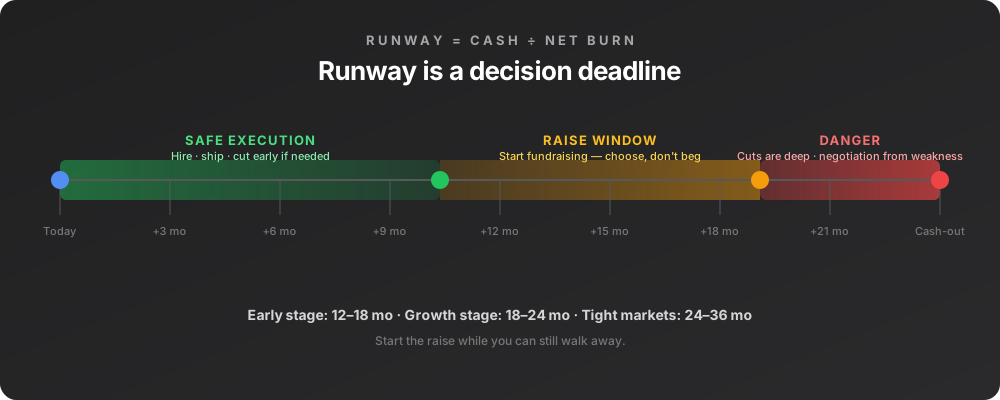
Runway is a decision deadline
Founders sometimes treat runway like a passive metric. It isn’t. It’s the deadline attached to your current plan.
If your net burn drops, runway extends even when gross spend stays the same. That’s why revenue quality matters so much, and why a pricing change is often a faster runway lever than a cost cut. Our walkthrough on how to price a developer tool covers reading willingness to pay from demand instead of guessing at it. You don’t need every dollar of spend to disappear. You need your cash-out timeline to improve.
Here are the decisions runway should drive:
- Hiring pace: add headcount only when you know how much runway the new payroll burden removes.
- Fundraising trigger: start raising while you still have time to choose investors, not when cash pressure forces speed.
- Marketing spend: keep spend that supports a clear revenue loop. Pause spend that’s just activity without evidence. If you have no paid history yet, our method for estimating customer acquisition cost before you have spend data gives you a defensible starting number.
- Cost cuts: cut early enough to preserve options. Late cuts are usually deeper and more chaotic.
The mistake I see most often is founders using gross burn to estimate runway. That overstates urgency if revenue is meaningful. The reverse mistake is just as bad. Using a rosy revenue month to estimate runway understates urgency and buys false confidence.
A simple operating cadence
Use a monthly cadence for burn and runway review. Then pressure-test that with a shorter cash forecast, especially if collections are uneven or enterprise customers pay slowly.
A straightforward rhythm looks like this.
Close the month quickly
Update cash, expenses and revenue while the numbers are still easy to chase.
Calculate gross and net burn
Keep the definitions consistent, so the same word means the same thing to you, your co-founder and your investors.
Update runway
Current cash divided by current monthly net burn, not last quarter's.
Stress-test the next few weeks
A shorter forecast catches timing gaps that monthly averages hide.
When runway gets tighter, strategy gets less theoretical. Every hire, every campaign, and every delay now has a visible cost in time.
Common Burn Rate Mistakes That Can Sink a Startup
Most burn-rate mistakes aren’t math errors. They’re classification errors, timing errors, or wishful-thinking errors.
What founders leave out
A surprisingly common problem is not deciding what belongs in monthly burn. Brex explicitly includes payroll, rent, supplies, inventory, taxes, insurance, and debt payments in monthly expenses. Many lighter explainers stop at a formula and leave those categories vague.
That vagueness is dangerous because founders tend to exclude the painful items.
| Expense | How it gets excused away | Belongs in monthly burn |
|---|---|---|
| Debt payments | "That is financing, not operations" | ✓ Yes: it still takes cash out of the business |
| Taxes | "Those are special" | ✓ Yes: still a cash outflow |
| Insurance | "That one is annual" | ✓ Yes: still part of the operating burden |
| Inventory or one-time launch spend | "It is not recurring" | ✓ Yes: if it hit the bank account, it affected runway |
If an expense shortens your cash life, it belongs in the conversation whether or not it feels recurring.
A practical fix is to separate expenses into two buckets in your model: core recurring and non-routine but real. Then you can look at normalized burn without pretending unusual cash drains don’t exist.
Where timing distorts the picture
Some months lie.
The month that flatters you
A founder closes a strong customer payment at month-end and reads it as a structural improvement in net burn. Another has a low-spend month because hiring slipped, then uses that month to justify a bigger roadmap. Neither view is reliable.
Watch for these distortions:
- Lumpy collections. Common in B2B SaaS. Revenue may be real, but cash timing still matters.
- Delayed hiring. Headcount plans often hit later than planned, which makes recent burn look better than future burn.
- Quarterly or annual bills. Averages smooth them out, but the bank account still feels them on the payment date.
- Fundraise proceeds mixed into operating cash. If you don’t separate financing inflows from operations, you’ll understate burn.
Confusing project burn with startup burn
Another subtle mistake is borrowing the wrong formula. Some project-management frameworks use “burn” in ways that have nothing to do with startup liquidity. That can be valid for project tracking, but it won’t tell you how many months the company can keep operating.
Use cash-based startup burn when you’re answering founder questions. Can we hire? Can we wait to raise? Can we survive a delayed deal cycle? Those are liquidity questions, not project accounting questions.
Forecasting Your Burn and Measuring Capital Efficiency
A founder who only calculates current burn is looking backward. That helps with control, but it doesn’t help much with timing. What matters is where burn is heading after planned hires, new infrastructure costs, pricing changes, and expected revenue movement.
Forecast forward, not backward
A practical forecast starts with your latest actuals and then layers in known changes.
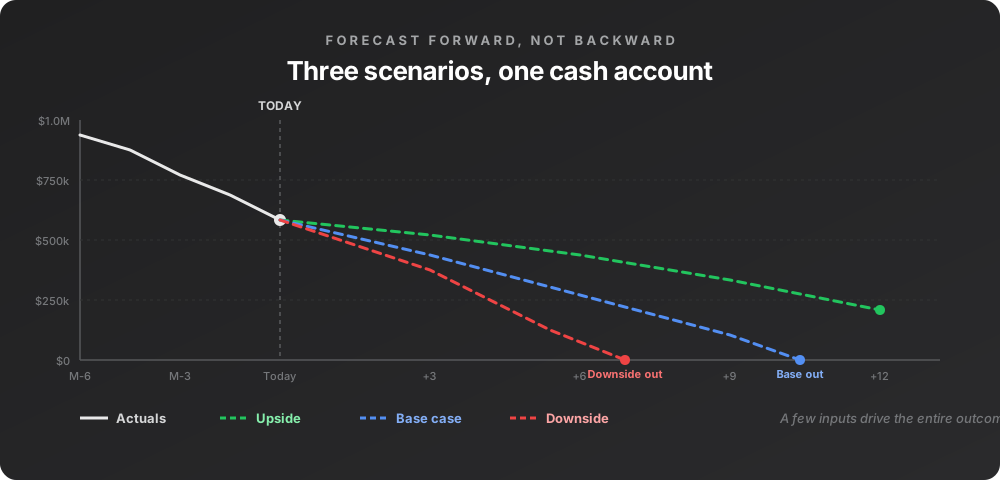
Build the model around real operating events:
- Planned hires. Add the payroll step-up in the month it starts.
- Revenue expectations. Use conservative assumptions for deals that aren’t closed. The revenue side of this model deserves its own build, which we walk through in how to forecast SaaS revenue using the MRR identity and cohort retention rather than a straight-line extrapolation.
- Contract renewals and annual bills. Put them in the month cash will leave.
- Scenario splits. Keep a base case, a downside case, and an upside case.
This doesn’t need to become a finance-science project. What matters is that you can see which decisions move runway the most. In many startups, a handful of items drive the entire outcome: headcount timing, sales productivity, infrastructure cost drift, and whether collections arrive on schedule.
Why investors ask about efficiency now
Burn alone doesn’t tell the whole story. Investors increasingly look at the burn multiple, calculated as net burn ÷ net new ARR, according to HSBC Innovation Banking.
A high burn can still be a healthy burn
A company can have a high burn rate and still be getting more efficient, as long as it is adding ARR fast enough for the burn multiple to improve. That is a more nuanced signal than raw burn by itself.
The burn multiple is a company-level ratio, so it hides which customers are actually paying for themselves. To see that, run the same question one customer at a time: contribution margin, margin-adjusted LTV, and CAC payback in months. Our guide to modelling SaaS unit economics sets that up for the case where you have very little data yet, which is where most burn arguments actually happen.
For founders, the practical takeaway is simple:
- Don’t defend burn with ambition alone. Show what the spend is producing.
- Track efficiency alongside runway. Survival matters, but so does whether cash is buying durable growth.
- Use period averages, not one heroic month. Investors and operators both trust trends more than snapshots.
The cheapest way to protect burn is to spend it on a problem that is already real. That is a discovery question as much as a finance one, and it starts before the model does. Here is the fastest-moving pain in the feed on EchoSift’s 2026-07-31 snapshot.
Movement like that is a better reason to commit payroll than a strong internal hunch. Our guide on how to find startup ideas covers where that demand evidence tends to surface first.
If you’re validating what to build before you spend more on headcount, tooling, or go-to-market, a signal platform like EchoSift can help you spot where developer pain is intensifying so your burn supports a sharper bet, not just a louder one. The mechanics of that check are covered in our guide on how to validate a SaaS idea, and the sizing side sits in our walkthrough of market opportunity assessment.
If you’re building for developers, EchoSift helps you find real market pain before you commit more burn to the wrong roadmap. It surfaces rising frustration across places like GitHub, Stack Overflow, and Hacker News, then clusters those complaints into patterns you can validate fast. Demand shows up as repetition across independent voices: as of the 2026-07-31 snapshot, EchoSift’s most-mentioned developer pain drew 99 mentions from 52 distinct owners, which is the kind of breadth that tells you a problem is worth funding before payroll starts against it. Worth noting that this figure moved: the 192-mention, 105-owner leader we cited at the July 5 refresh has since cooled out of the top slot. That is the same lesson this article applies to your own numbers, which is to price decisions off a current reading rather than a saved one. That gives founders a better shot at spending capital on problems that are early, real, and still open.
This article was drafted with AI assistance and reviewed against EchoSift’s proprietary signal data before publishing. All signal figures are live aggregates from EchoSift’s feed as of the 2026-07-31 snapshot.