How to Estimate Customer Acquisition Cost Before You Have Spend Data
A practical method to estimate customer acquisition cost for a developer tool before you have spend data, using demand concentration, blended versus paid CAC, and the CAC to LTV ratio.
 Alessio Persico Founder of EchoSift



Customer acquisition cost is the amount you spend to turn a stranger into a paying customer. The textbook version is simple arithmetic: take everything you spent on sales and marketing in a period, divide by the number of new customers you won in that same period. The problem for most developer-tool founders is that this formula needs data you do not have yet. Before launch you have no ad spend, no attribution, no cohort of paying users to divide by. So the number that should guide whether an idea is even worth building is the one number people skip until it is too late to change course.
This piece is about estimating customer acquisition cost early, before you have a single line of spend data, and using that estimate to choose between ideas. It is not about burn rate, which measures cash leaving per month, and it is not about pricing, which sets what a customer pays. CAC sits between them: it is the cost side of the equation that decides whether your price and your burn can ever meet. Get the estimate wrong and you can ship a product people want at a price they will pay and still go broke acquiring them.
Why the textbook formula fails before revenue
The standard definition of customer acquisition cost is total acquisition spend divided by customers acquired. It is a backward-looking measurement. It tells you what happened after you already spent the money. That is genuinely useful once you are live and buying growth, but it gives a pre-launch founder nothing, because both the numerator and the denominator are zero.
Worse, the naive version misleads even after launch. Your first ten customers usually arrive through channels that feel free: a Show HN thread, a reply in a GitHub issue, a friend of a friend.
Where the textbook formula fails
Divide a small spend by those first organic customers and CAC looks near zero. Founders read that as proof the model works and pour money in. Then organic reach saturates, and the paid CAC that was hiding underneath the blended number turns out to be several times your monthly price. The business did not change. The measurement was flattering you.
So the pre-revenue job is not to compute CAC precisely. It is to estimate the order of magnitude, and to pick problems whose audience is cheap to reach in the first place. That estimate starts with a question the formula never asks: how easily does this audience find you on its own?
Owner count is a proxy for acquisition cost
Here is the shift. Instead of guessing at ad prices you have never paid, look at how a pain is distributed across real people. A complaint mentioned a hundred times by three accounts is a different acquisition problem than the same complaint mentioned forty times by forty different people, even though the raw volume looks similar.
Look at a recent snapshot of live developer signals.
Those 46 owners sit behind “Inadequate Error Handling Leading to Crashes”, a volume of 94 mentions. The breadth is the important part. Forty-six independent people, not forty-six posts from a handful of loud users, are describing the same pain in public. An audience that self-identifies at that scale is an audience you can reach with content, documentation, and community, which is to say cheaply. High owner count is a leading indicator of low CAC. Put three clusters from the same feed side by side and the acquisition problem separates from the product problem.
| Cluster on the same feed | Mentions | Distinct owners | Reach you can expect |
|---|---|---|---|
| Inadequate Error Handling Leading to Crashes | 94 | 46 | ✓ Organic: content, docs, community |
| Need for Comprehensive Troubleshooting Documentation | 40 | 24 | ✓ Organic: content, docs, community |
| Local MCP Server Failures on OpenCode Desktop | 19 | 7 | ✗ Paid interruption only |
A handful of owners is not a market you can reach organically, however real the pain. “Unexpected truncation of session history” sits at 3 owners: genuine for those three, useless as a channel. To acquire those users at scale you would have to buy lookalike attention, and paid interruption is the expensive path. Same product effort, very different acquisition cost, and you can see the difference before spending a dollar.
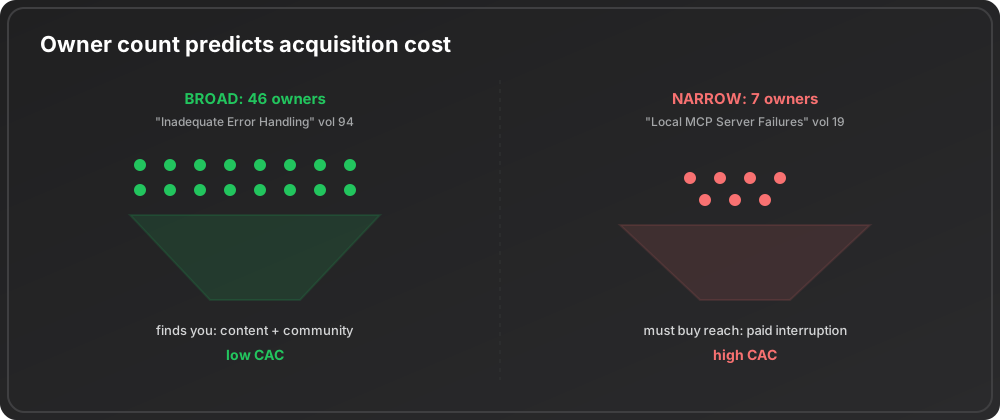
The pattern holds across the middle of the distribution too. “Inconsistent UI Contrast Across Themes” at 20 owners and “JWT Token Handling and Session Management Issues” at 17 owners are broad enough that the people who have the problem are searching, posting, and answering each other in public. Every one of those public discussions is a place your content can show up for free. Breadth of ownership is the closest thing to a free distribution channel a pre-launch founder has, and it is measurable today.
Blended CAC and paid CAC are two different numbers
Once you do start spending, keep two numbers, not one. Blended CAC is total spend divided by all new customers, including the ones who arrived organically. Paid CAC is spend divided only by the customers that spend actually bought. Blended CAC flatters. Paid CAC decides.
The reason to separate them is that they diverge exactly when it matters. Early on, organic wins drag the blended number down and make acquisition look solved. The paid number, sitting underneath, is what you will actually face when you try to grow past your organic ceiling. If your paid CAC is far above your monthly price of $39, you do not have a distribution problem you can outspend, you have a unit-economics problem you have to redesign around. Andreessen Horowitz makes this point bluntly in its list of startup metrics that matter: a blended CAC that hides an unsustainable paid CAC is one of the most common ways founders fool themselves.
For a pre-revenue estimate, assume your paid CAC will be several times whatever your first organic customers cost. Plan against the paid number, and let the blended one be a pleasant surprise.
From CAC to a decision: the ratio and the payback
An estimated CAC on its own does not tell you whether an idea is fundable. You compare it to what a customer is worth. That comparison is the customer lifetime value to CAC ratio, and a payback period.
Lifetime value is roughly your monthly price times gross margin times how many months a customer stays. At $39 a month with strong software margins and, say, a twenty-month average retention, a customer is worth several hundred dollars over their life. The widely used rule of thumb is that lifetime value should be at least three times CAC, and that the months of margin needed to repay CAC (the payback period) should sit under about twelve. If your estimated CAC pushes the ratio below three or the payback beyond a year, the wedge is not fundable at that price, no matter how large the audience looked.
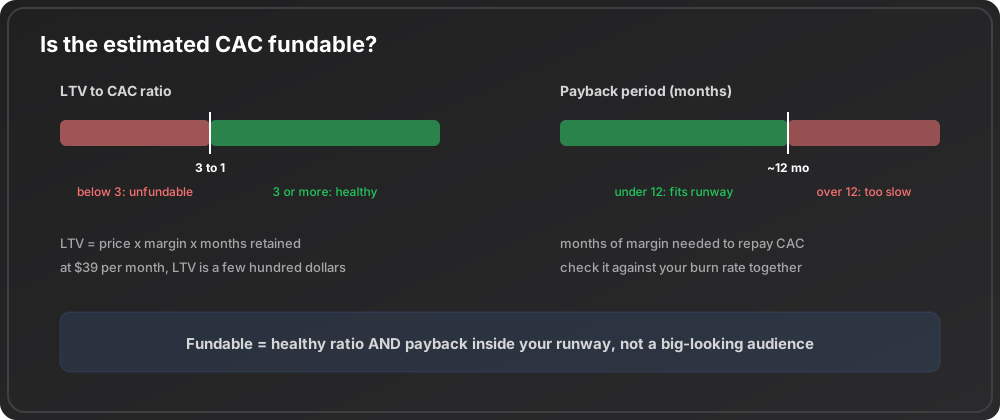
This is why CAC belongs at the idea stage, not the growth stage. It converts a vague sense of demand into a go or no-go. A pain with 46 owners and a plausible organic channel can clear the ratio comfortably. A pain with 7 owners that needs paid acquisition might not clear it even if the product is excellent, because the cost to reach each buyer eats the margin the price was supposed to earn.
Your real CAC is a weighted average across channels
The last mistake is treating CAC as a single figure. In reality it is a weighted average of the cost per customer on every channel you use, weighted by how many customers each channel brings. A cheap content channel and an expensive paid channel blend into one number that describes neither.
Estimate it channel by channel. For each place you plan to acquire, write down the cost to reach that audience and the share of customers you expect from it. For a developer tool the channels that actually work are usually content and search, community participation, and integration or marketplace presence, because that is where the 4 sources of public developer discussion already live. Paid search and sponsorships come later and cost more. When you compute cost per customer per channel first and only then blend, an expensive channel cannot hide inside a cheap one.
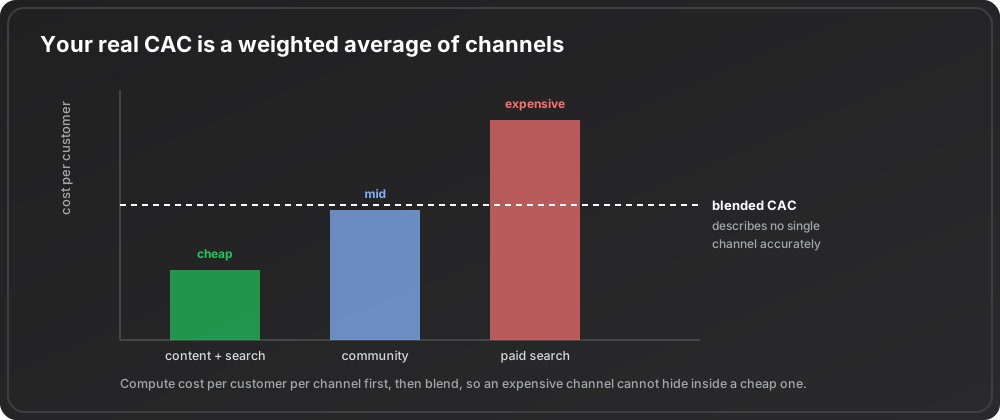
Segmenting the audience sharpens this further, because different developer segments congregate in different places and cost different amounts to reach. And the same signal data that tells you how much demand exists also tells you where it congregates, which is the raw input to a channel-level CAC estimate.
Tests that can return NO
Treat your CAC estimate as a claim you try to break, not a number you defend. Four checks that can each return a clear NO:
Is the audience broad enough to reach organically?
If the pain lives in single-digit owner counts like the 7 owners on the MCP server failures, the organic channel is a fiction and your estimate must assume paid reach.
Does the ratio survive the paid CAC?
Plug in the paid number, not the blended one. If lifetime value to CAC drops below three, the wedge fails the test regardless of how you feel about the product.
Does payback fit your runway?
A twelve-month payback is fine with two years of cash and fatal with six months. CAC interacts with burn rate, so check them together.
Is any single channel carrying the estimate?
If one cheap channel makes the whole thing work, ask what happens when it saturates, because it will.
If your idea passes all four, you have something rare: a problem with a broad, reachable audience and unit economics that hold once you have to pay for growth. If it fails one, you learned it for the price of an afternoon instead of a funding round.
This article was drafted with AI assistance and reviewed against EchoSift’s proprietary signal data before publishing.