Natural Language Processing API: A Builder's Guide for 2026
How to pick a natural language processing API in 2026: capabilities, six provider buckets, managed vs self-hosted, and a production checklist.
 Alessio Persico Founder of EchoSift



You need to add an NLP feature to a product. Maybe it’s a smart inbox classifier. Maybe it’s semantic search over your docs. Maybe a support chatbot that does more than match keywords. The first hour you start looking at options, the surface area triples: managed APIs, open-source libraries, fine-tuned models, vector databases, prompt engineering, fallback chains, eval harnesses.
The call that survives
Rarely the one that demoed best on Friday afternoon. It's the one that survives at the unit economics you can actually defend three quarters from now, with the latency budget you actually have, on the data you actually own.
This is a practical guide to choosing a natural language processing API in 2026. It covers what the primitives are, which provider buckets to know, when managed beats self-hosted, and the production checklist that catches the cost-and-latency surprises after launch.
Table of Contents
- What an NLP API Actually Is
- The Five Capabilities You’ll Actually Use
- The Six Provider Buckets in 2026
- When Managed vs Self-Hosted Makes Sense
- Three Decision Mistakes Builders Make
- A Production Checklist Before You Ship
- From Choosing an API to Shipping a Feature
What an NLP API Actually Is
A natural language processing API is a network endpoint that accepts text and returns something more structured than text: a label, a vector, a list of entities, a generated answer, a sentiment score. Underneath, almost every modern NLP API in 2026 is doing one of two things: running a transformer model and returning model output, or composing several transformer calls behind a higher-level interface.
The architectural shift that drives this is older than it feels. The 2017 paper Attention Is All You Need introduced the transformer, and within five years it had replaced almost every prior NLP architecture in production. Every API you’ll evaluate (OpenAI, Anthropic, Google’s classical Natural Language API, AWS Comprehend, the open-source models hosted on Hugging Face) is either a transformer model behind a REST endpoint or a thin orchestration layer over one.
That sameness underneath matters because it bounds the trade-offs. The provider you pick rarely changes what’s possible. It changes price, latency, lock-in, and how much operational rope you get handed.
Practical rule
The question is not "which API is smartest." It's "which API gives me the right operational shape for the volume, latency, and compliance constraints I actually have."
The Five Capabilities You’ll Actually Use
Most production NLP features are built from a small set of primitives. Knowing which ones you need is upstream of every other decision: provider, pricing model, even whether you need any external API at all.
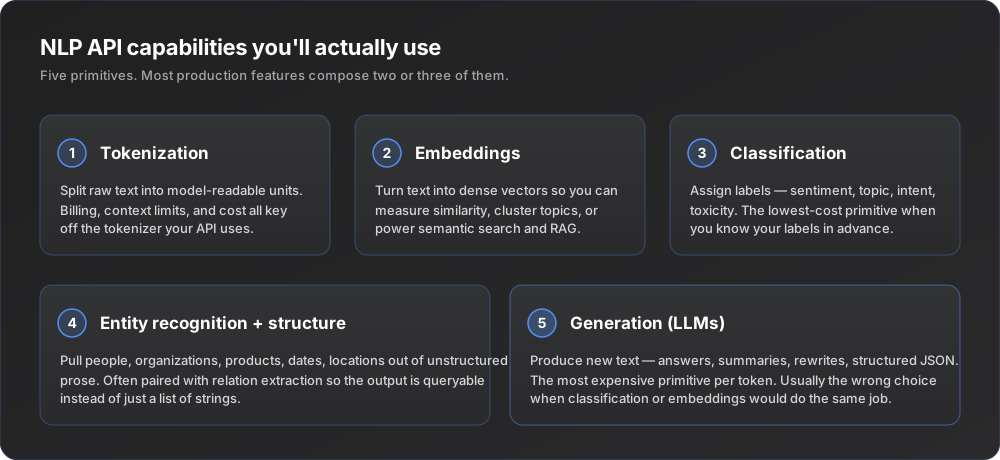
The five capabilities, in roughly increasing cost-per-call order:
- Tokenization. Splitting text into model-readable units. You usually don’t call this as a separate endpoint, but every other primitive’s cost and behavior depends on which tokenizer the provider uses. Two providers that look the same on paper can charge double for the same content because their tokenizers are different.
- Embeddings. Dense vector representations of text. They power semantic search, RAG retrieval, deduplication, clustering, and anomaly detection. The OpenAI embeddings guide documents the current generation: text-embedding-3-small returns 1536-dimensional vectors at the lowest cost, and text-embedding-3-large returns 3072-dimensional vectors when you need more recall.
- Classification. Assigning labels to text, such as sentiment, topic, intent, toxicity, or language. When your label set is known and stable, classification is the cheapest primitive that still does real work. It’s also the most predictable one to monitor in production.
- Entity recognition and extraction. Pulling people, organizations, products, dates, locations, and relationships out of unstructured text. Often paired with linking, which connects “GPT” to a canonical product entity instead of just a string.
- Generation. Producing new text: answers, summaries, rewrites, structured JSON. The most flexible primitive and by far the most expensive per call. Most teams over-use it. The instinct to ask the LLM to “just classify this for me” is almost always more expensive and less reliable than a fine-tuned classifier on top of embeddings.
Practical rule
If a classifier or embedding lookup would give the same answer as a generation call, use the cheaper primitive. The cost difference between primitives in production traffic isn't 2x; it's often 20-100x.
The Six Provider Buckets in 2026
Once you know which primitives you need, the next call is which kind of provider to hit them with. The market has consolidated around six functional buckets. Not six companies, but six shapes of company. Every individual provider lives in one bucket and sometimes spills into another.
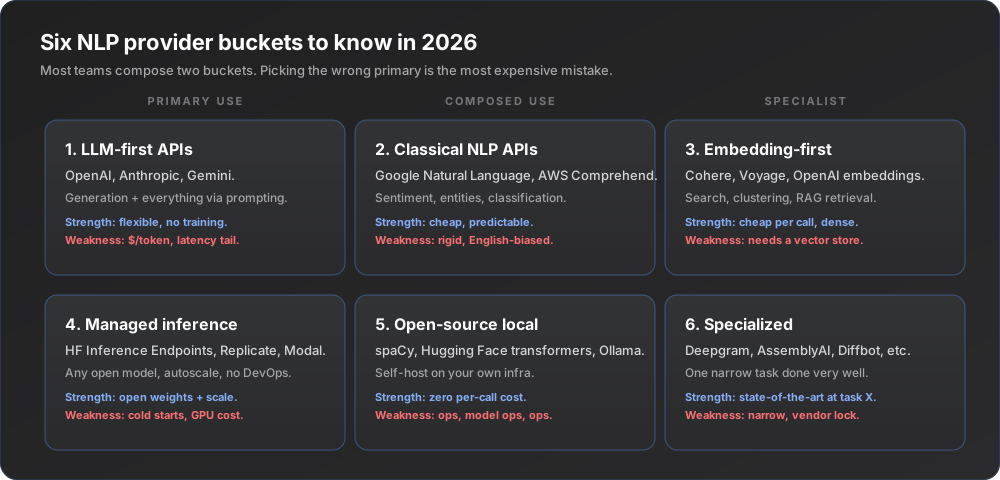
LLM-first APIs
OpenAI, Anthropic, Google Gemini. Sell generation as the primary product; embeddings, classification, and structured output come along for the ride via prompting. The right default when you don’t yet know which primitive you need, because a single endpoint can stand in for everything during prototyping.
Trade-off: prompting is flexible but expensive at scale, and tail latency is at the mercy of whatever the provider’s inference fleet is doing. P50 looks great; P99 routinely surprises teams that didn’t measure it.
Classical NLP APIs
Google Cloud Natural Language and AWS Comprehend are the two longest-running examples. Each exposes a handful of fixed endpoints (sentiment analysis, entity recognition, content classification, syntax analysis) with stable pricing and predictable latency.
These get dismissed as “old NLP” by builders who grew up on LLMs, which is usually a mistake. For a known label set on a known language at high volume, classical NLP APIs cost a fraction of an LLM call and respond in tens of milliseconds. The capability surface is narrower, but the operational story is much cleaner.
Embedding-first providers
Cohere, Voyage AI, OpenAI’s embedding models, several open-source competitors hosted on inference platforms. Sell embeddings as the primary product, sometimes paired with rerankers. The right choice when your feature is fundamentally about similarity, retrieval, or clustering.
Embedding-first providers tend to compete on quality-per-dollar in specific domains: code embeddings, multilingual embeddings, retrieval-tuned versus clustering-tuned. The right pick depends on what you’re measuring similarity over, not on which name has the best brand.
Managed inference platforms
Hugging Face Inference Endpoints, Replicate, Modal, Together AI, Anyscale Endpoints. Take any open-weights model and run it for you on autoscaling GPU infrastructure. You bring the model choice, they handle the deployment, scaling, observability, and cold-start handling.
This bucket is where most teams end up once their LLM-first bill stops looking reasonable. You give up some of the convenience of a single vendor in exchange for hosting an open model you can tune, swap, or move. The Hugging Face documentation explicitly positions this as eliminating “the complexity of AI infrastructure while providing enterprise-grade features,” which is the right framing. It’s a step toward self-hosting without going all the way.
Open-source local stacks
spaCy, the Hugging Face transformers library, Ollama, vLLM. Run on your own infrastructure end-to-end. spaCy in particular markets itself as “industrial-strength NLP in Python” and earns the description for tokenization, named-entity recognition, dependency parsing, and text classification across 75+ languages with no per-call cost.
The honest trade-off is operational. Per-call cost goes to zero, but you inherit model versioning, GPU capacity planning, eval drift monitoring, security updates, and the on-call rotation that goes with all of it. For a team with ML platform engineers, this is the cheapest endgame. For a team of two, it’s a trap until you have a clear cost reason to leave managed.
Specialized providers
Deepgram (speech-to-text), AssemblyAI (transcription + speech NLP), Diffbot (web extraction), Surfer/Clearscope (SEO-tuned NLP). One narrow task done extremely well. Worth a separate budget line when the task is on your critical path. Speech transcription quality is the canonical example where the best specialist outperforms the best general-purpose LLM by enough to justify the integration.
When Managed vs Self-Hosted Makes Sense
The single decision most teams over-think and under-time is when to graduate off a managed API. Three signals push you off, and none of them are “we use NLP a lot.”
| Signal | What it looks like | Where you go |
|---|---|---|
| Volume on a single narrow task | Token-priced rates for the same classification or extraction call at million-per-day volume. The crossover is usually where that job, done locally, would saturate one or two GPUs full-time. | ✓ A fine-tuned open model on managed inference or self-hosted |
| Latency budget the provider can't meet | Network round-trip plus a generative provider's P99 routinely puts you at 800-2000ms per call, against a product that needs sub-200ms or sub-100ms. | ✓ A smaller model running closer to your service |
| Data residency, privacy or contractual constraints | Regulated industries, EU data that can't leave a region, B2B contracts that prohibit third-party AI processing of customer data. A vendor's SOC 2 page does not solve these. | ✓ Self-hosting, or managed inference inside your own cloud account (BYOC) |
Outside those three, staying on a managed API is usually the right call longer than instinct suggests. Engineering time to migrate is real, and the per-call savings of self-hosting are dwarfed by the engineer-hours required to maintain it.
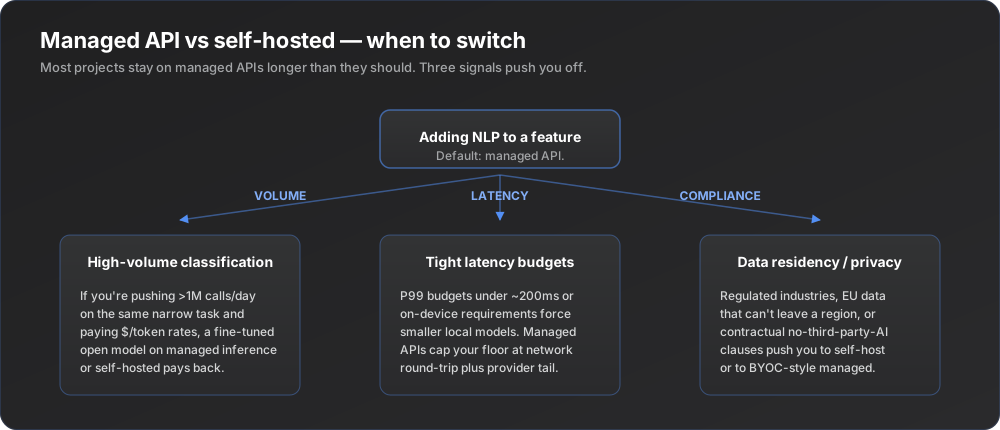
Practical rule: the right migration is the one driven by a signal you measured, not by a feeling that “we should probably own this.” Pick one of volume, latency, or compliance, and quantify it before you start a migration project.
Three Decision Mistakes Builders Make
The pattern of regrets is consistent across teams I see making this choice. Three mistakes account for most of them.
- Picking by demo, not by eval. Every provider has a demo that performs well on cherry-picked inputs. The provider that wins your evaluation on your real data, with your real edge cases, is rarely the one that won the sales pitch. Build an evaluation harness with 100-500 examples drawn from your actual traffic before you commit. Re-run it quarterly, because providers update models silently and quality drifts. Model reliability is a moving target, not a one-time check: as of the 2026-07-06 EchoSift snapshot, our own ingestion clustered a live pain signal titled “claude-opus-4.7 model unusable due to errors” (score 56.5, raised by 7 distinct owners across communities), a reminder that the model you evaluated last quarter can degrade under a point release. We hit the same lesson directly building EchoSift’s pain-signal classifier: the model that demoed best on canonical examples lost on long-tail developer slang once we ran it against a few hundred real complaints from our own ingestion pipeline of developer pain points.
- Underestimating tail latency. Always test latency under realistic concurrency, not single-call benchmarks.
- Locking in via tokenizers and prompt shapes. The most insidious form of lock-in is not the API surface at all. The real trap is the tokenizer and prompt format. You can swap from one LLM provider to another in an afternoon if your code goes through an abstraction. If your prompts have been hand-tuned over six months against one provider’s quirks, you’re locked in for a quarter of work to migrate. Build the abstraction early, even if you only use one provider day one.
P50 is the marketing number, P99 is the support number
Managed providers can have 5-10x ratios between the two. A 200ms median can hide a 2000ms tail when the provider's fleet is saturated.
A Production Checklist Before You Ship
Once the provider choice is made, the gap between a working prototype and a production-grade NLP feature is mostly operational. The list below catches what most teams forget until something breaks.
Eval harness in CI
Run a fixed evaluation set on every model or prompt change. Set thresholds. Block deploys that regress.
Fallback chain
Primary provider fails or rate-limits, then you fall back to a cached previous response, then a secondary provider, then graceful degradation. Most managed APIs will go down for at least a few hours per year; design for it.
Cost caps and per-user budgets
A single buggy prompt loop can burn a four-figure invoice in an hour. Token caps per request, request caps per minute, budget alerts at 50/80/95% of monthly spend.
Observability on tokens and tails
Log input tokens, output tokens, model name, latency, and HTTP status for every call. Build a P50/P95/P99 dashboard by endpoint. Alert on tail latency separately from median.
PII and redaction policy
Know what data leaves your boundary, where it's logged, how long the provider retains it. AWS Comprehend has a built-in PII detection and redaction primitive that's useful as a pre-processing step; most LLM providers leave this to you.
Rate-limit handling
Exponential backoff with jitter, queue depth limits, and a separate degraded mode when the queue saturates. Naive retry loops on a rate-limited provider make outages worse.
Prompt versioning
Every prompt is code. Version it, code-review it, and tie the version to the eval result that approved it.
Practical rule: if you cannot point at the chart that would alert you when your NLP feature starts costing twice as much per user or running twice as slow, you don’t have an NLP feature in production yet. You have a prototype with paying users.
From Choosing an API to Shipping a Feature
The bottleneck on most NLP features in 2026 is not which provider you picked. It’s whether you understood the primitives, picked the right operational shape, built the eval harness, and instrumented enough to catch the tail before users do.
The teams that ship well treat the API choice the way they’d treat any infrastructure choice: reversible if you abstracted it, instrumented from day one, and re-evaluated quarterly. The teams that ship badly are the ones who picked the LLM that demoed best and stopped thinking.
If you’re a developer-tool founder evaluating which NLP problem to build a product around in the first place, the harder question is the one upstream of this guide: which language problems do developers and small SaaS teams keep complaining about loudly enough that a focused product would actually solve something? That is a market-research question, not an API question, and the same signal-mining approach that surfaces developer-tools opportunities for 2026 applies just as well to NLP. Conversational-interface products in particular are a crowded field worth understanding before you build; our teardown of business chat programs walks through where the real gaps sit.
That’s the question EchoSift was built to make easier. We cluster developer complaints across GitHub, Stack Overflow, Hacker News, and other public dev communities, then score the resulting pain signals by growth and volume, so the “is this NLP problem actually painful for real builders” question gets a live answer instead of a guess based on which blog post you read this morning.
If you’re picking an NLP API this quarter, EchoSift helps you decide which language problems are worth solving in the first place. It surfaces clustered, scored pain signals from real developer communities so you can validate the upstream demand before you commit to a vendor or build your own model.
This article was drafted with AI assistance and reviewed against EchoSift’s proprietary signal data before publishing.